Pickleball has always been a sport defined by rapid innovation. In just a few short years, paddle technology has evolved from simple composite faces to sophisticated engineered cores designed to squeeze every last ounce of power from a player’s swing. But innovation, it turns out, has a price and JOOLA has decided it’s time to collect.
On April 7, 2026, JOOLA filed patent infringement litigation with the International Trade Commission (ITC) against 11 paddle brands for the unauthorized use of its proprietary Propulsion Core technology. The move sent shockwaves through the pickleball community and has implications that reach from weekend warriors to the sport’s top professionals.
What Is the Propulsion Core?
To understand what’s at stake, you first need to understand what JOOLA is claiming to own.
JOOLA is credited with creating the “Gen 3” category of pickleball paddles, featuring an EVA foam perimeter around a polypropylene honeycomb core, a new innovation that led to a noticeable increase in power. But the specific technology at the center of this lawsuit is more precise than the broader “Gen 3” design.
The Propulsion Core adds a specific type of flex to the interior of the paddle, creating a responsive, spring-like effect on contact letting players generate more pace on drives, counters, and speed-ups without swinging harder. The design is often described as a foam horseshoe or diving board shape. Critically, it does not extend all the way around the paddle’s perimeter just the top half or so.
JOOLA spent years investing in the research, development, and rigorous testing behind this technology, which is protected through a portfolio of patents and has become the standard in competitive pickleball.
Who Is Being Sued?
The list of defendants reads like a who’s who of the paddle industry. The defendants include Franklin Sports, Proton Sports, RPM Pickleball, Engage Pickleball, Friday Labs, Diadem Sports, Facolos, ProXR Pickleball, Paddletek, Adidas Pickleball, and Volair.
That’s a remarkably wide net spanning legacy manufacturers, newer upstarts, and even a major global sports brand in Adidas. The lawsuit appears to apply specifically to paddles featuring the “U”-shaped perimeter foam. Paddles where the foam runs all the way around the core like the Selkirk Era Power are not included in the lawsuit.
JOOLA’s Argument: Protect Innovation, Not Market Share
JOOLA has been careful to frame this lawsuit as a matter of principle rather than competitive self-interest.
“This is a principled decision, not a reactive one,” said Richard Lee, CEO of JOOLA. “We take our responsibility to defend what we’ve built seriously. Our goal is to protect our innovation and encourage others to innovate as well.” The Dink
The company was even more direct in its official statement.
“Protecting our innovation is not about limiting what others can do it’s about ensuring the investment, creativity and engineering required to advance this sport are rewarded,” JOOLA Lee said.
The implication is clear: if companies can copy winning technology without consequence, the incentive to innovate disappears entirely.
JOOLA added that when innovations are imitated without authorization, it
“undermines the integrity of competition and ultimately slows the sport’s progress.”
The Bigger Context: JOOLA Has Been Here Before
This patent filing doesn’t exist in a vacuum. JOOLA has been at the center of pickleball’s legal battles for years now.
In 2024, JOOLA filed a lawsuit against USA Pickleball, asserting that the governing body had de-listed its Gen 3 paddles without following its own guidelines, specifically by not honoring a 180-day “sunsetting period” that allows manufacturers to continue selling approved paddles before they are removed from the list.
That dispute grew contentious. USA Pickleball filed a countersuit, alleging that the paddles available for public purchase contained two to three times more foam around the edges than the prototypes originally submitted for approval.
Separately, Sport Squad (JOOLA’s parent company) agreed to settle two class action lawsuits claiming the company had falsely advertised that its Gen 3 paddles were approved by USA Pickleball ClassAction.org, though the company denied any wrongdoing.
The current ITC filing marks a new and more aggressive chapter: rather than playing defense, JOOLA is now taking the fight directly to its competitors.
What Happens Next?
The International Trade Commission is a powerful venue for this kind of complaint. ITC cases can result in import bans on infringing products, which would be devastating for any paddle manufacturer relying on overseas production, which is essentially the entire industry.
For consumers, the lawsuit raises real questions about the future availability of some of the most popular paddles on the market. If JOOLA prevails, brands could be forced to redesign their paddle cores from scratch, leading to product discontinuations and potential supply shortages.
For the broader sport, the case may force a reckoning about how quickly the pickleball industry, which has largely operated in a freewheeling, fast-moving mode, will need to mature into one that takes intellectual property seriously.
JOOLA has encouraged every brand to “bring their own ideas, their own engineering, and their own creativity”
a message that sounds collaborative on the surface, but in the context of a lawsuit against 11 companies, lands more like a warning shot.
The pickleball paddle industry will never look quite the same again.
This story is developing. Responses from the named defendants are expected in the coming weeks as the ITC process gets underway.
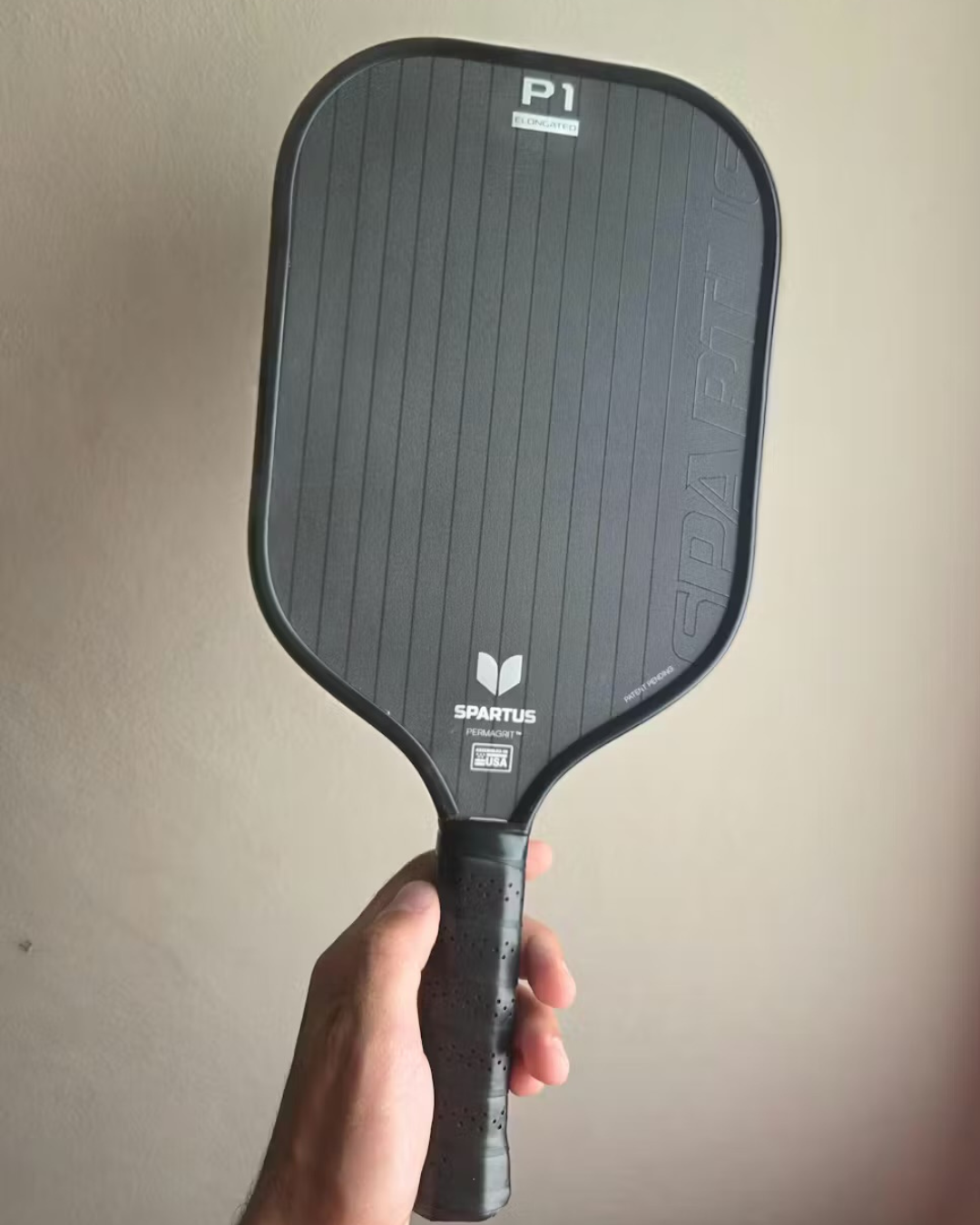
The Spartus P1 arrived quietly in January 2026, but the pickleball community quickly noticed. It launched as one of the first paddles in the market to solve what had become the sport’s most persistent equipment complaint: raw carbon fiber paddles losing their grit, and therefore their spin, after just a few months of heavy use. The P1’s answer is PermaGrit™, a patent-pending ceramic-hybrid surface that embeds particles directly into the face rather than relying on a surface texture that gradually wears away. Combined with a Gen 4 floating EPP foam core and assembled in the USA, the P1 pitches itself as a “long-term weapon” at a refreshingly honest $219.99 price point.
I’ve spent considerable time on court with the Spartus P1 Hybrid, the flagship shape in the P1 lineup. This review covers every meaningful performance dimension in honest detail, from the head-heavy swing weight to the surprisingly strong dwell time, along with a clear-eyed verdict on who this paddle is and isn’t for. If you are a doubles player who puts spin on every shot and wants a durable paddle that holds up for the long haul, keep reading.
Spartus P1 Full Specs Table
Specification
Detail
Available Shapes
Hybrid (reviewed), Standard / Widebody, Elongated
Paddle Length (Hybrid)
~16.3 inches
Paddle Width (Hybrid)
~7.7 inches
Core Thickness
16mm
Average Static Weight
8.1–8.22 oz
Swing Weight
116–119 (head-heavy profile)
Twist Weight
6.7–6.9 (above average stability)
Balance Point
~24.4 cm (head-heavy confirmed)
Paddle Face
PermaGrit™ Ceramic-Hybrid Surface (CFC composite)
Core Material
Gen 4 Floating EPP Foam + EVA Perimeter Ring
Construction
Floating foam core; Assembled in USA
Handle Length
~5.0–5.25 inches (short; fits two-handed shots)
Grip Circumference
4¼” (Medium)
Includes
Free neoprene paddle cover ($20 value)
Approvals
USAP Approved (tournament legal)
Warranty
Standard Spartus warranty (verify current terms at gospartus.com)
Price
$219.99
Assembly
USA
Construction & Materials
The Spartus P1 is built around two innovations that work together in a way that’s genuinely unusual in the 2026 paddle market. Most manufacturers have chosen one direction, go full Gen 4 foam for durability and feel, or stay with thermoformed Gen 3 carbon for explosive performance. Spartus did something different: they paired a Gen 4 floating EPP foam core with a completely proprietary ceramic-hybrid surface that redefined how grit can behave.
PermaGrit™: The Ceramic-Hybrid Surface
PermaGrit is the headline feature of the P1 and the technology Spartus has staked its reputation on. Traditional raw carbon fiber paddles use a “peel-ply” surface texture, think of it like a very fine sandpaper weave that is applied on top of the carbon face. The problem is that this texture physically abrades with use: the microscopic surface peaks get worn flat, and by month three of serious play, your drives start sailing long because the face can no longer grip the ball. Players who play four or more times per week often find themselves replacing paddles every quarter.
PermaGrit takes a fundamentally different approach. The ceramic particles are embedded into the face material itself rather than applied on top. Independent playtesters have reported virtually zero spin degradation even after 50+ hours of play, and Pickleball Studio’s grit-wear testing found 0% degradation over 80 games, a number that no traditional raw carbon paddle comes close to matching. On contact, the PermaGrit surface feels distinct: it has a slightly tacky, grippy quality that resembles running your finger across rubber rather than sandpaper. The ball literally sticks to the face for an extra microsecond, which is exactly what translates to higher spin output on brushing strokes and topspin serves.
The surface also has a crystalline visual quality, it actually sparkles in sunlight. This is not a cosmetic trick; it is a byproduct of the ceramic-particle composition and gives the P1 a distinctive look that immediately stands out on court.
Gen 4 Floating EPP Foam Core + EVA Perimeter Ring
Beneath the PermaGrit surface sits Spartus’s Gen 4 Floating-Foam Core. This is an expanded polypropylene (EPP) foam construction, the same core technology that powers the top-tier paddles from CRBN, Six Zero, and Friday Pickleball. Floating foam cores differ from traditional honeycomb polypropylene in a critical way: the core is a dense, continuous foam structure rather than a series of hollow cells. This means the core cannot “crush” under pressure (a known failure point in thermoformed Gen 3 paddles), and it maintains consistent performance characteristics across the entire face rather than behaving differently at the center versus the edges.
Surrounding the EPP core is an EVA perimeter ring, a softer, energy-absorbing foam layer at the edges. This ring serves two functions: it expands the effective sweet spot by stabilizing off-center contact, and it adds a layer of vibration dampening that makes the P1 more comfortable on repeated impact than a pure EPP or standard thermoformed paddle. The combination of dense EPP center and softer EVA perimeter creates what Spartus calls a “controlled force” response, powerful and predictable on full swings, composed and soft on resets.
CFC Composite Paddle Face
Independent testing has revealed that the P1 face material is a CFC (carbon fiber composite) layup, a blend of carbon fiber and fiberglass rather than pure T700 raw carbon. This is not a negative. The fiberglass component is what gives the P1 its denser, less hollow feedback on contact compared to paddles with pure raw carbon faces. It also explains the PermaGrit surface’s ability to retain its texture: the substrate beneath the ceramic particles is denser and more stable than pure peel-ply carbon, giving the embedded particles better structural support over time.
The P1’s swing weight landing between 116 and 119 is firmly head-heavy and this is expected, even natural, for a dense 16mm floating foam paddle. The mass in the head gives you real plow-through on drives and overheads, which is why the paddle feels authoritative on full swings from the baseline. It is also very forgiving on big swings: you do not need to time the paddle precisely because the head weight carries the ball through contact. The downside is that the head-heavy balance makes the paddle physically taxing over long sessions, and quick hand-speed adjustments in NVZ battles take slightly more effort than with a lighter, more balanced paddle. For players who can sustain the weight, the stability dividend is real and meaningful.
Twist Weight7.5 / 10
The twist weight sits in the 6.7–6.9 range, which is strong for a hybrid-shape paddle strong enough that you will feel wrist lag on fast exchanges if your wrist and forearm strength is not well-conditioned. Off-center hits stay surprisingly square and directionally honest, which is a genuine competitive advantage in hands battles at the NVZ. But the physical cost of that stability is real: the heavier twist weight means the paddle resists sudden directional changes. I would not recommend the Spartus P1 to players who have a history of arm injury, shoulder problems, or weak wrists. The combination of head-heavy swing weight and elevated twist weight is taxing even for healthy, well-conditioned players during long sessions. If you flag any of those concerns, look at the Six Zero Coral or Friday Aura instead, both of which are more ergonomically forgiving.
Sweet Spot 9.0 / 10
Genuinely surprising for a paddle in this weight and swing-weight class. The EVA perimeter ring working in combination with the EPP core creates a sweet spot that is wider than most players expect when they first pick the P1 up. Mishits lose pace but stay directionally controlled the face stays square on off-center contact far more often than a standard 16mm thermoformed paddle would. The PermaGrit surface compounds this advantage: on volley exchanges, the tackier surface grabs the ball even on slightly off-center contact, which produces spinny, shapeful volleys that stay in the kitchen. This is one of the P1’s genuine standout qualities. Put the ball in the right zip code and the paddle rewards you consistently.
Handle (Short, ~5.0–5.25″) 7.5 / 10
The handle on the P1 Hybrid is on the shorter side compared to the current wave of elongated handles dominating the market. That said, there is enough room for two-handed backhand shots without feeling cramped, and one-handed players will find the length comfortable and natural. The grip circumference is a medium 4¼”, which suits the majority of players well. The stock grip has a pleasant feel out of the box. Where the shorter handle becomes a notable trade-off is on serves and returns where players want maximum leverage and reach those shots may feel slightly more compact. If extended reach is important to your game, consider the P1 Elongated shape when it becomes more widely available.
This is where the combination of Gen 4 construction and PermaGrit becomes genuinely greater than the sum of its parts. The floating EPP foam core creates a longer dwell time than traditional thermoformed paddles the ball stays on the face a fraction longer, giving your stroke mechanics more time to impart spin and shape. But the PermaGrit surface takes this further: the ceramic-hybrid tackiness means the ball grips the face during that extended contact window, allowing you to add more rotational force than a smoother or worn surface would permit. The practical result is that returns whether a dink, a drive, or a reset carry noticeably more shape and force than you would produce with a standard 16mm paddle at the same swing speed. The ball exits with spin that actually curves and dips. For spin-oriented players, this dwell-time and PermaGrit combination is the best reason to choose the P1 over its competitors.
Power is the P1’s honest weak point and I say that without it being a dealbreaker. Placed on a spectrum, the P1 sits in the mid-tier among power paddles. It is not a power-first weapon like the Six Zero Black Opal or the CRBN TruFoam Barrage. The EPP foam core absorbs more impact energy than a stiffer thermoformed structure, and the PermaGrit surface’s tackiness actually slows the ball’s exit velocity marginally compared to a slicker, harder carbon face. What this means in practice: for players who generate their own power through swing mechanics and kinetic chain, the P1 delivers clean, well-directed drives with satisfying depth. For players who rely on the paddle to do the power work, the P1 will feel underwhelming on hard drives and serving. This profile makes it ideally suited for doubles players who prioritise spin, placement, and consistency over raw pace which is exactly the correct strategy for most doubles formats.
Pop / Put-Away 6.0 / 10
Pop is where the P1 feels most limited and in a curious way. In my experience, the PermaGrit surface is so grippy that it actually seems to absorb some of the sharp, crisp rebound energy that players associate with “pop.” The ball grips the face, dwells, gets spin applied, and then exits with shape and pace, but not with the explosive trampoline snap you feel with a raw carbon Gen 3 paddle or even the Six Zero Black Opal. At the NVZ during speed-up exchanges, you will notice this most: the P1 is composed and stable, but it does not give you that extra burst of energy on aggressive volleys that finishers want. If your game relies heavily on fast hands and put-away pop, the P1 is not your paddle. If your game is built on spin-heavy, placed volleys that make opponents work for every shot, the lack of pop becomes a non-issue because you are not relying on the paddle to finish points with explosive force.
Pros & Cons at a Glance
Pros
PermaGrit™ surface, industry-leading grit longevity (0% degradation over 80 games)
Outstanding dwell time enhanced by ceramic-hybrid tackiness
Surprisingly wide sweet spot for a paddle this dense
Spinny, shape-heavy volleys even on off-center contact
Heavy twist weight = steady face in hands battles
Excellent durability, EPP foam core resists crush
Strong value at $219.99 vs. competitors
Includes free neoprene cover ($20 value)
USAP approved for tournament play
Fun, serious, and recommended for all levels
Cons
Head-heavy swing weight, taxing over long sessions
High twist weight causes wrist lag; not for arm-injury-prone players
Mid-tier power, you must generate pace yourself
Pop is the weakest attribute, not a finisher’s paddle
Short handle may limit reach on elongated shots
Best suited for doubles rather than singles-dominant players
⚠ Arm Injury Warning The Spartus P1’s combination of head-heavy swing weight (116–119) and elevated twist weight (6.7–6.9) places a real physical demand on the wrist, forearm, and shoulder. Players with a history of tennis elbow, golfer’s elbow, rotator cuff issues, or general arm fatigue should approach this paddle with caution. Consider the Six Zero Coral (lighter, more balanced) or the Friday Aura (softer feel, lower physical demand) as alternatives.
Pricing & Value: Is $219 Worth It?
At $219.99, with a free neoprene cover included, the Spartus P1 represents strong value in the context of the 2026 market. This price puts it meaningfully below the Six Zero Black Opal ($250), the JOOLA Kosmos Pro V ($299), and even the CRBN TruFoam Barrage ($279). More importantly, the P1’s durability story changes the value calculation compared to every paddle at similar or higher price points. When a raw carbon fiber paddle at $250 needs replacing after four months because the grit has worn flat, the “cheaper” P1 at $219 may outlast two of those paddles on spin performance alone.
I would strongly recommend the Spartus P1 to players across all skill levels, with the caveat that arm-injury-prone players read the warning above carefully. The combination of long-lasting grit, EPP core durability, a generous sweet spot, and the unique dwell-plus-PermaGrit spin experience makes this one of the most honest, player-friendly paddle launches of 2026. It is a fun paddle to play with, and it is serious enough for tournament use. At $219 that combination is rare.
“The Spartus P1 is one of the few paddles I’ve played where I stopped thinking about the equipment after about twenty minutes. It just lets you play pickleball, and it rewards spin-first players every single rally.”
💡 Who Is This Paddle Built For? The Spartus P1 is at its best in the hands of doubles players at any level who love applying spin on every single shot, dinks, drives, serves, returns. If you describe your game as placement-first, spin-heavy, and rally-oriented rather than power-first and point-ending, the P1 will feel like it was made specifically for your style. It is also ideal for any player who is tired of replacing paddles every three to four months due to grit degradation.
Who Should Buy the Spartus P1?
Buy It If You…
Love applying spin on every shot and want a surface that keeps that spin alive for months, not weeks
Play primarily doubles and prioritise placement, rally construction, and spin-heavy dinking
Are tired of replacing paddles every 3–4 months because the grit wears out
Want strong dwell time that lets you shape shots with intention
Are a beginner, intermediate, or advanced player wanting a tournament-legal, durable all-rounder at a fair price
Have healthy wrists and shoulders and are conditioned for a slightly heavier paddle feel
Skip It If You…
Have a history of arm injury, tennis elbow, or weak shoulder, the head-heavy swing weight and high twist weight are a real physical risk
Primarily play singles and need a lighter, more maneuverable paddle for wide coverage
Rely on explosive pop and fast-hands put-aways as your primary finishing mechanism
Want a paddle that generates power for you, the P1 asks you to bring your own pace
Prefer a balanced or head-light paddle for extended sessions
How Does It Compare? Head-to-Head Table
Here is how the Spartus P1 Hybrid stacks up against three of the most popular paddles in its competitive price range and skill bracket:
Paddle
Price
Core
Thickness
Power
Spin / Grit
Pop
Durability
Best For
Spartus P1 ★
$219
Gen 4 EPP
16mm
Mid-Tier
Elite (PermaGrit)
Below Avg
Excellent
Spin-first doubles players
Six Zero Black Opal
$250
G4 Solid Foam
14mm
Elite
Top tier (Diamond Tough)
Explosive
Very Good
Advanced power attackers
Head Radical Pro15
$199
Triflex (PP+EPP+EVA)
15mm
Moderate
Good (SpinOn)
Moderate
Good
Versatile all-court players
Six Zero Coral
$200
G4 Tectonic EPP
16mm
Moderate-High
Top tier (Diamond Tough)
Good
Very Good
All-level all-court players
💡 Quick Verdict on the Alternatives If pure power is your priority, the Six Zero Black Opal at $250 is the most exciting option, but it has a tighter sweet spot and demands advanced technique. The Head Radical Pro15 at $199 is a versatile all-court paddle that plays well for intermediate players but won’t match the P1’s grit longevity. The Six Zero Coral at $200 is perhaps the P1’s most direct rival, both are 16mm Gen 4 paddles with durable diamond-or-ceramic grit surfaces, but the Coral is lighter, more balanced, and easier on the arm, while the P1 delivers more dwell time and spin shape.
Final Verdict
8.5 out of 10 Highly Recommended (with one key caveat)
The Spartus P1 is a genuinely excellent paddle that solves a real problem, grit degradation, better than almost any competitor at any price. The PermaGrit surface and Gen 4 EPP core combine to deliver one of the best dwell-time and spin-shaping experiences at $219. It is fun, durable, tournament-legal, and seriously capable. The only reason it is not a 9.5 is its head-heavy profile and high twist weight, which genuinely limit its audience. For spin-obsessed doubles players with healthy arms: this is one of the best buys in pickleball right now.
FAQ’s
What is PermaGrit on the Spartus P1?
PermaGrit™ is Spartus’s patent-pending ceramic-hybrid surface technology. Unlike traditional raw carbon fiber paddles that use a peel-ply surface texture that wears away with play, PermaGrit embeds ceramic particles directly into the face material itself. The result is a surface that retains virtually all of its spin-generating texture for far longer than standard carbon, with independent playtesters reporting 0% spin degradation over 80 games, and minimal loss even after 50+ hours of heavy play. On contact it feels slightly tacky or grippy, which increases ball dwell time and spin output.
Is the Spartus P1 good for beginners?
Yes, with one caveat. The P1’s wide sweet spot, forgiving Gen 4 foam core, and durable spin surface actually make it a very accessible paddle at any skill level. Beginners who start with the P1 will benefit from a paddle that does not become less effective after a few months, unlike most budget-tier raw carbon paddles. The one caveat is the head-heavy weight profile: players with weak wrists or any history of arm injury should opt for a lighter, more balanced paddle like the Six Zero Coral or Friday Aura instead.
Is the Spartus P1 good for singles pickleball?
The P1 can be used for singles, but it is better suited to doubles play. Singles demands more court coverage, faster hand exchanges across the full court, and higher power output on drives. The P1’s mid-tier power, slightly lower pop, and head-heavy profile are better matched to the tactical, spin-first game typical of doubles. Players who primarily play singles may prefer the Six Zero Black Opal (more power, faster swing) or the SLK ERA Power Elongated (better reach and drive output).
Will the Spartus P1 hurt my arm?
It depends on your physical condition and history. The P1’s swing weight (116–119) and twist weight (6.7–6.9) are both on the heavier end of the 16mm hybrid category. Healthy players with conditioned wrists and shoulders will typically manage fine, though they may notice fatigue during extended sessions. Players with a history of tennis elbow, golfer’s elbow, rotator cuff issues, or general arm fragility should avoid this paddle and choose a lighter, more balanced option. The EVA perimeter ring does provide some vibration dampening, which helps, but it does not fully offset the impact of the paddle’s mass on the arm and shoulder over time.
How does the Spartus P1 compare to the Six Zero Coral?
These are the two most directly comparable premium spin-focused 16mm Gen 4 paddles at similar prices. The Coral ($200) is lighter, more balanced, and easier on the arm, making it a better all-round recommendation for the broadest range of players. The P1 ($219) offers more dwell time, a tackier spin-generating surface (PermaGrit vs. Diamond Tough), and potentially better grit longevity based on current testing. The P1 is the better choice for spin-obsessed players who can handle the weight; the Coral is the better choice for players who want a forgiving, comfortable all-court paddle that is also excellent for beginners and intermediates.
How does the Spartus P1 compare to the Six Zero Black Opal?
The Six Zero Black Opal ($250) and Spartus P1 ($219) are different paddle archetypes. The Black Opal is a 14mm power-first paddle with explosive pop, fast ball speed, and elite spin, but a tighter sweet spot and a more demanding feel that suits advanced players. The P1 is a 16mm control-and-spin paddle with more dwell time, a wider sweet spot, and better arm-friendly forgiveness, but noticeably less pop and power ceiling. For players who finish points aggressively: Black Opal. For players who construct points through spin and placement: Spartus P1.
How does the Spartus P1 compare to the Head Radical Pro15?
The Head Radical Pro15 ($199) is a more traditional all-court paddle with a Triflex core (PP honeycomb + EPP + EVA) and a micro-forged raw carbon surface. It is lighter and more balanced than the P1, with better maneuverability. However, the P1’s PermaGrit surface will retain significantly better spin performance over time compared to the Radical’s standard raw carbon face. The Radical Pro15 is a great choice for versatile intermediate players who want a well-rounded feel; the P1 is the better choice for players who prioritise long-term spin performance and dwell time over raw power.
Is the Spartus P1 USAP approved for tournament play?
Yes. The Spartus P1 carries USAP (USA Pickleball) approval, making it legal for use in sanctioned amateur tournaments and leagues. Players targeting pro-adjacent qualifiers or specific event formats should verify the current approved paddle list at usapickleball.org, as approval lists are updated periodically. For the vast majority of recreational and competitive players, the P1’s legality is not a concern.
What shapes does the Spartus P1 come in?
The Spartus P1 is currently available in three shapes: Hybrid (the flagship and most widely available shape, reviewed here), Standard/Widebody, and Elongated. The Elongated version has a swing weight that can reach 120–124, which makes it even more demanding on the arm than the Hybrid. If you are newer to the P1 platform, start with the Hybrid shape. All shapes feature the same PermaGrit™ surface and Gen 4 floating EPP foam core.
How do I clean and maintain the PermaGrit surface?
The PermaGrit surface benefits from gentle care over aggressive maintenance. A standard rubber grit eraser can be used sparingly to clean the surface between sessions. Avoid aggressive scrubbing or using hard-bristle brushes, as these can potentially dislodge the ceramic particles over time. Light wiping with a damp cloth after play is typically sufficient. Store the paddle in the included neoprene cover to protect the face between sessions. Unlike traditional raw carbon paddles, the P1 surface does not require regular maintenance to restore spin, the ceramic particles do not degrade with normal play.
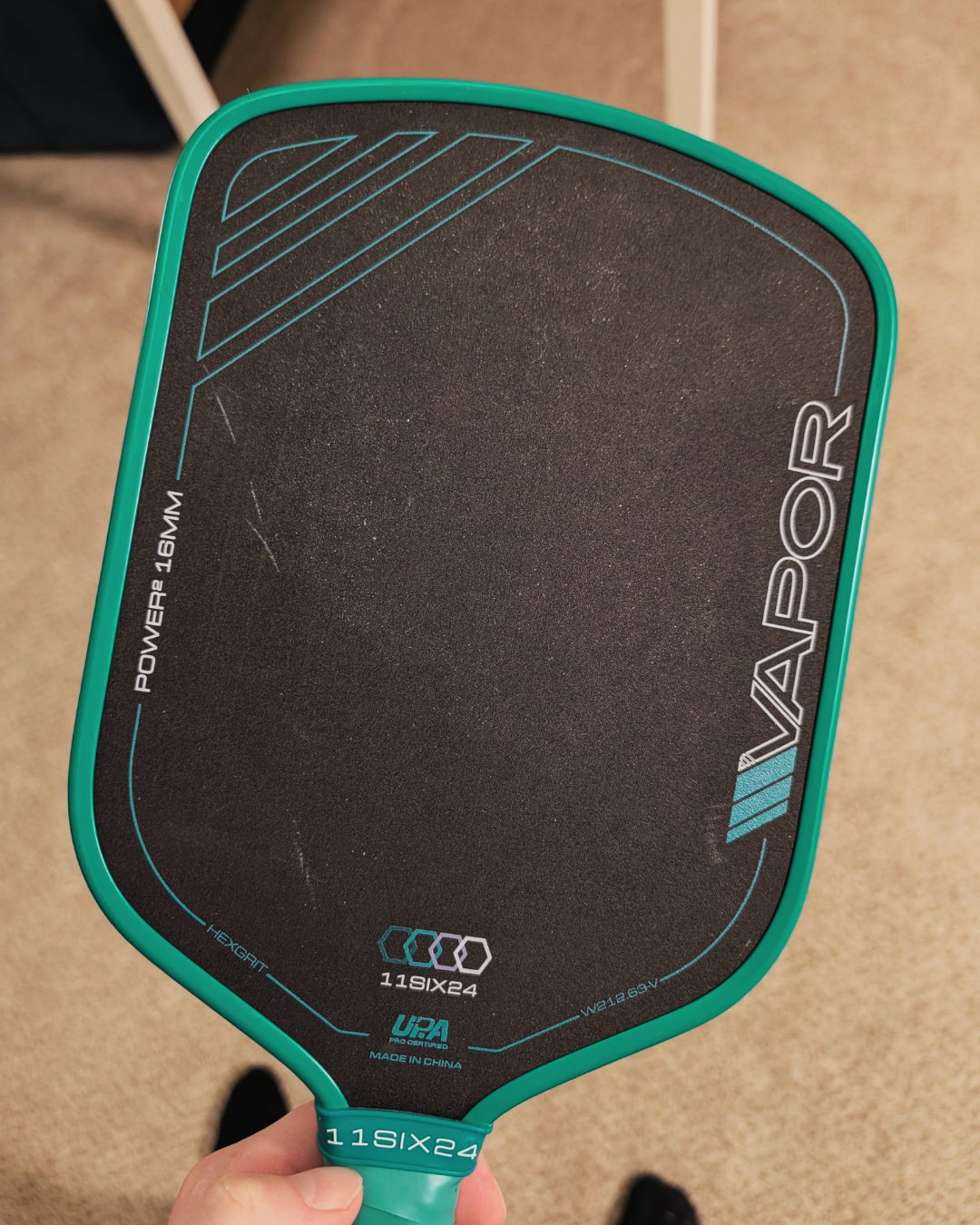
The pickleball paddle market in 2026 is noisier than ever. Every brand is promising elite spin, Gen 4 construction, and grit that lasts but most paddles feel indistinguishable from one another within the first month of play. The 11six24 Vapor Power 2 is different, and I am going to tell you exactly why.
This is not a paddle marketed on raw power. It is built around something more interesting: durable, controllable performance. After extensive on-court sessions, lead tape experiments, and head-to-head comparisons with the biggest names in the foam paddle category, here is the full breakdown.
Patent-pending, grit-infused peel ply; 98% retention in accelerated wear test
Core Construction
Gen 4 Floating Core
PP honeycomb surrounded by closed-cell EVA foam, perimeter-weighted
Handle Length
5.39″
Hybrid / short — not suited for 2HBH baseline play
Grip Circumference
4.06″
Standard grip size
Spin (RPM)
~2,138 RPM
New; post-wear test: 1,948 RPM (8.9% loss vs. ~18% for raw carbon)
Approval
UPA-A
Not currently on USAP list — verify before USAP-only events
Price
$209
Discount codes available at major retailers
Warranty
6 months
Standard for foam paddles; core durability exceeds warranty period
Construction & Materials: What Is Inside the Vapor Power 2
The Vapor Power 2 represents 11six24’s full commitment to Gen 4 construction philosophy, and the engineering choices here are deliberately different from the crowd.
The core is a floating polypropylene honeycomb surrounded entirely by closed-cell EVA foam, a design referred to as the “floating core” method. Unlike the competing “diving board” style used by brands like JOOLA, where foam covers only the upper two-thirds of the head, the floating core wraps the entire polymer, separating it even from the handle junction. X-ray analysis has also revealed white strips of perimeter weighting on the polymer core’s sides, which actively broadens the sweet spot and improves stability on off-center contact.
The face uses a CFC (Carbon Fiber / Fiberglass / Carbon Fiber) layup. The sandwiched fiberglass layer is the ingredient responsible for the paddle’s satisfying stiffness and pop, adding spring to the response without making it feel hollow or disconnected.
The true headline technology is HexGrit™, 11six24’s patent-pending, grit-infused peel ply surface. Where traditional raw carbon fiber paddles rely on a textured surface that physically abrades away within weeks of competitive play, HexGrit embeds the grip particles into the surface structure itself. Independent lab testing has confirmed the paddle retaining 98% of its original Ra (surface roughness) value, the highest recorded in its test class.
Modifier’s Note
Stock, the sweet spot is competent but can feel modest under pressure. Adding lead tape along the head and side edges, roughly 3 o’clock and 9 o’clock positions, meaningfully increases both twist weight and swing weight, and the result is a dramatically more forgiving and connected hitting surface. This is one of the most responsive paddles to lead tape customisation I have played.
Ready to pick one up? Use code SAFDINKS at checkout for $10 off Get the Vapor Power 2
On-Court Performance: The Deep Dive
Swing Weight: Heavy But Right
At ~113.7, the Vapor Power 2’s swing weight sits right in the middle of the competitive hybrid range. Most paddles in this tier cluster between 112 and 115, so there is nothing alarming here, but it is worth noting: this paddle rewards a big swing. If you have the mechanics to generate a full, looping backswing, the Vapor Power 2 turns that energy into penetration and depth that keeps opponents genuinely pinned. It does not feel sluggish during repositioning either, because the twist weight and overall balance work together to keep the paddle feeling planted rather than floppy. The heavier feel is not a flaw, it is the design working as intended.
The twist weight of ~6.86 is above average for the hybrid category, and you feel it the moment you start encountering off-center contact. Mishits that would send cheaper paddles twisting out of your hand simply hold. The unique combination of the floating core perimeter design and the embedded side weights on the polymer gives the Vapor Power 2 a stability profile that feels almost custom-tuned. It just feels right, and it is not an accident. After adding lead tape at the sides, twist weight moves up further, and the paddle enters genuinely excellent stability territory for everything from net exchanges to cross-court counters.
Sweet Spot: Stock Is Good, Modded Is Great
Out of the box, the sweet spot is honest: serviceable, but not the wide, forgiving expanse you get from a paddle like the Selkirk Boomstik. Where the Vapor Power 2 departs from stock paddles dramatically is in how it responds to customisation. Adding lead tape at 3 and 9 o’clock, and optionally at the top corners, transforms the contact zone. The modded version felt like a different paddle entirely: more forgiving across the face, more connected on mis-timed drives, and more consistent on aggressive dink flicks. If you are buying this paddle and not experimenting with lead tape, you are leaving performance on the court.
Handle: Hybrid Shape, Short Reach
At 5.39 inches, the Vapor handle is firmly in the short-to-mid range typical of hybrid shapes. For the vast majority of players, those who dink, drive with a single-handed forehand, and work the transition zone, this is perfectly fine. The issue arises for players who rely on a double-handed backhand for baseline drives. The short handle does not leave enough room for a comfortable two-handed grip without choking up significantly. If two-handed baseline groundstrokes are a cornerstone of your game particularly if you come from a tennis background and generate power off the back of the court with both hands this handle will frustrate you. Consider the elongated Hurache-X variant instead, which offers a full 6″ handle.
This is where the Vapor Power 2 genuinely separates itself from peers. The dwell time is exceptional. You can almost feel the paddle briefly absorbing the ball on contact, a quality that gives you a fraction of a second more to decide what kind of shot you are playing. That micro-pause between contact and release is the difference between reacting to the ball and shaping it. On resets, the paddle does not fire the ball back at you unpredictably it settles it, which makes dropping into the kitchen reliable under pressure. On speedups, the same quality gives your wrist snaps more authority. Premium dwell time is not just about touch it is about confident shot selection, and the Vapor Power 2 delivers it consistently.
Power: Controlled, Not Explosive
11six24 does not market the Vapor Power 2 as a power paddle, and this is admirable honesty from a brand. Placed directly against a Bread & Butter Loco, the difference in raw firepower is noticeable. The Loco has more explosive pop, more of that “cannon ball off the face” quality. The Vapor Power 2 plays with measured, controlled power enough to attack from the baseline with authority, and enough to finish points cleanly, but not the kind of paddle that generates power you did not intend to produce.
This distinction matters enormously depending on your background. Players who come from tennis with deep, aesthetically clean, full-swing drives may feel the Vapor Power 2 is holding them back. But for the overwhelming majority of recreational and competitive pickleball players whose swings are sometimes rushed, sometimes late, sometimes inconsistent this paddle is an incredible safety net. You can take an imperfect swing and still land the ball inside the sideline. The controllable power profile is not a compromise; for most players, it is a competitive advantage.
The rectangular body of the Vapor paddle shape does something special acoustically and mechanically on putaway shots and backhand flicks. The sound is lower, slightly bass-heavy, not hollow, not thin, but a satisfying, deep thud that communicates power without being jarring. On overhead putaways and sharp backhand counters, the combination of that body geometry and the CFC face produces a pop that feels and sounds authoritative. It is one of those tactile pleasures that makes a paddle genuinely enjoyable to play with, not just technically impressive. The sound alone on aggressive net exchanges is something I would describe as musical.
Durability & Spin Longevity: The Real Story
The pickleball industry’s biggest frustration for advanced players in 2025 was watching their $200 raw carbon fiber paddles go “bald” losing that crucial surface grip within six to ten weeks of heavy play. The entire premise of the Vapor Power 2 is a direct response to this problem.
In the most rigorous independent accelerated wear test conducted on this paddle, HexGrit retained 98% of its original surface roughness, the highest score recorded across all paddles tested in that class. The spin degradation in the same test was just 8.9%, compared to approximately 18% for traditional raw carbon fiber surfaces. The paddle showed essentially zero visible wear after 50+ hours of competitive play in separate field testing, with the surface still feeling factory-fresh to the touch in the impact zone.
The Gen 4 construction also contributes to core longevity. Where honeycomb-only paddles can develop internal fractures and crushing under sustained thermoformed stress, the floating EVA foam cocoon acts as a structural buffer, dispersing impact energy across a larger volume. The practical result is that this paddle holds its performance character across hundreds of hours of play not just the first month.
In our opinion, the Vapor Power 2 is currently the second most spin-capable paddle on the market for sustained long-term use behind only the Spartus P1 with its PermaGrit ceramic-hybrid surface. But crucially, the 11six24 edges ahead in spin RPM numbers and does so with a meaningfully lighter swing weight, making it the more accessible long-term weapon for most competitive players.
Head-to-Head Comparison: Vapor Power 2 vs. Top Competitors
Counter-punchers, high swing weight tolerant, durability seekers
Power players, tennis converts, aggressive baseline game
Advanced players, pure attackers, short rally finishers
Tournament Approval
UPA-A
USAP + UPA-A
USAP + UPA-A
USAP + UPA-A
Who Should Buy the 11six24 Vapor Power 2?
At $209, this paddle occupies an interesting and well-justified position in the market. Here is how to think about whether it is right for you:
Beginners: Strongly recommended. The controlled power profile is genuinely forgiving you can swing imperfectly and still keep the ball in the court. The premium dwell time rewards even early technique because it gives you feedback on contact quality. And critically, the HexGrit surface means your paddle will still perform exactly the same a year from now, without the demoralising performance dropoff that discourages new players.
Intermediate players (3.5–4.0): Excellent choice. The paddle’s combination of spin, touch, and stability grows with your game. As your backhand flick improves, as your reset mechanics tighten, and as you start shaping the ball with more intent, the Vapor Power 2 stays relevant. The lead tape modification unlocks a new level of performance when you are ready for it.
Advanced and pro players: Selectively recommended. If you prioritise durability above all else, love to apply heavy side spin and shape the ball with topspin-heavy mechanics, and do not require the raw explosive power of something like a Bread & Butter Loco or Six Zero Black Opal this is your paddle. If you are a former tennis player who generates power exclusively through massive, clean groundstrokes and needs that pop translated directly look at the Loco or Black Opal instead.
Frequently Asked Questions
Is the 11six24 Vapor Power 2 USAP tournament approved?
At the time of writing, the Vapor Power 2 is UPA-A (professional tour) approved, which is actually the stricter standard of the two. The paddle had not yet appeared on the USAP approved list. If you are playing a USAP-sanctioned league or event, verify with your tournament director before competing. For UPA-A and most recreational play, you are good to go.
How does HexGrit compare to raw carbon fiber in terms of spin longevity?
Significantly better. In controlled accelerated wear testing, HexGrit retained 98% of its original surface roughness versus raw carbon fiber paddles which lose roughly double that amount under the same conditions. For players frustrated by paddles going “bald” within a few months, HexGrit is a direct solution to that problem.
What lead tape modification is recommended for the Vapor Power 2?
The most effective setup is placing strips of lead tape at the 3 o’clock and 9 o’clock positions (the side edges of the paddle head). This increases twist weight and broadens the effective sweet spot noticeably. Start with 0.5g–1g strips per side and adjust from there. The paddle responds exceptionally well to this modification more so than many competitors.
Is the Vapor Power 2 good for two-handed backhands?
No, and this is one of the paddle’s clearest limitations. The hybrid handle at 5.39″ is on the shorter end of the spectrum. Players who rely on a double-handed backhand for power on baseline drives will find the handle cramped. If two-handed shots are central to your game, consider the 11six24 Hurache-X variant (6″ handle) or look at paddles with a longer handle in the elongated category.
How does the Vapor Power 2 compare to the Spartus P1 for spin?
Both are the top two performers in the durable-grit category as of 2026. The Spartus P1 uses PermaGrit, a ceramic-hybrid surface that some reviewers have reported as showing 0% degradation over 80 games and it edges slightly ahead in absolute spin durability. However, the Vapor Power 2 posts higher raw spin RPMs (~2,138) and comes with a notably more manageable swing weight (~113.7 vs. 116–119 for the P1). For most players who want both elite spin durability and paddle maneuverability, the Vapor Power 2 is the more balanced choice.
Is this paddle suitable for beginners?
Yes, and this is a stronger recommendation than most reviewers give. The Vapor Power 2 rewards inconsistent mechanics rather than punishing them. Its controlled power profile means the ball stays in the court even on imperfect swings, and the premium dwell time gives new players useful tactile feedback. For anyone who has developed basic consistency and wants a paddle that will still be their main for 12+ months, start here.
Does the Vapor Power 2 break in over time?
Like most foam-construction paddles, there is a subtle break-in period during which the core settles slightly and the feedback becomes marginally more open. However, the HexGrit surface is specifically designed not to change, which means the spin characteristics remain stable even as the core finds its final playing character. The break-in is minor compared to paddles with less robust surface technology.
How do I clean and maintain the HexGrit surface?
11six24 recommends wiping the face down with a damp microfiber cloth after each session to remove dirt, ball dust, and debris from the textured surface. Store the paddle in the included protective sleeve when not in use. Avoid aggressive scrubbing or abrasive cleaning tools, which could compromise the surface faster than normal play would.
Is $209 good value for the Vapor Power 2?
Yes, and the durability factor amplifies the value proposition significantly. A raw carbon fiber paddle at $199 that loses meaningful spin performance after 8–10 weeks of competitive play effectively costs more per month of peak performance than a $209 paddle that maintains 98% of its original surface character after five months. When you factor in discount codes typically available at checkout, the Vapor Power 2 is genuinely excellent value for its performance tier.
Use code SAFDINKS at checkout to bring it down to $199 → Order here
Final Verdict: The Most Durable Grit, and a Paddle That Earns Its Stripes
The 11six24 Vapor Power 2 is a rare thing: a paddle that lives up to its marketing. HexGrit is real, measurable, and genuinely superior to traditional raw carbon fiber in durability. The Gen 4 floating core construction is well-engineered, balanced, stable, and responsive to customisation in a way few paddles are. The pop on put aways and backhand flicks sounds and feels right. The dwell time is among the best available. And the controlled power profile is not a weakness, for most players, it is a feature.
Where it falls short is narrow and well-defined: short handle, modest stock sweet spot, not a raw power weapon. Lead tape fixes the sweet spot. The handle is a design choice you need to evaluate against your game. And the power level is, by design, exactly what 11six24 intended.
For beginners, this is one of the best paddles on the market, full stop. For competitive advanced players who prioritise durability, sidespin, and a reliable long-term weapon, this is your paddle. The Vapor Power 2 is, in our view, the second most spinny paddle currently available, sitting just behind the Spartus P1, but ahead of everything else, and it will stay there far longer than most paddles on this list.
Use code SAFDINKS for $10 off your Vapor Power 2 → Shop now
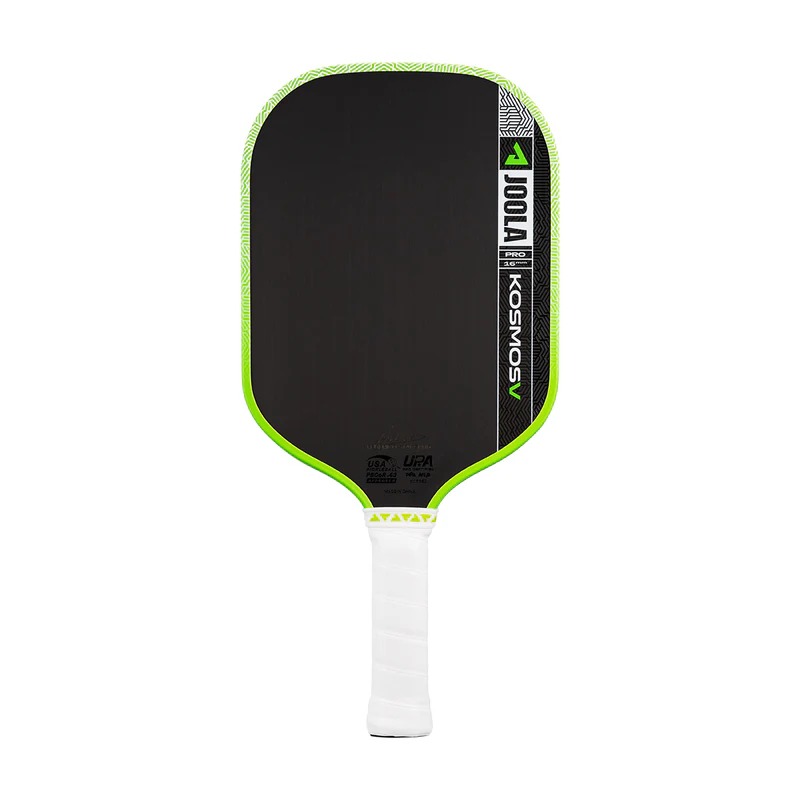
When JOOLA unveiled the Kosmos Pro V 16mm on March 3, 2026, it debuted as Federico Staksrud’s first signature paddle shape in the JOOLA lineup and arguably the most talked-about release in the brand’s Pro V series. The name Kosmos is fitting: JOOLA described it as the “missing link” in their lineup, blending the elongated reach of the Perseus with the wider forgiveness of the Scorpeus to create something genuinely new, a hybrid shape designed for all-court dominance.
I’m a 16mm player through and through. I’ve spent considerable time with the JOOLA Pro IV Perseus 16mm, and when the Kosmos landed in my hands, the transition was immediately interesting, not always comfortable, but interesting. This review covers every meaningful performance dimension of the Kosmos 16mm, along with an honest verdict on whether its $300 price tag can be justified given the number of options available in the market. Please note: This review is based on a 12-day usage of the paddle, one which I bought as any other regular customer. If you guys find my paddle reviews, do help me get my affiliate links so I can support my dream of becoming a paddle reviewer like John Kew.
The Kosmos Pro V doesn’t chase trends, and JOOLA will tell you that’s intentional. While most of the pickleball industry has stampeded toward full-foam Gen 4 cores in 2025 and 2026, JOOLA doubled down on their Gen 3 Honeycomb Propulsion polymer core, the same foundational material that powered the legendary Pro IV series. The difference this time is what’s wrapped around it.
KineticFrame Technology
The headline engineering feature of the Pro V series is the patent-pending KineticFrame. Inspired by kick-point engineering in hockey sticks and golf clubs, the KineticFrame modifies the frame structure to flex and recover during impact in a more controlled, parallel way rather than the traditional “diving board” neck flex seen in conventional thermoformed paddles. The result is a reduction in launch angle deviation (from ~4.5° in prior models to ~1.5° with the Pro V), meaning a more predictable ball exit on every shot.
Textured Carbon Fiber Face
The paddle face uses JOOLA’s proprietary textured carbon fiber, not raw T700 like you find on CRBN or many foam-core paddles, but a finish designed to balance spin generation with predictable response. The texture is noticeable but not aggressive, fitting the overall “precise power” philosophy JOOLA built the Pro V around. On contact, the face feels crisp and connected.
Hyper-Foam Edge Wall
New to the Pro V series, the Hyper-Foam Edge Wall supplements the polymer core at the perimeter. This addition contributes to a wider effective sweet spot and adds vibration dampening that makes the Kosmos noticeably more comfortable on repeated off-center contact compared to the Pro IV.
Thermoformed Construction
The Kosmos is built using thermoformed construction, a process that bonds the face to the core under heat and pressure to create a unified, dense structure. This contributes to the paddle’s pop and power potential, but is also why thermoformed paddles like this one carry a delamination risk over time, particularly with a polypropylene honeycomb core. More on this in the verdict.
Performance Breakdown: Rated & Reviewed
Swing Weight8.5 / 10
Relatively light for a 16mm paddle, making it one of the standout physical attributes of the Kosmos. Despite the hybrid shape’s added width, swing weight stays low enough that your hand speed doesn’t suffer during fast NVZ exchanges. If you’re coming from a traditional elongated 16mm, you’ll notice the Kosmos feels more manageable under pressure. It’s also forgiving on big, full swings; you can commit from the baseline without feeling the paddle take over your mechanics.
Twist Weight8.0 / 10
The twist weight on the Kosmos is on the heavier side, and that is a feature, not a bug. In hands battles at advanced levels, a heavier twist weight means the paddle stays square on contact rather than rotating on your grip. That fraction of added stability is the difference between a reset that sits in the kitchen and one that pops up for your opponent to attack. As someone who plays a lot of fast doubles, this is one of the quiet performance advantages of the Kosmos that doesn’t show up in a spec sheet. I would also like to point out that I did not feel too much vibration on off-center shots, which i generally feel with other 16mm paddles.
Sweet Spot8.5 / 10
Surprisingly wide for a paddle at this performance level, but it’s a controlled sweet spot, not an explosive one. The Hyper-Foam Edge Wall pushes the effective hitting area toward the perimeter, meaning mishits don’t punish you as harshly as on the narrower Perseus. That said, don’t mistake width for liveness. The Kosmos sweet spot is designed to keep the ball in play with precision, not to juice every contact with extra pace. For dinks, drops, and transition resets, this is exactly what you want.
Handle (Elongated, 5.25″)9.0 / 10
The 5.25-inch handle is a genuine strength of the Kosmos 16mm. It provides enough real estate for two-handed backhands without feeling oversized, and the Feel-Tec perforated cushioned grip sits well in the hand during long sessions. Two-handed players will feel right at home. Single-handed players will find the length natural and the 4¼” grip circumference ideal for a medium-grip preference. No fatigue issues observed during extended play.
Dwell Time9.0 / 10
This is where the Kosmos 16mm meaningfully separates itself from the Pro IV 16mm, and from most 16mm paddles in this price bracket. The dwell time is noticeably longer: the ball stays on the face a fraction longer at every contact point, whether dinking softly at the kitchen or driving from the baseline. The practical outcome is exceptional shot shaping. Topspin comes easily, slice bites cleanly, and returns, both dinks and drives, arrive with more shape and predictability than you’d achieve with a faster-rebounding paddle. In my experience, this longer dwell time adds spin on every single return, giving the ball good shape going into your opponent’s side.
Power6.5 / 10
Honest rating: roughly 75% compared to dedicated power paddles. The Kosmos is not a power paddle, and JOOLA makes no pretence of that. The KineticFrame’s “precise power” philosophy means the paddle amplifies your mechanics rather than adding free pace. If your technique is strong and you generate your own power through kinetic chain and swing path, the Kosmos rewards you with clean, well-directed drives. If you rely on your paddle to generate pace on serves and drives, then do not expect the Kosmos to do that for you. Players coming from the Pro IV will specifically notice a reduction in passive pop off the face.
Pop / Put-Away Ability9.5 / 10
This is the Kosmos 16mm’s standout feature, barely edging out its dwell time. High balls become weapons in your hand. I was able to put away overhead opportunities with a confidence I haven’t felt in many 16mm paddles, which tend to soften the response too much on aggressive overheads. The pop on finishing shots is distinctly sharper than what the dwell time metric would suggest; the KineticFrame’s stored energy releases cleanly on full-swing contact. Initially, I struggled in hands battles because I’m accustomed to 16mm paddles, and the Kosmos required adjustment. But once I found my rhythm, the pop in fast exchanges became a genuine offensive weapon. When you’re set up and going for a finish, the Kosmos delivers.
Pros & Cons at a Glance
Pros
Outstanding dwell time: best-in-class for shot shaping
Standout pop on high balls and put-away shots
Heavy twist weight stabilizes hands-battle exchanges
Light swing weight for a 16mm: fast in hand
Wide, controlled sweet spot: forgiving on mishits
Elongated handle perfect for two-handed backhands
USAP & UPA-A tournament approved
12-month warranty (registration required)
Cons
$300 price is hard to justify for most players
Power output is below average: you must generate your own
Polypropylene honeycomb core risks delamination under 12 months
Requires 4.0+ skill level to fully exploit
Hands battles take adjustment time switching from other 16mm paddles
No Gen 4 foam core — durability concern vs. competitors
Cheaper alternatives offer comparable performance
⚠ Durability Alert: JOOLA has retained the Honeycomb Propulsion polypropylene core for the Pro V series. While KineticFrame adds carbon reinforcement at the upper frame, historically prone to core crush in Gen 3 thermoformed designs, the fundamental delamination risk remains. Based on the track record of similar paddles, players who log heavy hours should realistically budget for potential delamination within 12 months. At $300, that’s a legitimate concern.
Pricing & Value: Is $300 Justified?
This is the most difficult question the JOOLA Kosmos 16mm faces, and I’ll be direct. I am a genuine fan of Federico Staksrud’s game. His strategic, composed approach is exactly what the Kosmos was engineered to express. But being a fan of the player does not mean the paddle is the right recommendation for most buyers.
At $299.99, the JOOLA Kosmos 16mm sits at the absolute premium end of the market. For context, the Friday Aura Pro Elongated, a Gen 4 full-foam paddle with competing performance metrics, is available for around $159. The CRBN TruFoam Barrage comes in at $279.99 with a newer core architecture. The SLK ERA Power sits at $200 with a comparable feel profile for aggressive players.
The Kosmos’s value proposition rests on KineticFrame precision, Federico’s design input, and JOOLA’s brand heritage. Those are real things. But they don’t offset the reality that the core material is the same honeycomb polypropylene that has delaminated in competitive players’ Pro IV paddles, and the paddle’s performance ceiling requires a certain skill level to access.
I would not recommend this paddle to the masses, the pricing does not justify the durability concern, and you need to reach a certain level to truly adapt to and extract value from the Kosmos 16mm.
That said, if you’re a 4.5+ player who values shot shaping, dwell time, and controlled pop above all else, and you replace paddles regularly anyway, the Kosmos 16mm is genuinely excellent at what it does. The pop is special. The dwell time is special. The twist weight in hands battles is special. It just needs to be the right player at the right price point.
How Does It Compare? Head-to-Head Table
Here’s how the JOOLA Kosmos Pro V 16mm stacks up against four of its closest rivals across key buying factors:
Paddle
Price
Core Type
Thickness
Power
Control
Pop
Durability Risk
Best For
JOOLA Kosmos Pro V 16mm ★
$299
Gen 3 Poly
16mm
Moderate
Excellent
Standout
Medium-High
4.5+ Control-First
CRBN TruFoam Barrage
$279
Gen 4 Foam
14–16mm
High
Good
High
Low
Aggressive Power Players
SLK ERA Power
$200
Gen 3 + EVA
16mm
High
Good
Good
Low
3.5–4.5 Power-First
Luzz Inferno Pro 4
~$165
Gen 4 MPP Foam
16mm
Moderate
Good
Good
Very Low
Budget-Conscious 3.5–4.5
Friday Aura Pro
$159
Gen 4 EPP+EVA
16mm
High
Good
Explosive
Very Low
All Levels, Value Seekers
Key Takeaway: The Friday Aura Pro and SLK ERA Power deliver comparable or superior power output at $100–$140 less than the Kosmos, with significantly lower durability risk thanks to Gen 4 foam cores. The Kosmos’s advantages: dwell time, shot-shaping precision, and twist-weight stability are real, but they primarily manifest at the 4.0+ level.
Who Should Buy the JOOLA Kosmos 16mm?
Buy It If You…
Play at 4.0 DUPR or higher with an established soft game
Have the technical ability to generate your own power on drives and serves
Prioritize shot shaping, controlled dwell time, and dinking precision over raw firepower
Are a fan of Federico Staksrud’s strategic, transitional style of play
Replace paddles regularly, and durability is less of a concern
Skip It If You…
Play below 4.0 and are still developing fundamentals
Want a paddle that helps generate pace, the Kosmos requires you to supply that yourself
Are concerned about durability and don’t want to spend $300 every 10–14 months
Primarily want power and pop on serves and drives, the CRBN TruFoam Barrage or Friday Aura Pro serves you better at lower cost
Are budget-conscious, the SLK ERA Power and Luzz Inferno Pro 4 offer excellent value at significantly less
Final Verdict
7.5 out of 10: Very Good, with Caveats
The JOOLA Kosmos Pro V 16mm is a technically excellent paddle with a genuinely special pop profile and the best dwell time I’ve experienced in the 16mm Gen 3 category. But durability concerns tied to the polypropylene core, a power output that demands high-level technique, and a $300 price tag in a market flush with outstanding Gen 4 alternatives mean it earns a conditional recommendation, outstanding for the right player, hard to justify for everyone else.
FAQ’s
Is the JOOLA Kosmos 16mm good for beginners?
No. The Kosmos 16mm is a precision performance paddle designed for players at the 4.0 DUPR level and above. Its power profile requires you to generate pace through your own technique; beginners and intermediate players will find it underwhelming on drives and serves. We recommend something like the SLK ERA Power or Friday Aura Pro for players below 4.0.
How does the JOOLA Kosmos 16mm compare to the JOOLA Pro IV Perseus 16mm?
The Pro IV Perseus 16mm has a more explosive, “free” pop profile, meaning the paddle contributes more passive pace on shots. The Kosmos Pro V is quieter, softer, and more controlled, with significantly more dwell time and better shot shaping. The KineticFrame reduces launch angle deviation, making it more consistent but requiring more player-generated power. If you want the livelier, poppier paddle, stick with the Pro IV. If you want shot-shaping precision and controlled power, the Kosmos is the step up.
What skill level is the JOOLA Kosmos 16mm designed for?
The Kosmos 16mm is designed for high-level all-court play at the 4.0–5.0+ DUPR range. The Pro V series is built around “precise power,” meaning the paddle amplifies your mechanics rather than providing free pace. Players who can generate their own power and rely on placement, dwell, and shot shaping will extract the most value from this paddle.
Is the JOOLA Kosmos Pro V worth $300?
At $300 with a honeycomb polypropylene core that carries a meaningful delamination risk within 12 months of regular competitive play, the Kosmos’s value proposition is difficult to justify for most players. Excellent Gen 4 foam-core alternatives, including the Friday Aura Pro at $159 and the SLK ERA Power at $200, offer comparable or superior durability and performance for $100–$140 less. For elite 4.5+ players who specifically need the Kosmos’s dwell time and shot-shaping precision, the premium may be justified.
What is JOOLA KineticFrame technology?
KineticFrame is JOOLA’s patent-pending frame engineering system introduced with the Pro V series. Inspired by kick-point engineering in hockey sticks and golf clubs, the KineticFrame redesigns the paddle’s frame and throat to flex and recover parallel to the paddle face during impact. The result is a more predictable ball exit trajectory on every shot, with reduced launch angle deviation from ~4.5° to ~1.5° compared to the Pro IV series.
What is the difference between the JOOLA Kosmos 14mm and 16mm?
The 14mm Kosmos is Tyson McGuffin’s version, designed for players who prioritize fast hands, more pop in exchanges, and aggressive attacking play. The 16mm is Federico Staksrud’s version, designed for more dwell time, greater control, softer feel in transitions, and a broader sweet spot. Choose the 16mm for control-first or soft-game-heavy play; choose the 14mm for maximum speed and offensive pop.
Will the JOOLA Kosmos 16mm delaminate?
It’s a legitimate risk. The Kosmos uses JOOLA’s Honeycomb Propulsion polypropylene core, the same core family used in the Pro IV, which has a documented history of delamination in competitive players who log high hours. JOOLA has added carbon fiber reinforcement to the upper frame in the Pro V, which may help. But players who play 4+ times a week should realistically account for potential delamination within 12 months. The 12-month warranty (registration required) provides some protection; confirm the terms carefully before purchase.
What paddle shape is the JOOLA Kosmos?
The Kosmos is JOOLA’s first hybrid shape, blending the elongated reach of the Perseus with the wider body of the Scorpeus. At 16.3″ × 7.7″, it sits between the two: longer than a standard paddle, wider than a pure elongated, more forgiving than a narrow performance shape. JOOLA positions it as the “Goldilocks” shape for all-court play.
Which pros use the JOOLA Kosmos 16mm?
The JOOLA Kosmos Pro V 16mm is Federico Staksrud’s signature paddle. Staksrud is a top-ranked professional on the PPA Tour and one of the most strategically sophisticated players in men’s professional pickleball. The Kosmos 16mm was designed to match his composed, transition-heavy playing style.
Why Paddle Thickness Is the First Decision You’ll Make
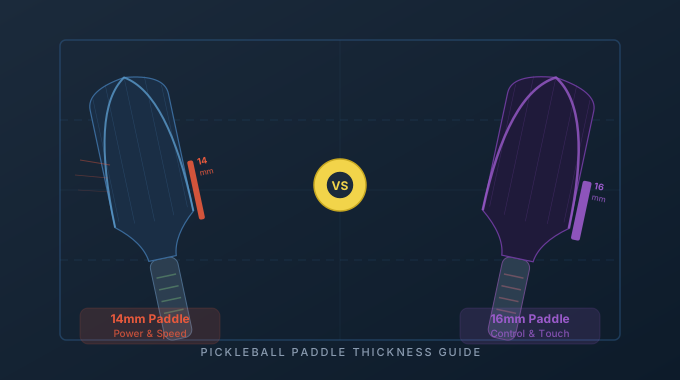
Walk into any pickleball specialty store or scroll through a paddle retailer’s website, and you’ll quickly notice that most paddles are offered in two core thicknesses: 14mm and 16mm. The difference sounds negligible, just 2 millimeters, but anyone who has played with both will tell you the gap in feel and performance is anything but small.
The choice between a 14mm and 16mm pickleball paddle affects nearly every aspect of your game: how hard you can drive the ball, how well you can reset at the kitchen, how forgiving the paddle is on mishits, how fast your hands move in a firefight, and even how your arm and wrist feel after a long session.
This guide will walk you through every meaningful difference between 14mm and 16mm paddles, backed by real-world player experience and paddle science, so you can make a confident, informed purchase that matches your playing style and skill level.
What Does Paddle Thickness (Core Thickness) Actually Mean?
Before diving into comparisons, it’s worth clarifying what “14mm” and “16mm” actually refer to. These measurements describe the thickness of the paddle’s core, not the paddle face or the overall paddle dimensions.
Most modern pickleball paddles use a polymer honeycomb core sandwiched between two face materials (carbon fiber, fiberglass, graphite, or Kevlar). The thickness of that honeycomb core is what’s measured in millimeters. A thicker core means more material between the two faces, which fundamentally changes how energy is absorbed and returned at the moment of contact. The newest core technology is EPP and EPA core.
Common core thickness options in the market range from 10mm (very thin, used by elite power players) to 16mm. The 14mm and 16mm options represent the two most popular choices for recreational and competitive players alike.
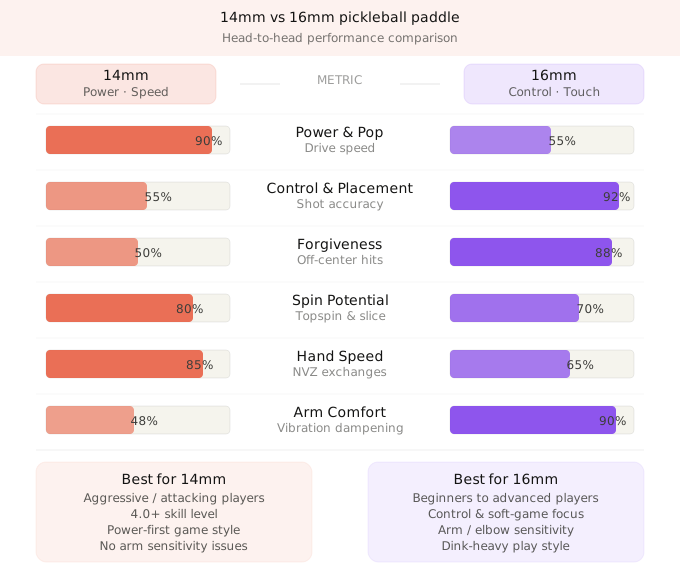
14mm vs 16mm Pickleball Paddle: The Six Key Differences
The thinner core of a 14mm paddle compresses and rebounds more quickly at contact. This “trampoline effect” translates into noticeably more pop and ball speed off the paddle face. Your drives feel explosive, your speed-ups at the net come off sharper, and put-away shots are easier to finish.
The 16mm paddle, by contrast, absorbs more of the ball’s energy into the thicker core. This dampening effect sacrifices some raw power but gives you much greater control over where that energy goes.
The bottom line: If you love ripping drives and living at the net with fast hands, the 14mm paddle gives you a natural power advantage.
2. Control and Shot Placement
Winner: 16mm
The thicker core of a 16mm paddle absorbs more ball energy, giving you a longer dwell time, that is, the ball stays on the paddle face a fraction longer before rebounding. This extended contact window makes it easier to guide shots, execute delicate dinks, and place the ball precisely into gaps.
The soft, muted feel of a 16mm paddle is particularly beneficial in the transition zone and at the kitchen, where touch and consistency matter more than raw power. Resets, drop shots, and third-shot drops all become more manageable with the additional control a thicker core provides.
The bottom line: If your game is built around ball placement, dinking consistency, and minimizing unforced errors, the 16mm is almost certainly the better match.
3. Spin Generation
Winner: 14mm (slight edge)
Spin in pickleball is primarily driven by the paddle face surface (raw carbon fiber generates the most spin), but core thickness also plays a role. The faster rebound of a 14mm paddle means the face exits contact with the ball more quickly, which can enhance the bite and spin potential for players with a brushing stroke.
The 16mm paddle’s slower rebound and softer contact can reduce the amount of spin generated on identical swings, though this difference is modest and can often be offset by technique.
4. Forgiveness and Sweet Spot Size
Winner: 16mm
Forgiveness refers to how well a paddle performs on off-center hits. A useful metric for this is twist weight: a measurement of a paddle’s resistance to twisting on contact with the ball (on a scale of roughly 5 to 8, with 6.4 being average). Thicker cores tend to produce higher twist weights, meaning the paddle stays more stable and the ball still travels reasonably well even when you don’t hit it dead center.
A 14mm paddle, with its smaller core, can feel noticeably punishing on mishits; the smaller sweet spot means off-center contact results in more dramatic speed and direction loss.
The bottom line: Beginners and intermediate players who still miss the center of the paddle regularly will enjoy a much more forgiving experience with a 16mm.
5. Hand Speed and Maneuverability
Winner: 14mm
Because 14mm paddles are generally lighter (less core material = less overall weight), they’re quicker to accelerate and maneuver. In fast hands exchanges at the Non-Volley Zone (NVZ), that extra hand speed can be the difference between getting your paddle on the ball in time or being caught out of position.
The 16mm paddle, being heavier and thicker, may slow your hand speed slightly. For players who rely on quick reflexes and fast reactions at the net, this difference is real and noticeable.
6. Feel and Vibration
Winner: 16mm (for comfort); 14mm (for feedback)
The 16mm paddle delivers a softer, plusher feel on contact. It absorbs vibration more effectively, which means less strain is transmitted to your hand, wrist, and elbow over time. This makes the 16mm a particularly smart choice for players managing tennis elbow, golfer’s elbow, or any repetitive strain issue.
The 14mm paddle produces a crisper, stiffer impact sensation. Many advanced players prefer this because it provides instant feedback; you know immediately whether you’ve hit the sweet spot or not. However, if you’re sensitive to vibration, a 14mm paddle can feel harsh over long sessions.
Quick Comparison Table
Feature
14mm Paddle
16mm Paddle
Power / Pop
✅ Higher
❌ Lower
Control
❌ Lower
✅ Higher
Spin Potential
✅ Slightly better
❌ Slightly lower
Sweet Spot
❌ Smaller
✅ Larger
Forgiveness
❌ Less forgiving
✅ More forgiving
Hand Speed
✅ Faster
❌ Slightly slower
Vibration / Comfort
❌ More vibration
✅ Less vibration
Best for Skill Level
Intermediate–Advanced
Beginner–Advanced
Best Playstyle
Aggressive, attacking
Control, all-court
Who Should Choose a 14mm Paddle?
A 14mm paddle is the right fit if you:
Play at a 4.0 skill level or above, and want to add more offense to your game
Prioritize fast hands and net aggression over soft game consistency
Have good technique and consistently hit the center of the paddle
Enjoy generating your own power through swing mechanics and wrist snap
Want more pop on drives, counters, and put-aways
Do not suffer from arm or elbow pain that might be aggravated by vibration
Many 5.0-level competitive players gravitate toward 14mm paddles specifically for the offensive edge they provide in high-speed exchanges. The extra pop and maneuverability are genuinely advantageous at the net when trying to finish points, something that becomes increasingly valuable as you move up in skill level.
Who Should Choose a 16mm Paddle?
A 16mm paddle is the right fit if you:
Are you a beginner or intermediate player, still building consistency and technique
Rely on touch shots, dinks, and resets as the foundation of your game
Prefer a larger sweet spot that rewards you even on imperfect swings
Experience arm or wrist discomfort and need a dampened, vibration-absorbing feel
Play longer sessions and want a paddle that’s gentler on your body
Are trying to reduce unforced errors and improve placement over power
It’s worth busting a common myth here: thicker does not mean “for beginners only.” Many top professional players use 16mm paddles in tournament play. The thicker core is a strategic choice; it’s about results and consistency, not about playing ability.
Does Skill Level Change the Equation?
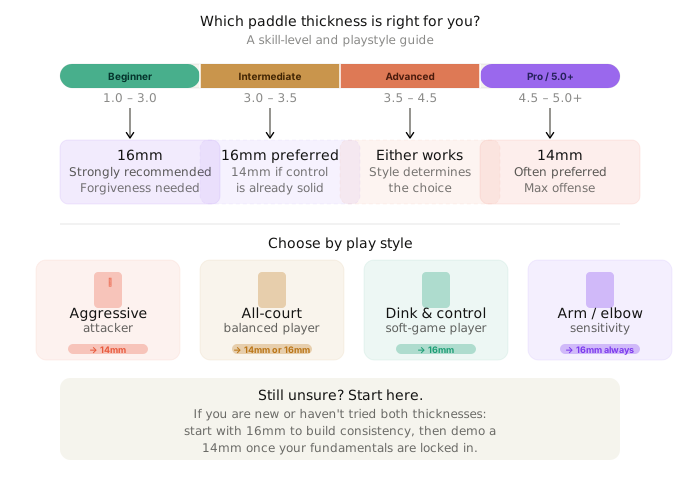
Yes, significantly. Here’s a general framework:
Beginners (1.0–3.0): The 16mm paddle is almost universally the better starting point. The forgiving sweet spot and consistent feel help you build proper strokes without the paddle punishing your early mistakes.
Intermediate players (3.0–4.0): Either thickness can work well depending on playstyle. If your soft game is strong, a 14mm can add offensive dimension. If you’re still developing control, stick with 16mm.
Advanced players (4.0–5.0+): At this level, personal preference and playstyle dominate the decision. Aggressive, attacking players often prefer 14mm. Control-dominant, tactically-minded players often prefer 16mm. Many high-level players own both and switch depending on opponent and conditions.
Does Paddle Face Material Matter When Choosing Thickness?
Absolutely, face material and core thickness interact with each other. Here are the key pairings to understand:
Carbon Fiber Face + 16mm Core: This is arguably the most popular combination among serious recreational and competitive players. Carbon fiber’s spin generation and consistency, paired with the control and forgiveness of a thick core, result in a paddle that’s excellent for all-around play with a premium soft game.
Carbon Fiber Face + 14mm Core: The combination preferred by attacking, power-oriented players. Maximum pop and spin potential at the cost of some control and forgiveness.
Fiberglass Face + 16mm Core: A more budget-friendly combination that still delivers solid control. Fiberglass provides a slightly softer touch than carbon fiber and is easier on the arm.
Fiberglass Face + 14mm Core: Provides pop without the extreme stiffness of carbon, a reasonable middle ground for players who want power but are sensitive to harsh feedback.
Common Myths About Paddle Thickness Debunked
Myth 1: “Thinner paddles are for pros, thicker ones are for beginners.”False. Many elite professionals play with 16mm paddles for their reliable control. Paddle choice is about playstyle, not bragging rights.
Myth 2: “2mm is too small a difference to notice.”False. Players who switch between 14mm and 16mm consistently report immediate, significant differences in feel, power, and control. The 2mm gap is one of the most impactful spec changes you can make.
Myth 3: “A 14mm paddle automatically makes you hit harder.”Partially false. The 14mm paddle does produce more pop on identical swings, but if your technique lacks power generation, the paddle alone won’t solve that. A well-executed swing with a 16mm can still produce significant power.
Myth 4: “You should stick with one thickness forever.”False. Many players own both thicknesses and rotate between them based on matchup, playing conditions, or even just mood. Experimenting is the best way to understand your preferences.
How to Test Before You Buy
Whenever possible, demo a paddle before committing. Most local pickleball clubs, sporting goods stores with pickleball sections, and dedicated pickleball retailers offer demo programs. Testing a 14mm and a 16mm version of the same paddle model (like the Joola Kosmos or Joola Perseus Pro Series) gives you the cleanest apples-to-apples comparison.
When demoing, pay attention to:
How your dinks feel: are they easy to control or do they fly long?
How your drives respond: do they have enough pop, or do you want more touch?
Off-center hits: Does the paddle feel stable, or does it twist?
How your arm and elbow feel after 30–45 minutes of play
Final Verdict: 14mm vs 16mm Pickleball Paddle
There is no objectively “better” thickness. Both 14mm and 16mm paddles are used by players across every skill level, and both have legitimate advantages:
Choose 14mm if you prioritize power, speed, spin, and fast hands, and your technique is solid enough to make the most of a smaller sweet spot.
Choose 16mm if you prioritize control, consistency, forgiveness, and a softer feel, especially if you’re still developing your game or value your long-term arm health.
If you’re still on the fence, most experts and experienced players agree: start with 16mm. It’s easier to learn on, more forgiving, and still capable of excellent power when you swing with intention. Once your fundamentals are solid, experimenting with a 14mm paddle becomes a more rewarding and lower-risk experience.
Of all the variables that define a pickleball paddle, surface material, core thickness, shape, grip size, and weight are arguably the most immediately felt and the most misunderstood. Pick up the wrong weight and the consequences show up fast: mishits at the kitchen line, a tired arm by the third game, or worse, the dull ache of pickleball elbow creeping in after every session.
Pick up the right weight, and the paddle disappears. It becomes an extension of your arm. Volleys feel crisp, drives carry real punch, and you can play for hours without thinking about your equipment at all.
198–255gTypical weight range for composite paddles
227gThe “sweet spot” preferred by 80% of players
3gOf lead tape shifts swing weight noticeably
72%Of beginner injuries linked to wrong-weight gear
Weight influences four key performance pillars simultaneously: power generation, swing speed and reaction time, shot control and precision, and arm fatigue and long-term injury risk. No other single spec does all four at once. That’s why getting this decision right is worth the time it takes to read this guide.
It’s also worth understanding the difference between static weight and swing weight. The number printed on the packaging is static weight, how heavy the paddle is sitting on a scale. Swing weight describes how the paddle actually feels in motion. Two paddles can have the same static weight but very different swing weights depending on where the mass is distributed (head-heavy vs. handle-heavy). A head-heavy 221g paddle can feel heavier than a handle-heavy 230g paddle during play. Keep this in mind throughout.
The Three Weight Categories
The pickleball community has converged on three broadly accepted weight classes. Different retailers use slightly different cutoffs, but the ranges below reflect the most widely used standards in 2026:
Category 01
Under 207g
Featherlight paddles built for speed, touch, and rapid-fire exchanges at the net.
Lightweight
Category 02
207–235g
The balanced zone. Power and control coexist. Recommended for most players at most levels.
Midweight
Category 03
238g+
Maximum mass for maximum drive power. Favored by power-baseline players and singles specialists.
Heavyweight
PICKLEBALL PADDLE WEIGHT CATEGORIES
LIGHTWEIGHT
Under
207g
✓ Fast reactions
✓ Dink control
✗ Less power
MIDWEIGHT
207–
235g
✓ Power + control
✓ All-court play
✓ Lowest injury risk
HEAVYWEIGHT
238g
and up
✓ Maximum power
✓ Singles play
✗ Slower at net
Net · Kitchen · Touch
All-court · Doubles · Beginners
Baseline · Power · Singles
Paddle shapes above are proportional; lightweight is narrower, heavyweight is wider and longer
Standard pickleball paddle: max 61cm total length · max 30cm width (USAP rules)
Pickleball paddle weight categories
Within midweight, some retailers further subdivide into “light-mid” (207–215g) and “mid-heavy” (230–238g), but for decision-making purposes, the three-class framework is sufficient for most players.
Lightweight Paddles (Under 207g)
Lightweight paddles are the racquet equivalent of a sports car: agile, responsive, and built for precision. The reduced mass means less resistance on your swing, which translates directly into faster hand speed and quicker recoveries at the non-volley zone (the kitchen).
Who Should Use a Lightweight Paddle?
Players who thrive at the net, love dink rallies, and rely on touch over power are the natural audience for lightweight paddles. Those coming from table tennis or racquetball, sports built on wrist-speed and quick reactions, often adapt to lightweight pickleball paddles immediately. Players managing joint sensitivity may also find that the reduced arm load helps them play longer without discomfort.
✓ Pros
Fastest reaction time: ideal for kitchen volleys
Superior maneuverability and paddle speed
Less shoulder fatigue during long matches
Excellent touch and feel on soft shots
Natural fit for dink-heavy playing styles
✕ Cons
Less raw power behind baseline drives
More shock transferred to elbow on impact
Requires faster swing speed to generate pace
Can feel unstable against hard-driving opponents
Despite common belief, very light paddles are not the automatic cure for pickleball elbow. A paddle that’s too light forces your elbow to absorb more raw vibration on impact. If you’re dealing with arm pain, a midweight paddle (221–227g) is often the better prescription.
Midweight Paddles (207–235g)
If there’s a universal starting point in pickleball gear, this is it. Midweight paddles consistently earn recommendations from coaches, equipment specialists, and tour players as the optimal category for the vast majority of players, beginner through advanced. The physics are simple: enough mass to drive through the ball cleanly, light enough to react quickly at the net.
“The midweight zone: 221 to 235g, is where about 80% of all players will perform at their best, regardless of skill level.”
The Goldilocks Zone of Pickleball
A paddle in the 221–235g range offers what equipment analysts call “biomechanical balance.” It provides enough physical mass to plow through the ball on baseline drives without requiring an aggressive swing. It delivers structural stability for consistent shot placement. And critically, it remains agile enough for blocking and resetting at the kitchen without sacrificing defensive reaction time.
For players coming from tennis, particularly those accustomed to mid-weight racquets, a midweight pickleball paddle will feel immediately familiar. The swing mechanics translate well, and the reduced weight compared to a tennis racket means the adjustment period is short.
✓ Pros
Best overall balance of power and control
Suitable for all court positions
Forgiving learning curve for new players
Reduces injury risk vs. extremes on either end
Ideal for doubles play at any level
✕ Cons
Not the absolute fastest at net volleys
Not the most powerful option for singles baseline play
Wide range means sub-category selection still matters
Heavyweight Paddles (238g+)
Heavyweight paddles are specialized tools. The extra mass creates greater momentum through the swing arc, meaning more force reaches the ball with less absolute swing speed required. For power-first players, particularly those who play singles, who stand at the baseline, or who have a slower natural swing speed, the tradeoff is favorable.
Who Benefits Most from a Heavy Paddle?
Older players whose swing speed has decreased over time often find that a heavier paddle compensates effectively, producing adequate pace without demanding explosive arm mechanics. Singles specialists benefit similarly, since singles pickleball rewards powerful drives in a way that doubles does not. Professional players on the tour typically use paddles in the 233–244g range; they need the mass to counter opponents hitting at elite speeds from the baseline.
✓ Pros
Maximum power output on drives and serves
More shot “forgiveness” — larger effective sweet spot feel
Less effort needed to generate pace
Excellent for singles and baseline play
✕ Cons
Slower reaction time at the kitchen line
Increased shoulder and forearm fatigue over time
Not recommended for players with existing arm issues
Requires stronger conditioning to wield effectively
Full Weight Comparison Table
WEIGHT vs. PERFORMANCE: FOUR KEY FACTORS
Lightweight
Midweight
Heavyweight
Power
Under 207g
Low–Moderate
207–235g
Moderate–High
238g+
High
Control
Under 207g
Excellent
207–235g
Very Good
238g+
Moderate
Reaction
Under 207g
Fastest
207–235g
Fast
238g+
Slower
Safety
(arm & elbow)
Under 207g
Good (elbow risk)
207–235g
Best: lowest overall risk
238g+
Good (shoulder risk)
Performance comparison across all three weight classes
Factor
Lightweight (<207g)
Midweight (207–235g)
Heavyweight (238g+)
Power
Low–Moderate
Moderate–High
High
Control
Excellent
Very Good
Moderate
Reaction Speed
Fastest
Fast
Slower
Arm Fatigue
Low shoulder / higher elbow
Low–Moderate
Higher shoulder/forearm
Best For
Net play, dinking, touch shots
All-court play, doubles
Baseline drives, singles, power
Recommended Skill
Intermediate–Advanced
All levels
Advanced / physically conditioned
Injury Risk
Elbow shock if too light
Lowest overall risk
Shoulder strain if overused
Playing Style
Touch player, dink specialist
All-rounder, doubles specialist
Power baseliner, singles player
Best Weight by Player Type & Skill Level
BEST PADDLE WEIGHT BY PLAYER TYPEBeginner
Any new player or sport switcher
→ 207–235g midweight
Start here
Net / touch player
Dink-first, kitchen specialist
→ Under 207g lightweight
<207g
Intermediate all-rounder
Developing all-court game
→ 210–235g mid range
221g
Power / baseline player
Drive-first, singles specialist
→ 230–244g heavyweight
238g+
Advanced / competitive
Tour or high-league play
→ 233–244g + fine-tune with tape
Racquetball / table tennis
Fast-twitch wrist-speed game
→ Under 207g lightweight
Recommendations are starting points, adjust with lead tape after developing a feel for your paddle
Best weight by player type and skill level
For Beginners
The clear recommendation for beginners is a midweight paddle in the 207–235g range. While it’s tempting to reach for either extreme, a super-light paddle thinking it’ll be “easier to swing,” or a heavy one hoping for built-in power, both choices create problems before you’ve had the chance to develop sound technique. The midweight range gives you room to develop your game without your equipment fighting against you.
For Intermediate Players
By the intermediate stage, you know whether you’re a net-first or baseline-first player. Net-first players can begin exploring paddles on the lighter end of the midweight range (207–218g). Baseline-oriented players who want to add pace to their drives can explore the heavier midweight options (224–235g). Experimentation within the midweight class, rather than crossing into the extremes, is usually the smartest intermediate strategy.
For Advanced & Competitive Players
Advanced players often have strong opinions developed through years of iteration. Many competitive players land on a very specific target weight, sometimes within a 6g window, and use lead tape for fine-tuning. Elite pro players on the PPA and MLP tours predominantly use paddles in the 233–244g range, where the added mass helps neutralize pace from power-hitting opponents.
For Seniors & Players with Joint Issues
The midweight range remains the safest harbor here. A paddle that’s too light amplifies elbow shock; one that’s too heavy strains the shoulder and forearm under repetitive use. The 221–230g range strikes the right balance, providing enough mass to handle ball impact without demanding extreme muscular effort throughout a long match.
If you previously played tennis with an average-to-heavy racquet, start with a midweight pickleball paddle. If your previous racquet sport was table tennis or racquetball, both lighter and faster, a lightweight pickleball paddle will likely feel more natural to your swing mechanics.
Paddle Weight & Injury Prevention
The relationship between paddle weight and arm injury is more nuanced than “lighter is safer.” USA Pickleball guidance has identified improper equipment as one of the most common sources of arm pain among recreational players, and the error cuts both ways.
A paddle that is too light forces the smaller muscles and tendons of your elbow to absorb the raw kinetic shock of ball impact directly. With less mass in the paddle to dampen that force, more vibration travels up the arm. This is a direct pathway to lateral epicondylitis, what the pickleball community calls “pickleball elbow.” Paradoxically, players dealing with early elbow discomfort often make things worse by switching to the lightest paddle they can find, believing the reduced weight will spare their arm. In many cases, it accelerates the problem.
A paddle that is too heavy introduces a different risk: chronic muscular fatigue and, eventually, shoulder strain. Swinging a heavy paddle requires constant effort from the rotator cuff and supporting forearm muscles. If those muscles aren’t conditioned for the workload, strain develops over time, especially in players logging multiple games per week.
“For most players dealing with arm pain, the answer isn’t the lightest paddle available; it’s the midweight range around 221–227g.”
The general guidance from equipment specialists and sports medicine professionals is that the 221–227g midweight zone represents the lowest-risk weight category for most players, particularly those with pre-existing joint sensitivity or those new to racquet sports. If you add lead tape or other customization, always start small, build gradually, and stop immediately if any new discomfort develops.
Customizing Your Paddle Weight with Lead Tape
Lead tape, a thin adhesive-backed strip of dense metal, is the primary tool players use to fine-tune paddle weight after purchase. It’s fully legal under USA Pickleball rules and widely used across all competitive levels, from recreational club players to touring pros.
Where You Place It Changes Everything
Adding the same amount of tape to different positions on the paddle produces meaningfully different results:
LEAD TAPE PLACEMENT: EFFECT ON SWING WEIGHT & BALANCE
sweet
spot
Top edge (12 o’clock)
Head-heavy → more power
Bigger sweet spot at top
Both sides
(3 & 9 o’clock)
Wider sweet spot
More off-centre stability
Handle / throat area
Handle-heavy → more control
Quicker feel at net
Handle-heavy
Head-heavy
Balance point shifts depending on where tape is placed
Start small: 1–2g strips
Test over several sessions before adding more
Lead tape is fully legal under USA Pickleball rules at all levels of competition
Lead tape placement guide and effect on paddle balance
Tape Placement
Effect on Feel
Best For
Top edge (12 o’clock)
Head-heavy feel; more power, bigger sweet spot at top
Power-focused players, drive specialists
Both side edges (3 & 9 o’clock)
Wider sweet spot, more stability on off-center hits
Players seeking shot forgiveness and consistency
Handle / throat area
Handle-heavy balance; more control, quicker feel at net
Dink-first players, net specialists
Just three grams of lead tape added to the outer edge guard measurably alters the functional swing weight and dynamic balance point of a paddle. Advanced players can feel weight changes as small as 6g during play, which is why some competitive players specify a guaranteed weight range (e.g., 213–218g) when ordering from manufacturers. For most recreational players, a range variance of 6g will be imperceptible.
Start with a small strip (1–2 grams) and play with it for several sessions before adding more. Jumping straight to maximum lead tape risks overloading joints that aren’t conditioned for the extra load. If you notice new arm discomfort, remove the tape immediately.
Frequently Asked Questions
What is the best pickleball paddle weight for beginners?
For beginners, a midweight paddle between 207 and 235g is the safest and most effective choice. This range offers a balance of power and control that helps new players develop sound technique without either extreme working against their progress.
Does a heavier pickleball paddle cause elbow pain?
It can, particularly if the paddle exceeds what your arm muscles are conditioned to handle over extended play. However, a paddle that is too light can also cause elbow pain by transmitting more shock on impact. The midweight range of 221–227g is generally recommended for players managing elbow sensitivity.
What weight do professional pickleball players use?
Most professional pickleball players use paddles in the 233–244g range. The added mass helps them counter the pace of opponents hitting at elite speed and generate power on baseline drives without requiring an extreme swing.
Is it legal to add lead tape to a pickleball paddle?
Yes. Lead tape (also called weight tape) is explicitly permitted under USA Pickleball rules. Players at all levels use it to fine-tune the static weight and swing weight balance of their paddles within legal specifications.
What is the difference between static weight and swing weight in a pickleball paddle?
Static weight is the total mass of the paddle measured on a scale — the number you see on product listings. Swing weight describes how the paddle actually feels during a swing, which is influenced by where the mass is distributed. A head-heavy paddle will feel heavier than its static weight suggests; a handle-heavy paddle will feel lighter and more maneuverable.
How much does grip size affect pickleball paddle weight?
Grip size does affect total paddle weight. A 4.5″ double grip can add approximately 14g to a paddle, while a thinner 4″ grip can reduce weight by about 6g. Switching grip sizes is one way to make minor weight adjustments without purchasing a new paddle.
⚡ The Final Verdict
Your Perfect Weight, Simplified
If you’re new to pickleball or returning from another racquet sport, start with a midweight paddle (207–235g). It will serve you better than any other choice while your game develops.
If you’re an experienced player who lives at the kitchen line and thrives on touch, explore the lighter end of midweight or lightweight class (198–213g). Speed is your weapon.
If you’re a power player, a singles specialist, or someone with a naturally slower swing speed: move toward the heavier midweight or heavyweight range (235–244g). Let mass do the work.
And if you want to fine-tune? Buy the paddle closest to your target weight and use lead tape to dial in the last 14–28g and balance point exactly where you need it.
When players start looking for a new pickleball paddle, one of the first things they hear is that a paddle has “great power” or “a lot of pop.” The problem is, these terms are often thrown around without much explanation, which leads to confusion and, more importantly, poor paddle choices.
Power and pop are not the same thing, even though both influence how fast the ball comes off your paddle. Understanding the difference between the two, and knowing which one actually suits your game, can have a direct impact on how you perform, whether that’s finishing points at the baseline or winning quick exchanges at the kitchen.
What Is Power in a Pickleball Paddle?
Power in a pickleball paddle refers to how much pace you can generate when you take a full, committed swing. It shows up most clearly when you have time to set your feet and drive through the ball, such as on serves, returns, and baseline drives.
A paddle with good power allows you to hit deeper shots with less effort. You don’t feel like you have to swing out of your shoes just to push your opponent back. Instead, the paddle does some of the work for you, transferring energy efficiently into the ball and helping you maintain pressure from the back of the court.
Players who rely on aggressive playstyles, especially those who like to drive their third shots or play singles, tend to benefit from paddles that lean toward power. It allows them to dictate rallies, force weak replies, and create opportunities to finish points early.
What Is Pop in a Pickleball Paddle?
Pop, on the other hand, is about what happens on short, compact swings, particularly at the kitchen line. It refers to how quickly and sharply the ball rebounds off the paddle face with minimal effort.
You’ll notice pop most during fast-paced situations, hand battles, punch volleys, quick blocks, and reaction shots. A paddle with good pop feels lively and responsive. Even with a short movement, the ball comes off clean and fast, allowing you to keep up with rapid exchanges.
In doubles play, where most points are decided at the net, pop becomes extremely important. It helps you react quickly, counter effectively, and apply pressure without needing a big backswing.
Why Power and Pop Are Often Confused
The confusion between power and pop comes from the fact that both involve speed, but they show up in completely different moments of a rally.
Power is something you feel when you have time to swing freely. Pop is something you rely on when you don’t.
A paddle can feel powerful on drives but still lack quick response at the net. Similarly, a paddle can feel incredibly lively in hand battles but struggle to generate depth from the baseline. This is why choosing a paddle based only on “how fast it feels” can be misleading if you don’t consider where that speed is coming from.
Why Power Matters in Real Match Play
Power plays a critical role in controlling rallies from the back of the court. When you can hit deep, penetrating shots consistently, you force your opponents into defensive positions, often leading to shorter balls that you can attack.
It also becomes a weapon on:
Serve returns that push opponents back
Passing shots when opponents crowd the net
Overheads that finish points cleanly
Without enough power, you may find yourself working harder just to stay neutral in rallies. Your shots land shorter, giving opponents more time and more options.
Why Pop Matters Even More in Doubles
While power helps you start the point strong, pop often determines how the point ends, especially in doubles.
At the kitchen line, everything happens quickly. You don’t have time for big swings, and that’s where pop becomes your biggest asset. A paddle with good pop allows you to:
Punch volleys with minimal effort
Counter speed-ups effectively
Keep your paddle compact and efficient
Maintain pressure during hand exchanges
Players who struggle in fast net battles often aren’t slow; they’re using paddles that don’t respond quickly enough in tight situations. This is generally affected by a paddle’s swing weight and twist weight.
The Trade-Off Between Power and Pop
Most paddles don’t maximize both power and pop equally. There’s usually a balance.
Paddles built for power tend to:
Have lower dwell time
Feel stiffer
Reward full swings
Be less forgiving on touch shots
Paddles built for pop and control tend to:
Feel softer or more connected
Excel in short swings
Offer better touch
Sacrifice some baseline depth
The key is not choosing the “best” paddle overall, but choosing the one that matches how you actually win points.
What Influences Power and Pop in a Paddle?
Several design elements affect how much power or pop a paddle has.
Core Thickness
Thinner paddles usually produce more power and quicker rebound. Thicker paddles absorb more energy, which improves control but reduces raw speed.
Fiberglass faces tend to feel more powerful and lively, while carbon fiber faces emphasize control and spin, often slightly reducing raw pop. The future of paddles seems to be tilting more towards all foam paddles, EPP and EPA to be precise.
Paddle Weight
Heavier paddles can generate more power due to increased momentum, but may feel slower in hand battles. Lighter paddles improve reaction speed and perceived pop at the net.
Paddle Weight
Heavier paddles can generate more power due to increased momentum, but may feel slower in hand battles. Lighter paddles improve reaction speed and perceived pop at the net.
How to Choose What You Need
The right balance between power and pop depends entirely on your playing style.
If you’re someone who:
Likes driving the ball
Plays singles often
Wins points from the baseline
You should lean toward power-oriented paddles.
If you:
Play mostly doubles
Spend a lot of time at the kitchen
Rely on quick hands and counters
You should prioritize pop and responsiveness.
For most intermediate players, especially in doubles, a slightly pop-focused paddle with enough power for occasional drives tends to be the most practical choice.
Power vs Pop in Pickleball Paddles: Comparison Table
Feature
Power
Pop
Definition
Ability to generate pace on full swings
Quick rebound on short, compact swings
Where It Shows Up
Baseline drives, serves, passing shots
Kitchen volleys, hand battles, counters
Swing Type
Full, aggressive swings
Short, compact movements
Feel at Contact
Heavy, explosive
Quick, snappy, responsive
Best For
Singles play, driving third shots
Doubles play, fast net exchanges
Control Level
Can be harder to control if too high
Easier to control in tight situations
Common Trade-Off
Less touch and finesse
Less depth on full drives
Influenced By
Paddle weight, stiffness, thinner cores
Face responsiveness, balance, swing speed
Ideal Player Type
Aggressive baseline player
Quick hands, net-focused player
Final Thoughts
Power and pop are both essential, but they serve different purposes. One helps you control the rally from a distance, while the other helps you win it up close.
When you understand how each one works, you stop guessing and start choosing paddles with intention. And that’s when your equipment actually starts supporting your game instead of holding it back.
The goal isn’t to have the most powerful or the most responsive paddle; it’s to have the one that shows up exactly when you need it most.
FAQs
What is the difference between power and pop in pickleball paddles?
Power is how much pace you can generate on a full swing, while pop refers to how quickly the ball rebounds off the paddle during short, compact shots, especially at the net.
Which is more important: power or pop?
It depends on your playing style. Power is more important for singles and baseline play, while pop is more important in doubles where fast hand battles at the kitchen decide most points.
Can a paddle have both power and pop?
Yes, but most paddles lean slightly toward one side. Some modern paddles aim to balance both, offering decent power on drives and quick response at the net.
Do thicker paddles have less power?
Generally, yes. Thicker paddles tend to absorb more energy, which improves control and feel but slightly reduces raw power compared to thinner paddles.
Why does my paddle feel powerful but hard to control?
You may be using a paddle with high power but low dwell time, meaning the ball leaves the face quickly. This can make it harder to control softer shots like dinks and resets.
Is pop important for beginners?
Pop becomes more important as you move into intermediate and advanced play, especially in doubles. Beginners can benefit from a balanced paddle that offers both control and moderate pop.
How do I know if I need more power or more pop?
If your shots lack depth and feel weak from the baseline, you likely need more power. If you struggle in fast exchanges at the net, you likely need more pop.
When most players shop for a pickleball paddle, they look at the obvious specs: weight, thickness, and surface material. But two of the most important performance factors often get overlooked: swing weight and twist weight.
These numbers don’t always appear clearly on product pages, yet they heavily influence how a paddle feels in your hand, how fast you can react at the kitchen, and how stable the paddle remains on off-center hits.
If you’ve ever picked up two paddles with the same listed weight but felt like one moved faster or felt more solid on mishits, you were experiencing differences in swing weight and twist weight.
Let’s break down what each one means and why smart players pay attention to both.
What Is Swing Weight in Pickleball Paddle?
Swing weight measures how heavy a paddle feels when you swing it, not when you simply hold it. Technically, it reflects how the paddle’s mass is distributed relative to your hand.
Two paddles can both weigh 8.0 ounces on a scale but feel completely different in motion. One may whip through the air easily, while the other feels sluggish. That difference is swing weight.
While swing weight affects how fast you can move the paddle, it also plays a role in how much pop you feel at the net. This ties closely into the difference between power vs pop in pickleball paddles.
In Simple Terms
Lower swing weight = faster hand speed, easier maneuverability
Higher swing weight = more plow-through, more drive stability
Swing weight becomes especially noticeable during quick exchanges at the kitchen.
Why Swing Weight Matters on the Court
Swing weight directly affects how quickly you can position your paddle and how much momentum you carry through the ball.
At the Kitchen Line
Lower swing weight helps with:
Fast hand battles
Quick counters
Rapid paddle adjustments
Defensive reaction volleys
If you play a speed-up heavy doubles game, this matters a lot.
From the Baseline
Higher swing weight can help with:
Deeper drives
More stable contact
Better plow-through
Heavier passing shots
Players who rely on full swings often appreciate the extra mass in motion.
Signs Your Swing Weight Is Too High
Many intermediate players unknowingly use paddles that are too slow for their hands.
Watch for these clues:
You feel late in hand battles
Quick body shots jam you
Paddle feels slow to reset
You struggle against fast opponents
If this sounds familiar, your swing weight may be working against you.
Signs Your Swing Weight Is Too Low
On the flip side, extremely low swing weight can create its own issues.
You might notice:
Drives lack depth
Paddle feels unstable on blocks
You lose plow-through on hard shots
Put-aways don’t feel heavy enough
Balance is key, especially in doubles.
What Is Twist Weight in Pickleball Paddles?
Twist weight is less talked about but equally important. It measures how resistant the paddle is to twisting in your hand on off-center contact.
Every time you hit the ball outside the sweet spot (which happens more often than players admit), the paddle wants to rotate slightly. Twist weight determines how much it actually moves.
In Simple Terms
Higher twist weight = more stability on mishits
Lower twist weight = more paddle wobble on off-center hits
If swing weight is about motion through the air, twist weight is about face stability at impact.
Why Twist Weight Matters More Than Most Players Realize
Perfect center contact is rare in real play, especially during fast exchanges.
Higher twist weight helps:
Keep the paddle face stable
Reduce mishit vibration
Maintain directional control
Improve consistency under pressure
This becomes especially important in defensive situations when you’re reacting rather than swinging freely.
Where You’ll Notice Twist Weight Most
During Fast Hand Battles
When exchanges speed up at the kitchen, you don’t always catch the sweet spot cleanly. A paddle with good twist weight stays firm instead of fluttering.
On Stretch Volleys
When you’re reaching wide and making contact toward the edge of the paddle, higher twist weight prevents the face from opening or closing unintentionally.
On Blocks and Counters
Stable paddles absorb pace better and keep the ball low. Lower twist weight paddles can feel shaky in these moments.
What Paddle Features Influence Swing Weight?
Several design elements affect how heavy a paddle feels in motion.
Head Shape
Elongated paddles usually have higher swing weight because more mass sits farther from your hand. Standard or hybrid shapes often feel quicker.
Balance Point
Head-heavy paddles swing slower but drive through the ball harder. More evenly balanced paddles feel quicker at the net.
Overall Paddle Length
Longer paddles naturally increase swing weight. Even small differences in length can change maneuverability noticeably.
What Affects Twist Weight?
Twist weight is mostly influenced by how much mass sits toward the paddle’s edges.
Perimeter Weighting
Paddles with foam-injected edges or reinforced perimeters usually have higher twist weight because there’s more stability around the face.
Paddle Width
Wider paddles generally resist twisting better than very narrow elongated shapes, all else being equal.
Construction Quality
Higher-end paddles often engineer stability more carefully, even without dramatically increasing static weight.
This isn’t an either-or situation. They affect completely different parts of performance.
Swing weight controls how fast you can move the paddle
Twist weight controls how stable the paddle is on contact
Ideally, you want a paddle that:
Moves quickly enough for your hand speed
Stays stable enough under pressure
Many modern paddles try to optimize both, but there is always some trade-off.
How to Choose the Right Balance for Your Game
Prioritize Lower Swing Weight If You:
Play fast doubles
Win points in hand battles
Value quick counters
Often feel late at the kitchen
Prioritize Higher Twist Weight If You:
Want more forgiveness
Miss the sweet spot occasionally
Value block stability
Play against heavy hitters
The Sweet Spot for Most Intermediate Players
Most improving doubles players benefit from:
Moderate swing weight (not too sluggish)
Solid twist weight (for stability under pressure)
This combination supports both quick hands and consistent blocking, two skills that matter more and more as competition improves.
Swing Weight vs Twist Weight: Quick Comparison Chart
Feature
Swing Weight
Twist Weight
What It Measures
How heavy the paddle feels during a swing
Resistance to twisting on off-center hits
Affects
Hand speed, maneuverability, plow-through
Stability, forgiveness, control on mishits
Lower Value Means
Faster hands, easier to maneuver
Less stability, more paddle wobble
Higher Value Means
Slower hands, more power through contact
More stability, better off-center control
Most Noticeable During
Hand battles, volleys, quick exchanges
Blocks, counters, stretched shots
Important For
Speed, reaction time, net play
Consistency, control, defensive play
Influenced By
Balance, paddle length, head shape
Edge weighting, paddle width, construction
Best For
Fast doubles players, quick hands
Players wanting forgiveness and stability
Trade-Off
Too high = slow hands
Too low = unstable paddle face
Final Thoughts
Swing weight and twist weight might not be the flashiest paddle specs, but they quietly shape how confident you feel on the court. One controls your speed through the air; the other controls your stability at impact.
When players say a paddle feels “fast,” “solid,” or “forgiving,” they’re usually reacting to these two factors, even if they don’t realize it.
If you want your next paddle upgrade to actually improve your game, start paying attention to how the paddle moves and how it behaves on mishits. Those details often matter more than the headline specs.
FAQs
What is swing weight in a pickleball paddle?
Swing weight is how heavy a paddle feels when you swing it. It affects how fast you can move your paddle, especially during quick exchanges at the net.
What is twist weight in pickleball?
Twist weight measures how stable the paddle is on off-center hits. Higher twist weight means less wobble and better control when you miss the sweet spot.
Is lower swing weight better?
Lower swing weight is better for faster hands and quick reactions, especially in doubles. However, too low can reduce power and stability on drives.
Is higher twist weight always better?
Higher twist weight improves forgiveness and consistency, but extremely high stability can sometimes make the paddle feel less maneuverable.
Can two paddles have the same weight but feel different?
Yes. Even if two paddles weigh the same, differences in swing weight and balance can make one feel faster and the other feel heavier in motion.
Which matters more: swing weight or twist weight?
Both matter equally but affect different things. Swing weight impacts speed and maneuverability, while twist weight affects stability and control.
What’s a good balance for intermediate players?
Most intermediate players benefit from moderate swing weight for speed and solid twist weight for stability, especially in doubles play.
When players talk about how a paddle “feels,” they’re usually describing two things: how long the ball seems to stay on the paddle face, and what the paddle feels like in the hand after contact.
Those two sensations come down to dwell time and vibration management.
They aren’t just marketing buzzwords. They directly affect control, spin, comfort, and even long-term arm health. If you’ve ever switched paddles and thought, “This one feels softer,” or “This one feels harsh,” you were reacting to differences in dwell time and vibration, whether you realized it or not.
Let’s break down what these terms actually mean and why they matter more than most players think.
What Is Dwell Time in Pickleball?
Dwell time refers to how long the ball remains in contact with the paddle face during impact. We’re talking milliseconds, but in pickleball, milliseconds matter.
A paddle with higher dwell time holds the ball slightly longer before releasing it. That extra fraction of contact creates:
Better control on drops and resets
Easier spin generation
A softer, more connected feel
More margin on touch shots
On the other hand, a paddle with low dwell time releases the ball quickly. The result is:
Quicker pop off the face
A more responsive or “crisp” feel
Less time to manipulate spin
Potentially less forgiveness on soft shots
Neither is objectively better. It depends on your playing style.
Why Dwell Time Matters for Control and Spin
If you rely heavily on third-shot drops, dinks, and resets, dwell time becomes especially important. When the ball sits on the paddle face a split second longer, you gain more control over trajectory and placement.
It also plays a major role in spin.
Spin requires friction and contact. The longer the ball interacts with the paddle surface, the more opportunity you have to brush up for topspin or carve under for slice. That’s why paddles known for heavy spin often feel slightly softer or more connected at contact.
Players transitioning from tennis tend to prefer higher dwell time because it feels more familiar, less “pingy,” and more controlled.
Higher dwell time often improves control, but it can slightly reduce raw power. If you want to understand this balance better, check out our guide on power vs pop in pickleball paddles.
What Affects Dwell Time?
Several paddle characteristics influence dwell time:
Polymer honeycomb cores typically offer balanced dwell and control.
EVA foam or EPP cores often increase dwell time and produce a more muted feel.
Thinner, stiffer cores usually reduce dwell and increase pop.
Foam-core paddles, in particular, are known for enhancing ball pocketing, though they sometimes trade off raw power.
2. Paddle Thickness
Thicker paddles (14mm vs 16mm, for example) generally provide more dwell time because there’s more material absorbing impact.
Thinner paddles feel quicker and more explosive, but can feel less forgiving on off-center hits.
3. Surface Material
Carbon fiber faces tend to grip the ball better than fiberglass, increasing perceived dwell and spin potential. Fiberglass, by contrast, usually feels livelier and more powerful but releases the ball faster.
The face doesn’t control dwell entirely, but it absolutely influences how it feels.
What Is Vibration Management in Pickleball Paddles?
Vibration management refers to how well a paddle absorbs and disperses shock when the ball makes contact.
Every time you hit the ball, vibration travels through the paddle and into your hand, wrist, and elbow. Some paddles dampen that shock efficiently. Others transfer more of it directly to your arm.
If you’ve ever felt a sharp sting on a mishit, that’s poor vibration dampening.
Over time, excessive vibration can contribute to:
Arm fatigue
Wrist discomfort
Elbow irritation
Reduced confidence on hard shots
This becomes especially important for players who play multiple times per week.
Why Vibration Control Matters for Arm Health
While paddle design alone doesn’t cause injuries, poor vibration management can aggravate existing issues, particularly tennis elbow.
A paddle that feels overly stiff or hollow may produce more noticeable feedback on contact. Some players like that crisp sensation. Others find it harsh after long sessions.
Well-dampened paddles tend to:
Feel more solid
Sound less “pingy”
Reduce post-game soreness
Improve confidence on blocks and counters
Comfort isn’t just about luxury; it impacts performance over time.
What Impacts Vibration in a Paddle?
Core Density and Composition
Foam-based cores generally absorb vibration better than traditional honeycomb polymer cores. However, not all foam paddles are equal. Some are tuned for pop rather than dampening.
Denser cores can reduce vibration but may increase overall paddle weight.
Edge Construction
Foam-injected edges or reinforced perimeter builds can reduce vibration on off-center hits. This also expands the effective sweet spot.
A paddle that feels stable across the face typically manages shock better.
Handle and Grip Design
The handle acts as the bridge between paddle and player. Cushioned grips, longer handles, and slightly thicker grip builds can soften vibration transfer.
Some players add an overgrip not just for sweat absorption, but for shock reduction.
The Relationship Between Dwell Time and Vibration
Although they’re different concepts, dwell time and vibration often influence each other.
Paddles with higher dwell time frequently feel softer because the ball isn’t rebounding instantly. That softer interaction can reduce harsh vibration feedback.
Conversely, paddles with extremely quick rebound and high pop sometimes feel stiffer in the hand.
However, this isn’t always a direct correlation. Some modern paddle constructions manage to combine solid pop with excellent dampening, though usually at a higher price point.
Who Should Prioritize Dwell Time?
You’ll likely benefit from higher dwell time if:
You focus on control over raw power
You rely heavily on spin
You struggle with resets
You’re moving up from beginner to intermediate play
Control-oriented doubles players typically prefer paddles with noticeable dwell.
Who Should Prioritize Vibration Management?
Vibration dampening should be a priority if:
You play frequently (3+ times per week)
You’ve experienced elbow or wrist discomfort
You prefer a muted, solid feel
You value comfort during long sessions
Even if you don’t currently have arm issues, choosing a paddle with good vibration control can be a preventative move.
Finding the Right Balance
The best paddle isn’t the one with the most dwell or the least vibration. It’s the one that complements your playing style without compromising comfort.
Before buying, consider:
Do I want more spin or more pop?
Do I prefer a crisp or muted feel?
Am I sensitive to vibration?
Do I prioritize control at the kitchen?
If possible, demo paddles. Feel is subjective, and numbers alone won’t tell the whole story.
Final Thoughts
Dwell time and vibration management aren’t just technical specs buried in product descriptions. They directly influence how confidently you hit third shot drops, how consistently you reset under pressure, and how your arm feels after two hours of play.
Understanding these concepts helps you choose equipment intentionally instead of chasing trends.
In the end, the right paddle should feel like an extension of your hand, stable on contact, controlled under pressure, and comfortable enough to trust point after point.
Pickleball Core Types: Dwell Time & Vibration Comparison
The core is the engine of a pickleball paddle. It influences how long the ball stays on the face (dwell time), how much feedback you feel in your hand (vibration), and how the paddle performs in soft vs power situations.
Below is a practical breakdown of the most common core types and how they affect feel and comfort.
Core Type
Dwell Time
Vibration Dampening
Feel at Contact
Power Level
Best For
Polymer Honeycomb (Polypropylene)
Moderate
Moderate
Balanced, slightly muted
Medium
All-around players
Nomex Honeycomb
Low
Low
Crisp, loud, firm
High
Power hitters
Aluminum Honeycomb
Moderate
Moderate-High
Soft but responsive
Low-Medium
Control players
EVA Foam Core
High
High
Plush, connected, muted
Medium
Spin & control-focused players
EPP Foam Core
High
High
Soft but lively
Medium-High
Modern all-court players
Hybrid (Foam + Honeycomb)
Moderate-High
High
Stable, solid
Medium
Players wanting balance of pop + comfort
How Each Core Type Actually Plays
Polymer Honeycomb (Polypropylene)
This is the most common core in pickleball. It offers a balanced blend of dwell time and vibration dampening without leaning too heavily into power or softness. Most recreational and intermediate paddles use polymer because it provides reliable consistency without extreme feedback.
For most players, polymer feels familiar and stable, not overly plush, not overly stiff.
Nomex Honeycomb
Nomex cores are known for power and crisp response. The ball leaves the paddle face quickly, resulting in lower dwell time. The tradeoff is increased vibration and a firmer feel.
Players who love fast hands and put-away power may enjoy Nomex. However, those sensitive to arm discomfort often find it too harsh for extended sessions.
Aluminum Honeycomb
Aluminum cores are less common today but still favored by some control players. They provide a softer feel compared to Nomex and decent vibration control, though they lack the explosive power of modern builds.
They tend to reward patient, placement-focused play.
EVA Foam Core
EVA foam cores have grown in popularity in “Gen 3 and Gen 4” style paddles. Foam increases dwell time noticeably, allowing the ball to pocket slightly on contact. This enhances spin potential and soft shot control.
Vibration dampening is typically excellent, making these paddles more comfortable during long play sessions. However, some foam paddles sacrifice raw power in exchange for feel.
EPP Foam Core
EPP (Expanded Polypropylene) is a newer innovation designed to combine the plush feel of foam with improved energy return. Compared to EVA, EPP often feels slightly livelier while still offering strong vibration control.
For players who want dwell time without losing pop, EPP is an interesting middle ground.
Hybrid Core Constructions
Hybrid cores combine honeycomb structure with foam perimeter injection or layered reinforcement. The goal is simple: expand the sweet spot, increase dwell slightly, and reduce harsh vibration without killing power.
These paddles tend to feel solid across the face and are popular among competitive players who want modern performance without excessive stiffness.
FAQ’s
What is good dwell time in a pickleball paddle?
Good dwell time means the ball stays on the paddle face long enough to improve control and spin without feeling mushy. Control-oriented players typically prefer moderate to high dwell time, especially for drops and dinks.
Does more dwell time mean less power?
Not necessarily. While higher dwell time often feels softer, modern paddle construction can maintain solid power. However, extremely high dwell paddles may feel less explosive than stiff, low-dwell designs.
Which core is best for tennis elbow?
Foam-based cores (EVA or EPP) and well-built hybrid cores generally offer better vibration dampening. Polymer cores can also work well if paired with good edge reinforcement and grip cushioning. Avoid overly stiff, high-vibration paddles if you’re managing elbow discomfort.
Why does my paddle feel “pingy”?
A pingy or hollow sound usually indicates lower vibration dampening. Stiffer cores and thinner paddles tend to transmit more shock and produce sharper acoustic feedback.
Is thicker always better for vibration control?
Thicker paddles (like 16mm vs 13mm) usually absorb more impact and provide better vibration control. However, thickness alone doesn’t guarantee comfort; construction quality matters just as much.
Do carbon fiber faces increase dwell time?
Carbon fiber faces improve surface grip and spin potential, which can enhance the feeling of dwell time. However, the core still plays the biggest role in actual ball pocketing.
Can overgrips help reduce vibration?
Yes. Adding an overgrip can slightly reduce shock transfer into the hand while also improving comfort and sweat absorption. It’s a simple way to fine-tune paddle feel.
In pickleball, not every ball is worth fighting for. One of the most overlooked skills is knowing when and how to concede the court. Remember, once you reach the advanced and pro level, every player knows how to execute different types of shots, so not all your shots are going to be winners. This is why you need to be okay with conceding the court; in simpler terms, conceding the court doesn’t mean quitting on the point. It means making a smart positional choice that prevents your opponent from hitting a high-percentage winner while setting you up for a better defensive or neutral rally.
Players who refuse to concede space often end up:
Overreaching
Popping balls up
Getting passed down the line
Or losing balance and court coverage
Learning when to step back, slide over, or reset is a major step toward smarter, more consistent pickleball.
What Does “Conceding the Court” Mean in Pickleball?
Conceding the court means intentionally giving up a portion of the court, temporarily to protect yourself from a higher-risk situation.
This usually happens when:
You’re late to a ball
Your opponent has strong court position
You’re stretched wide or moving backward
The incoming shot is low, fast, or well-angled
Instead of forcing a low-percentage reply, you retreat, reposition, or block safely, buying time to recover.
Think of it as controlled defense, not passive play.
Why Conceding the Court Is Actually a Winning Strategy
Many players associate court concession with weakness. In reality, it’s a sign of court awareness and discipline.
Here’s why it works:
Reduces unforced errors
Forces opponents to hit extra shots
Turns offense into neutral rallies
Preserves balance and footwork
Prevents outright winners
At higher levels, most points aren’t won by spectacular shots; instead, they’re won because someone refused to give up a cheap error.
Common Situations Where You Should Concede the Court
1. When You’re Pulled Wide Off the Sideline
If your opponent hits a sharp crosscourt angle and pulls you outside the sideline:
Don’t try to flick a low-passing shot
Don’t lunge for a miracle winner
Instead:
Let the ball travel
Reset crosscourt or down the middle
Recover back toward your half
Trying to do too much from outside the court almost always leads to pop-ups or net errors.
2. When You’re Late Getting to the Kitchen Line
If you’re transitioning forward and your opponent hits a hard drive at your feet:
Concede forward court position
Take a step back
Block softly into the kitchen
Forcing a volley while moving forward and off-balance is one of the fastest ways to lose points.
3. When Opponents Have Net Control
If both opponents are set at the NVZ and you’re stuck back:
Don’t try to blast through them
Don’t aim for the sidelines under pressure
Instead:
Drop the ball safely into the kitchen
Or drive middle with margin
You’re conceding offensive pressure temporarily to regain neutral positioning.
4. When You’re Defending a Speed-Up
Against a sudden speed-up:
You don’t need to counterattack every time
You don’t need to win the hands battle instantly
Concede a step of space:
Soften your grip
Block the ball back low
Reset the rally
Smart blocks frustrate aggressive players far more than reckless counters.
How to Concede the Court Properly
Step 1: Recognize the Losing Position Early
Good concession starts with recognition:
Are you off-balance?
Is the ball below net height?
Is your opponent in control?
If yes, it’s time to defend and not attack.
Step 2: Choose Safety Over Style
When conceding:
Aim crosscourt, not down the line
Aim middle, not corners
Add margin over the net
High-percentage shots extend rallies and expose opponent impatience.
Step 3: Move Your Feet, Not Just Your Paddle
Conceding isn’t standing still.
Slide laterally
Create space for contact
Recenter after the shot
Many errors happen because players try to fix poor positioning with wristy shots.
Step 4: Recover Immediately After the Shot
The goal of conceding is recovery.
Move back into position
Reclaim the kitchen line
Be ready for the next ball
Concede → reset → re-engage.
The Difference Between Conceding and Being Passive
This distinction matters.
Conceding the court:
Is intentional
Is temporary
Has a recovery goal
Being passive:
Happens by default
Lacks purpose
Leaves you reactive
Strong defenders are proactive about when they give space and when they take it back.
How Pro Players Use Court Concession
Watch high-level doubles, and you’ll notice:
Players backing off the line to block speed-ups
Letting borderline balls go instead of reaching
Resetting crosscourt rather than forcing winners
They aren’t weaker, they’re disciplined.
Most rallies are won by the player who makes the fewest bad decisions, not the flashiest shots.
Drills to Practice Conceding the Court
Controlled Reset Drill
One player attacks from the kitchen
Defender practices stepping back and resetting
Focus on soft hands and margin
Wide Ball Recovery Drill
Feed balls outside the sideline
Player practices safe return and recovery
Emphasis on footwork and patience
Speed-Up Defense Drill
Practice blocking without counterattacking
Goal: reset 5 balls in a row
Final Thoughts: Smart Players Know When to Give Ground
Learning how to concede the court in pickleball is about playing the long game within each rally and across the match.
You don’t need to win every exchange. You just need to avoid losing them cheaply.
The more comfortable you get with controlled concession, the more pressure you put on your opponents to actually beat you, instead of waiting for you to make mistakes.