Category: Advanced Patterns

Discover the strategic plays and shot sequences used by pros! Learn how to recognize, practice, and apply advanced game patterns to outsmart opponents in competitive matches.

  • What is Stacking?

    If you’ve played doubles pickleball, you may have heard players talk about “stacking.” And if you’ve never tried it yourself, it might sound confusing at first. But once you understand how it works, stacking can completely change the way your team controls rallies, positions itself, and builds smarter strategies.

    This guide breaks down everything you need to know about stacking in doubles pickleball, how it works on both serve and return, and when it helps (or hurts!) your team, yes there are times when not stacking can also win you points.

    What Is Stacking in Pickleball?

    Stacking is an advanced doubles strategy where teammates start points on the same side of the court instead of splitting left and right like in traditional positioning. By doing this, players can stay on their preferred side for the entire match usually to protect a weakness or maximize a strength. If you’ve watched pro pickleball matches then you will see that all teams consist of a right side player and a left side player this is because stacking is the most effective tactic in Pickleball.

    You still have to follow the basic serving and receiving rules, meaning the correct player must serve or receive from the correct box. But outside of those two requirements, players can stand almost anywhere on (or even slightly off) the court.

    This makes stacking a powerful tool when you want:

    • Both forehands in the middle
    • A specific player covering a specific side
    • To attack your opponents’ weaker player or weaker wing
    • To create unpredictable movement and disrupt patterns

    Understanding Even and Odd Sides

    Each player has an “even” (right) and “odd” (left) side. Your even side is determined by where you start the match and not necessarily the standard right-hand position.

    • When your team’s score is even, the original first server stands on the even/right side.
    • When your team’s score is odd, that player stands on the odd/left side.

    Stacking simply rearranges where the non-server or non-receiver stands before the point starts.

    How Stacking Works

    The mechanics of stacking depend on whether you’re serving or receiving. Here’s how both look in practice:

    Stacking on the Serve

    When stacking during service:

    1. The correct server stands in the proper service court (even or odd).
    2. Their partner stands next to them on the same side usually just outside the sideline so the server has enough space to serve and move.
    3. Once the serve is hit, both players slide into their preferred positions.

    Example:
    If your team wants both forehands in the middle, you may start on the right side every time and slide into position once the ball is served.

    This setup keeps everything legal while allowing you to quickly “switch” into your chosen formation without confusion.

    Stacking When Returning a Serve

    This is where stacking becomes trickier.

    Instead of standing in front of the non-volley zone, the non-receiving partner waits just outside the sideline on the same side as the receiver.

    Here’s the flow:

    1. The receiving player stands in the correct service return box.
    2. The partner stands beyond the sideline near the kitchen line.
    3. As soon as the receiver hits the return, both players slide into their desired positions.

    Because the returner starts deeper and farther from their final spot, stacking on the return requires:

    • A deep return
    • Time to move
    • Good communication

    It’s doable and once you start practicing it, it will become second nature.

    Stacking vs Switching

    These two terms often get blended together, but they’re not the same.

    Switching

    Switching happens after the serve or return, usually during the first or second shot when teammates trade sides mid-rally.

    Stacking

    Stacking happens before the point begins, positioning players so they can seamlessly switch immediately after contact.

    Most advanced teams use both: stack → serve/return → switch.

    Hand Signals for Stacking

    To avoid shouting instructions (which your opponents will hear!), many teams use quick hand signals behind the back of the player at the kitchen:

    • 🖐️ Open hand – Switch
    • Closed fist – Stay
    • ✌️ Two fingers – Fake switch (used to confuse opponents)

    Hand signals become crucial once rallies get fast and court movement increases.

    Is Stacking Legal in Pickleball?

    Yes, stacking is 100% legal.

    According to USA Pickleball Rule 4.B.7:

    “In doubles… there is no restriction on player positioning as long as all players are on their side of the net.”

    Only two things must remain correct:

    • The proper player must serve.
    • The proper player must return the serve.

    Everything else is fair game.

    Does Handedness Matter?

    Absolutely.

    A lefty–righty pair is one of the most common reasons teams adopt stacking. By stacking correctly, you can keep both forehands pointed toward the middle this will let you and your partner get maximum reach, power, and control.

    Half Stacking vs Full Stacking

    Full stacking

    Stacking on both serve and return.

    Half stacking

    Stacking only when serving, and playing traditional positions when receiving.

    Many newer players prefer half stacking because stacking on the return requires more coordination and footwork.

    When Should You Stack?

    Stacking helps most when:

    • You want both forehands in the middle
    • A player has a strong forehand or weak backhand
    • You want to maximize a dominant right-side or left-side player
    • You want to break opponents’ rhythm
    • You want to take advantage of a slow or predictable opponent

    If a certain formation helps you win more points then stack into it.

    When NOT to Stack

    Stacking isn’t always the best choice.

    Avoid stacking when:

    • It puts a teammate’s weaker shot in the middle
    • Both players end up covering mostly backhands
    • It causes confusion or miscommunication
    • Your returns aren’t giving you enough time to switch
    • You’re making positioning errors because you’re overthinking

    Stacking should help simplify your strategy and not complicate it.

    Pro Tips to Stack Successfully

    Return deep with height
    Avoid rushing while hitting
    Communicate with signals
    Practice drills that include switching footwork
    Start with half stacking before moving to full stacking

    Bottom Line

    Stacking is an advanced but incredibly useful strategy in doubles pickleball. Once you understand how to position yourself and when to shift, it becomes a powerful weapon to highlight your strengths, hide weaknesses, and create constant pressure on your opponents.

    Try it in your next match you’ll be surprised how much more control you gain over the court.

    FAQs

    Is stacking allowed in every level of pickleball?

    Yes. Stacking is completely legal and used at all levels, from recreational play to pro tournaments.

    Do both players have to stack, or can one stay in their usual spot?

    Teams can stack fully, half stack, or not stack at all. It’s entirely based on strategy and comfort.

    Is stacking difficult for beginners to learn?

    It can feel confusing at first, but once you understand even/odd positions and practice moving together, it becomes second nature.

    Do teams need hand signals to stack properly?

    Hand signals aren’t mandatory but are highly recommended to avoid miscommunication especially during fast games.

    Should I stack if my partner is left-handed?

    Yes! Lefty–righty teams benefit the most from stacking because both forehands can stay in the middle.

    Is stacking only useful for advanced players?

    Not at all. Even casual players can benefit, especially when trying to protect a weakness or simplify positioning.

    Is stacking risky?

    Only if communication is poor. With good signals and practice, stacking becomes one of the safest and smartest strategies in doubles.

  • Advanced Pickleball doubles strategies used by Pro players

    Pickleball is arguably the one racket sports that gets more views and attention for its doubles format rather than singles, and yes we said’ ‘racket sports.’ Doubles pickleball opens the door to strategy, teamwork, communication, and that special kind of chaos that makes you laugh even while you’re scrambling for the next shot. It’s social, fast-paced, and incredibly rewarding once you begin understanding how two players can move and think as one unit. As a coach, I’ve seen so many players instantly fall in love with doubles simply because it adds layers to the sport that singles just can’t replicate.

    So let’s break it all down. How do you actually play doubles? What strategies matter most? And how do you become the kind of partner that people want to play with every time? Below, I’ll walk you through everything starting from rules, fundamentals, advanced tactics, all the way to mindset training, so you are always confident stepping onto the court with any partner you play with.

    Understanding the Rules of Doubles Pickleball

    The rules for doubles pickleball are very similar to singles, but there are a few extra details you need to know—especially when it comes to calling the score. In singles, it’s simple: your score first, your opponent’s score second. In doubles, we add a third number: the server position. Before every serve, the server calls out their team’s score, the opponents’ score, and whether they are server 1 or 2 for that rally.

    Throughout the game, both players on a team will get a chance to serve before a side-out occurs. That’s why identifying server 1 and 2 matters. The only exception is the very first service of the match where only one player serves at the start, and a fault immediately results in a side-out. After that, normal rotation takes place.

    It sounds confusing at first, but trust me, it becomes second nature. If you want to fast-track your comfort with doubles, a couple of private lessons or drilling sessions with a local coach can speed up the learning process, only for rules though. To get better and be more consistent you will still have to do drills regularly.

    Basic vs. Advanced Pickleball Doubles Strategies

    When you’re just starting out, your job is simple: get the fundamentals down. You don’t need stacking, crash & drive, or precision poaching right away. Start with consistent serves, cleaner footwork, and reliable shot placement. Get a feel for how the game flows with a partner precisely the timing, the rhythm, and the communication.

    But once those basics feel comfortable, that’s when the fun begins. Advanced doubles strategies like stacking, poaching, and patterned movement add a new dimension to your game. And when you and your partner finally sync up on these concepts? That’s when you start playing real doubles pickleball.

    Now without further adieu, let’s break down the core strategies you should focus on at each stage.

    Getting to the Kitchen Line Immediately After the Return

    The single most important strategy in doubles: advance to the non-volley zone (NVZ) as soon as you return the serve. Almost every high-percentage play happens from the kitchen line. If you stay stuck at the baseline, you’re playing defense the entire point and your chances of winning drop dramatically.

    Good teams sprint to the line together. Great teams know exactly why they’re doing it and even when to stay back, yes you read that right!

    Develop a Reliable Drop Shot

    The drop shot is the bridge between the baseline and the kitchen. When your opponents beat you to the NVZ line, a soft, controlled drop shot forces them to hit up on the ball and gives you time to move forward. A well-executed third-shot drop is often the difference between winning and losing against strong teams.

    Keep Your Opponents Pinned to the Baseline

    Just like you don’t want to stay back, your opponents don’t either. If you can keep them deep while you and your partner control the kitchen line, the point is already tilting heavily in your favor. Use deep drives, heavy topspin, and firm volleys to keep pressure on them and prevent them from advancing. Check out our article on the types of shot to learn how to execute these shots better.

    Aim for the Feet

    Simple but deadly. Shots at the feet force awkward upward contact, which usually leads to a pop-up—your opportunity to finish the point. Whether you’re driving, dinking, or countering, the feet are always a high-percentage target.

    Serve Deep & Consistently

    A deep serve buys you time. It pushes the returner back and prevents them from charging the kitchen too quickly. Instead of overhitting focus on depth, direction, and reliability.

    Stand Behind the Baseline on the Return

    Many new players stand right on the line and end up jammed or forced to backpedal. Standing a couple of feet behind gives you time to react, step into your return, and maintain balance. And remember you must let the serve bounce, so you don’t want to be standing too close to the baseline while receiving a serve.

    Hit Deep Returns

    A deep return of serve keeps your opponent back long enough for you to get to the kitchen line. It also makes their third shot tougher, forcing them into lower-percentage drops or rushed drives.

    Be Intentional With Your Positioning

    Great doubles teams don’t just stand in “their side.” They adjust based on opponent tendencies, partner strengths, and shot patterns. Sometimes that means shifting closer to the middle, shading toward a dangerous shot, or spreading wide to protect angles.

    Win the Race to the NVZ

    Back when I was new at Pickleball, a senior player would always tell me, “take control of the net, take control of the net,” at first I did not realise how important that it but later when I got to higher levels, I realized that almost all points are decided by which team gets to the kitchen first and holds it. So remember, tour mission: get to the kitchen early, make sure you’re partner gets there too, and stay disciplined once you’re in the NVZ.

    Third Shot Options: Drop or Drive

    Your third shot is your first tactical decision as the serving team.

    • Drop when the return is low, short, or when you want to advance safely.
    • Drive when the returner is out of position, when you see a backhand target, or when you want to set up a fifth-shot drop.

    Attack on the Fourth if You Can

    If your opponent fails to get to the kitchen line, the fourth shot can be a fantastic time to go on offense. Keep the ball low, find their weak side which is mostly a player’s backhand, and force them to hit up.

    Use Spin When Appropriate

    Adding topspin, backspin, or sidespin creates unpredictable bounce and trajectory. It doesn’t need to be excessive, controlled, consistent spin is more dangerous than flashy inconsistency.

    Attack the Middle

    Hitting down the middle creates hesitation, confusion, and miscommunication. It also provides plenty of margin for error. If you hear your opponents arguing about whose ball it was, you’re doing something right. Besides aiming for the middle is always a high percentage shot in comparison to aiming for the corners.

    Poaching With Purpose

    A poach is an aggressive move where you take a ball intended for your partner. It’s not about stealing, it’s about capitalizing on patterns. Great poachers communicate clearly, move decisively, and finish points efficiently. Poor poachers… well, they frustrate teammates.

    Stacking

    Stacking allows each player to stay on their preferred side of the court. Lefty/righty combos benefit most, but even same-handed teams use stacking to maximize forehands, protect weaknesses, and control the middle.

    Dinking with Patience

    Dinking is a chess match. You’re not just hitting soft shots you’re building patterns, targeting weaknesses, and waiting for the ball that sits even half an inch too high. Patience wins more dink rallies than power or skill ever will. As a pro tip I would suggest that not every high dink needs to be put away, bide your time and make the put away count the most.

    Keep Every Ball Low

    If you consistently send high, attackable balls, you’ll constantly be defending. A soft grip and clean technique help you keep the ball skimming just above the net.

    Pro/Advanced Tips for Playing Doubles Pickleball

    Improve Your Decision-Making

    Skill matters, but smart decisions win matches. Know when to attack, when to reset, and when to simply keep the ball in play.

    Accuracy Over Power

    You can’t overpower strong players, but you can outplace them. Hit smarter, make your opponents move around, once you tire them out you improve your chances to not only win the rally but even the entire match.

    Communicate Constantly

    Call “yours,” “mine,” “switch,” “no,” and “bounce.” The quieter the team, the more points they give away.

    Trust Your Partner

    Good teams back each other up. Great teams anticipate each other’s moves. You should be well aware of your partner’s skillset, for eg even if you are on the left side and your partner has a strong backhand let them pick the center balls, that way the opponent will always have to second guess their strategies.

    Read Out Balls

    Learning to let balls go long is one of the fastest ways to jump levels. Shoulder-high drives with pace almost always sail long so let them, by chance if it lands it, your opponent will still stop driving hard knowing you are up for letting high balls sail away.

    Move Together

    If your partner moves left, you shift left. If they move back, you do the same. Think of yourselves as connected by an invisible rope.

    Stay Patient

    The best players don’t rush. They wait for the right ball, the right moment, the right angle. Patience is a weapon.

    Should You Drive or Drop the Third Shot?

    It depends on the return. If it’s low and short, a drop is your best option. If it’s deep and gives you space to generate pace, a drive might create a pop-up or force an error. Your goal isn’t to hit a perfect shot—it’s to put your team in a better position for the fifth.

    How to Become an Ideal Doubles Partner

    Practice with your regular partner often, do match pattern drills, as that is where the real magic happens. Play with your partner often. Learn their habits. Celebrate their good shots, support them after bad ones, and stay calm no matter what. Body language matters do not slump, groan, or show frustration. Be the partner who lifts the team, not the one who sinks it.

    Remember Doubles isn’t just about great shots it’s about great energy.

    Final Thoughts

    Doubles pickleball adds strategy, teamwork, and fun to every match. Whether you’re learning the basics or stepping into advanced tactics like stacking and poaching, every layer you add makes the game richer. So grab a partner, hit the courts, and start building the kind of chemistry that turns rallies into highlights.

    .

  • What is a bert?

    If you’ve ever watched a pickleball match and seen a player explode into action by darting around the kitchen to put away a shot, you’ve probably witnessed a Bert. This crowd-pleasing move is one of the most exciting and arguably one of the most strategic techniques in modern pickleball.

    The Bert is all about surprise, court awareness, and precision. When performed correctly, it can flip a rally in your favor and instantly apply pressure on your opponents.

    At HomeForPickleball, our mission is to help players at every level grow their game with clear, practical guides. Remember, though no strategy improves your game without consistent drilling. Even if you don’t have a partner, solo drills and basic training equipment can help you sharpen the skills needed to pull off advanced moves like the Bert.

    What Is a Bert in Pickleball?

    A Bert is similar to the popular Erne shot with one key twist. Instead of taking the shot from your own sideline, you move around the kitchen onto your partner’s side of the court to intercept the ball.

    You remain outside the non-volley zone (NVZ) as you attack, often catching opponents off guard. The unexpected angle, combined with the speed of the movement, makes the Bert an incredibly effective weapon at higher levels of play.

    How to Master the Bert Technique

    Perfecting the Bert requires sharp footwork, quick decision-making, and excellent communication with your partner. Here’s how to build the foundation:

    1. Start With Movement Basics

    Practice quick lateral steps along the kitchen line. Train your body to move fast without sacrificing balance or control.

    2. Stay Visually Locked In

    Your eyes should track both your opponents and your partner. Reading the play early is the difference between a winning Bert and being caught out of position.

    3. Integrate It Into Real Gameplay

    Don’t wait for perfect conditions. Look for cross-court dinks that sit up just enough for you to attack. As your confidence grows, the timing will feel more natural.

    4. Relax Your Grip

    A looser grip allows smoother transitions between forehand and backhand shots and is crucial when you’re attacking at full speed.

    5. Train With Purpose

    Set aside dedicated time in each practice session to work solely on Bert footwork and shot execution. Repetition builds instinct.

    Step-by-Step Guide to Executing the Bert

    To execute a successful Bert shot in pickleball here are the key things that you need to keep in mind:

    1. Scout Your Position: Start near the NVZ line on your partner’s side.
    2. Read the Opponent: Look for a high or floaty cross-court dink.
    3. Move Fast: Sprint or shuffle around the kitchen, staying outside the NVZ.
    4. Time the Ball: Meet it immediately after it bounces on your side.
    5. Strike With Intention: Aim for a sharp, aggressive angle to surprise your opponents.
    6. Recover Quickly: Slide back into your defensive position and prepare for the next exchange.

    Pro Tips:

    • Footwork Matters: Light, agile steps make the Bert possible.
    • Timing Is Everything: The moment you identify a Bert opportunity, commit fully.

    Benefits of Adding the Bert to Your Game

    The Bert is a high-value move with real strategic advantages and also one of the most stylish shots in pickleball.

    1. Outsmart Opponents

    The Bert creates angles they don’t expect, often resulting in instant winners.

    2. Expand Your Court Coverage

    By using your partner’s side intelligently, you reach shots that would typically be unreturnable.

    3. Improve Your Agility

    Practicing the Bert strengthens reaction time, footwork, and overall court movement.

    4. Increase Offensive Pressure

    You gain more chances to attack early in the rally, controlling pace and tempo.

    5. Boost Your Game IQ

    Reading the setup for a Bert forces deeper tactical awareness and better partner communication.

    6. Keep Your Opponents Guessing

    When mixed wisely into your strategy, the Bert makes your playstyle unpredictable and dangerous

    Frequently Asked Questions

    Is the Bert legal in pickleball?

    Yes, the Bert is completely legal as long as you stay outside the non-volley zone (kitchen) when making contact with the ball. You are allowed to move around the kitchen onto your partner’s side of the court, but you cannot step into the NVZ or touch the kitchen line during the shot. As long as your feet stay clear, the Bert is a perfectly valid, and highly effective advanced technique.

    What’s the difference between a Bert and an Erne?

    Both shots involve attacking from outside the kitchen, but the Erne is executed from your own sideline, while the Bert requires you to move around the kitchen and attack from your partner’s sideline. The Bert is more advanced because it demands quicker movement, better timing, and strong partner communication.

    When should I attempt a Bert in a match?

    The best time to go for a Bert is when your opponent sends a high or attackable cross-court dink, especially one that floats up or travels close to your partner’s sideline. This gives you time to explode around the kitchen and hit the ball at an unexpected angle. Avoid forcing the move pick moments where the setup naturally presents itself so you stay balanced and avoid leaving your side of the court exposed.

  • What is an Erne?

    The opponent has sent a loopy ball but its bound to fall in the kitchen and with that youre chances of hitting a volley also went away, but what if we told you there is a way to legally hit this ball on the volley in Pickleball? If you’re eyeballs lit up then you need to first thank one certain Mr. Erne Perry and then continue reading this guide in order to learn what is an Erne shot in pickleball.

    What Is an Erne in Pickleball?

    At Home for Pickleball, we love talking about the shots played by the pros and the Erne is hands down one of them.

    An Erne is basically an aggressive volley taken while you position yourself just outside the court, striking the ball in the air as it travels above the kitchen. For it to be legal, you must jump or move into the out-of-bounds area beside the non-volley zone, make contact mid-air, and land completely outside the kitchen. No part of your body, paddle, or momentum can drift into the NVZ.

    You can hit an Erne on either side of the net, but timing and footwork are everything. When you pull it off cleanly, it’s usually the last shot of the rally. But before chasing highlight-worthy shots, we strongly encourage players to build the fundamentals of steady dinks, patient patterns, and reliable volleys first. These are the skills that set you up to recognize and create Erne opportunities instead of forcing them.

    So why do the pros drill this shot so often? Not just because it makes for good highlights on ESPN. The real reason is simple: knowing when to attack with an Erne can be the difference between finishing a game confidently and walking away thinking “if only.” It’s a weapon that can elevate your game from a strong 4.0 play into a 5.0 play where players are always decisive, intentional, and always plan for the next shot simply by predicting patterns.

    Now that you know what makes the Erne so effective, let’s break down how to actually hit one.

    Why Is It Called An Erne?

    Ok we know reading about this can be a bit boring but it is only fair to put the limelight on why the shot is called an Erne.

    The Erne gets its name from Erne Perry, a competitive pickleball player who became widely recognized for hitting this shot time and again and winning points with it as well. His ability to time the move perfectly and use it as a real offensive weapon made the shot stand out and ultimately earned it his name.

    Erne Perry didn’t invent the technique, but he’s the one who put it on the map. His breakout moment came during the 2010 USAPA National Pickleball Tournament in Buckeye, Arizona, where he used the shot so effectively that players and spectators couldn’t stop talking about it. From that point forward, the move became known simply as “the Erne,” a nod to the player who brought it into the spotlight.

    Mastering the Erne

    The Erne is one of those shots that can light up a rally and just as easily leave experienced players shaking their heads. It’s not simply the jump beside the non-volley zone that makes it tricky. What really matters is timing, precision, and a bit of controlled boldness or what we like to call it ‘cockyness’

    But here’s the good news: the Erne doesn’t have to feel overwhelming. Imagine you’re deep into a fast-paced point, you recognize the setup, take a clean split step, and explode toward the sideline. In one smooth motion, your paddle meets the ball mid-air, and you put away the Erne with authority. Your opponents freeze, your partner grins, and for a moment the whole court feels electric, and just like that the momentum of the game turns into your favor

    That’s the magic of the Erne it blends finesse with power and rewards players willing to think ahead and trust their instincts. It’s also a reflection of your growth as a player: your discipline, your willingness to evolve, and your love for the sport.

    With the right coaching, consistent reps, and a paddle that matches your style, mastering the Erne isn’t just possible but it is the next exciting step in elevating your pickleball game.

    What Does An Erne Look Like?

    An Erne is the kind of shot that makes you feel like a certified Avenger on the pickleball court. When your usual toolbox isn’t getting the job done and the point looks out of reach, the Erne steps in as your secret weapon.

    The setup usually starts in a tight dink exchange. If you’ve managed to pin your opponent into a corner and they’re forced to send their dinks closer and closer to your sideline, stay alert. Watch the height and lift on their shot. The moment you see a ball with enough air under it, that’s your cue. Explode past the kitchen, leap into the out-of-bounds lane, and strike the volley cleanly mid-air. Just remember the golden rule: nothing your feet, your paddle, or your momentum can touch the net or the non-volley zone.

    Pulling off an Erne at the right moment doesn’t just win you the point. It sends a message: you’re here to play bold, play smart, and take control of the court.

    The Bert and Erne in Pickleball

    The Bert and Erne shots are like two peas of the same pod in Pickleball given that both are meant to have a surprise element and the one hitting the shot lands outside the court. You wont see these shots being hit successfully quite often as both require an advance level of skill which is only developed after hours and hours of practice. Both shots are equally effective but can also make you look like an absolute beginner if not attempted correctly. So use them wisely and sparingly, but then again we at HomeforPickleball believe in the saying fortune favors the brave, and so we will teach you both the shots without having to spend thousands of dollars on Pickleball coaches.

    What Is A Bert in Pickleball?

    A Bert is another exciting, high-energy shot in pickleball almost like the Erne’s adventurous cousin. It’s a volley you take by coming in front of your partner and finishing the shot outside the court on their half. Think of it as an Erne, but instead of stepping out on your own sideline, you land yourself across your partner’s side. Because you’re essentially “poaching” their space to attack, the Bert is often called a poach. And when you pull it off cleanly, it opens up a much sharper angle, especially if you’re attacking with your dominant forehand side.

    But communication is everything. If you’re planning to go for a Bert, your partner needs to know ahead of time. Without that heads-up, you both risk collapsing into the same half of the court and leaving the opposite side completely exposed.

    Now that we’ve cleared that up, let’s get back to what you are here for, ‘the Erne,’ althought if the bert shot peaked your interest, go read our guide on how to execute the bert shot to get better at it.

    How to setup and execute the Erne

    Before you start chasing Ernes, it’s important to approach the shot with the right mindset. Don’t fall into the trap of trying to set up an Erne on every point. Mixing up your patterns is what keeps your opponents guessing, that unpredictability is exactly what increases your chances of turning an Erne opportunity into a lethal shot to end a rally.

    To create the perfect setup, you will need a blend of sharp decision-making, patience at the kitchen line, and the ability to read your opponent’s dink patterns. When you combine anticipation with smart variation, the openings for an Erne appear naturally instead of being forced.

    The setup

    Your dink placement is the key to creating a clean Erne opportunity. To set one up, you want to guide your opponent into sending their dink closer to your sideline. When the ball drifts wide, you’ll have the space—and the angle—to step outside the court and attack the volley for an Erne winner.

    But remember, variety is everything. If you rely on the same pattern too often, your opponent will spot the setup long before you make your move. And once they start reading it, you might find them turning the tables and Erne-ing you instead.

    If your opponent begins anticipating your wide-dink setups, switch gears. Try mixing in other aggressive patterns, like the popular shake-and-bake strategy, to keep them guessing and maintain control of the rally.

    Awareness and reading patterns

    Being aware when to charge for the Erne is equally as important as anticipating the opponent’s dink heights. Once you have engaged your opponents in a few dink rallies you can then identify if their dinks have spin on then or are they at “Erning height”. Most pro players usually use the first 2-3 points to identify their opponents dinks and movements to identify if Erne’s would be effective finishers.

    Legal Aspects of the Erne Shot

    The Erne shot is legal in pickleball because it has nothing to do with the non-volley zone rules. Let me explain, As per the NVZ rule, all volleys must be initiated from outside the non-volley zone or the NVZ line. So when a player hits an Erne, they step away from the NVZ line hence it is a legal shot. But also remember even after you hit an Erne, you’re follow through or any part of your body cannot touch any part of the net or the net post.

    Defending Against the Erne

    Some may think that it is impossible to defend against an Erne and they could not be more wrong about that. The key to counter an Erne is identifying it early and setting your paddle angle and body position correctly, If these two things are done correctly you can counter an Erne shot by hitting a cross-court dink on the volley, hit a lob shot or simply body bag the one hitting the Erne as they are most likely to be out of position for a return shot.

    The Impact of the Erne on Pickleball

    The Erne shot has undoubtedly opened up a whole new pattern of strategies in Pickleball. Gone are those days where you could easily drop your 5th shot into a diagonal corner, or expect to get away with a loopy cross court dink. The Erne is soon becomming a focal point for the most rapidly growing sport in history. If you want to master the Erne or read about how to counter the Erne shot then check our guide about Various Pickleball strategies.

    Master the Fundamentals First

    The Erne shot is undisputed when it comes to the most stylish pickleball shot with the ATP coming in a close second. With that being said, while the Erne is a lethal weapon to add to your arsenal of advanced shots, if you play it often in a match, you will get predictable and your opponent can leverage that to their advantage. So like we say in almost all our guides and tutorials, first thing to do is, master the basics. Always remember, make an habit of getting more points rather than getting only a few highlight points. So if you’re new to the sport of pickleball or a seasoned pro, it is always good to brush up on the basics. Once you have learned to art of taking early leads, you can then try to hit shots like an Erne consistently

  • How to improve your serve in 5 simple steps

    A pickleball rally starts with a serve, and when it is your chance to serve, you can dictate the flow of the point from your first shot itself. In this article, we will show you 5 tricks that every pro player uses to make their serve into a weapon, so without further adieu, lets get into it!

    5 Pickleball Serve Tips That’ll Instantly Make You Look Like You Know What You’re Doing

    If there’s one thing that sets the tone for every rally, it’s your serve. You could have the best dink game in town, but if your serve is weak, you’re basically starting every point on defense. So let’s fix that.

    I’ve seen it all on the courts the stiff-arm servers, the “I forgot my hips exist” folks, and the dramatic tossers who think they’re auditioning for Wimbledon. Let’s clean up those habits and serve like a pro.

    Tip #1 – Use Your Whole Body, Not Just Your Arm

    If your serve looks like you’re swatting a fly, we need to talk.

    A lot of beginners (and even a few sneaky intermediates) try to serve using just their arm or wrist. Sure, it works, but it’s like trying to hit a home run using only your forearm you’re leaving all that power on the table.

    Think of your body as a chain your legs, hips, core, and shoulders should all work together. Start from the ground up and rotate through the shot. That’s your “kinetic chain.” Use it, and suddenly your serve feels smoother, stronger, and way more consistent.

    Tip #2 – Master a Closed or Semi-Open Stance Before Going Fully Open

    Here’s where I see a lot of players go wrong they face the net square-on, like they’re posing for a passport photo.

    When you’re serving, try a closed stance, where your front shoulder points toward the net. If that feels too tight, a semi-open stance works just fine. This gives you room to rotate your body and really drive through the ball.

    It’s not that an open stance is “wrong,” but it’s like running before you can walk. Master the fundamentals first, your future self (and your shoulder) will thank you for it.

    Pro Tip: If you’ve been hammering in nothing but power serves, your opponent is already coiled and waiting to crush the return. They’ve read your play! To flip the script and win the mental battle, introduce the surprising slow serve. By wrong-footing them with a soft shot they weren’t expecting, you disrupt their momentum and instantly reclaim control of the point. Think of the serve as your opening gambit in a chess match; always mix up pace and placement to keep your opponent guessing and off-balance. Read our guide on the types of pickleball serves to learn what is a power serve, slow serve and other

    Tip #3 – Tension Is the Enemy of Power

    Here’s a coaching truth: if your grip looks like you’re trying to strangle the paddle, your serve is doomed.

    A tight grip and tense arm make your motion jerky and inconsistent. Instead, loosen up. Let the paddle do some of the work.

    Your motion should be smooth a simple low-to-high swing, like you’re brushing up through the ball. Imagine hitting through three balls lined up in a row, not just one. That’s the follow-through we want.

    Pickleball serves are all about rhythm, not muscle. So relax that death grip, take it from us, your shots (and your elbow) will love you for it.

    Tip #4 – Don’t Reach Back, Just Rotate

    Some players think they need a giant backswing to get power. You don’t. This isn’t golf.

    If you’re taking your paddle halfway to your neighbor’s backyard, you’re doing too much. Instead, set up with your paddle near your hip, turn your shoulders, and let your body rotation bring the paddle through naturally.

    Power doesn’t come from reaching, rather, it comes from timing and technique. Plus, you’ll look way smoother doing it.

    Tip #5 – Stop Tossing. Just Drop It.

    Here’s a funny thing that a bunch of players do is that they toss the ball like they’re pitching a softball. Don’t do that.

    In pickleball, the serve drop rule means you’re literally just… dropping it, duh!. Hold the ball around hip height and as you start your swing, simply let it fall. No toss, no flick, no drama.

    Your goal is one clean, fluid motion — drop and hit. It’s simpler, more consistent, and way easier to repeat under pressure.

    https://www.instagram.com/reel/DQ_ksz6jSk6/?igsh=MWNnN2RrZTNyNmJ0dw==

    Final Thoughts

    Serving might look simple, but it’s one of the most technical shots in the game. Each of these small details right from using your legs to relaxing your grip, it all adds up to a serve that’s not just consistent but confident.

    So next time you step onto the court, remember:
    ✅ Engage your whole body.
    ✅ Stay relaxed.
    ✅ Drop, don’t toss.

    And if all else fails just smile, breathe, and remember that even the pros miss their first serve sometimes.


  • Shake and Bake Pickleball strategy explained

    Shake and Bake Pickleball strategy explained

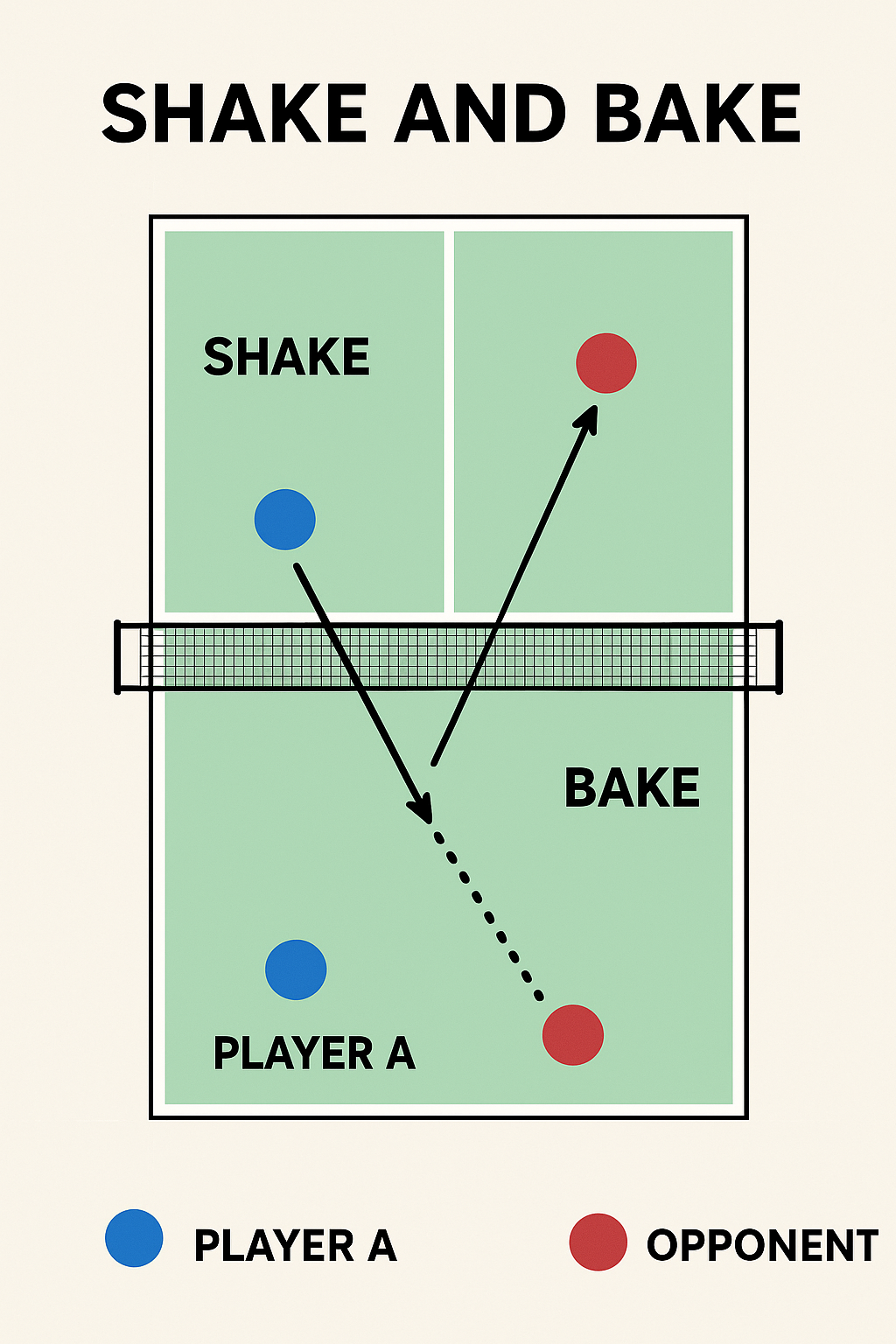
    The “Shake & Bake”, also known as the “Drive and Crash,” is a doubles strategy in pickleball that’s gaining popularity as the sport continues to evolve and become faster. Traditionally, players relied on the third-shot drop to transition to the net. However, with more players favoring a third shot drive, the Shake & Bake is a strategy that you need to study in order to learn how to implement it as well as counter it.

    Before diving into why this strategy works so well, let’s first understand what the Shake & Bake actually is.

    What is Shake & Bake strategy?

    This strategy can only be used by the serving team in doubles pickleball. It works when one player drives the third shot, while their partner “crashes” toward the net. By moving in quickly, the partner at the net is ready to take the fifth shot as a volley, often putting them in an ideal position to finish the point with a winner.

    The key to executing the Shake & Bake successfully is clear communication — the player planning to drive the third shot should let their partner know beforehand. This allows the crashing partner to anticipate the play and position themselves effectively.

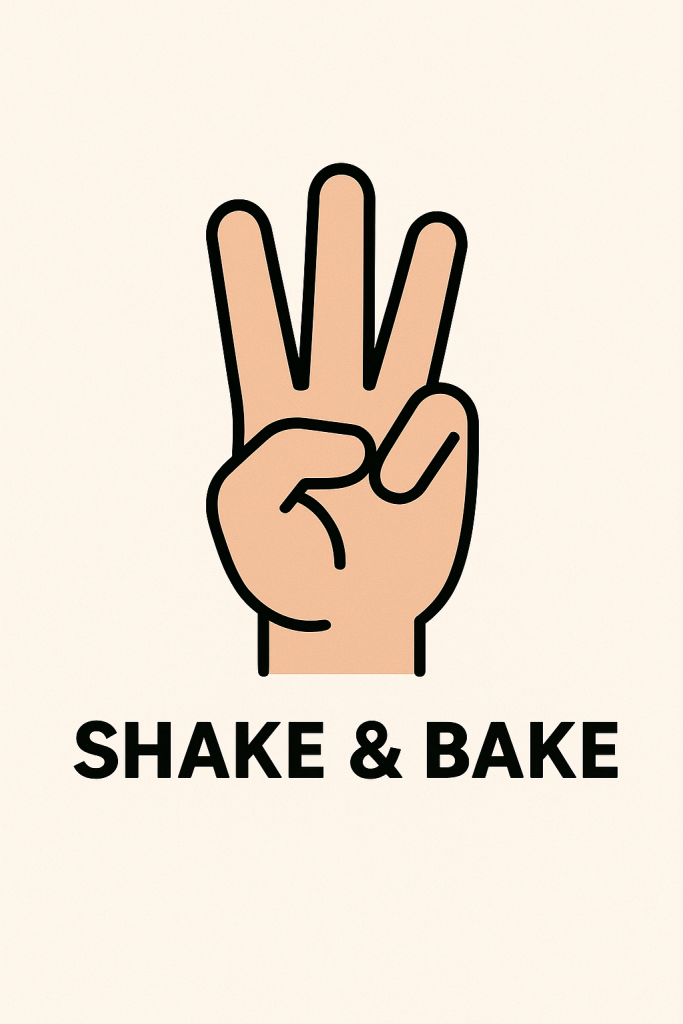
    diagram of a hand sign to signal your doubles partner in pickleball that you want to execute the 'shake and bake' strategy

    In addition to shortening rallies, this strategy helps the serving team build momentum and maintain an aggressive edge throughout the point.

    How to Execute the “Shake & Bake” in Pickleball

    Like any other pickleball strategy, the “Shake & Bake” requires plenty of practice and clear communication between partners to execute it effectively. Once you and your partner establish a reliable routine and build confidence in this play, it can become a powerful weapon to help you win more matches.

    To master the Shake & Bake, there are five key elements you need to focus on.

    1. Hit a Quality Third Shot

    The foundation of a successful Shake & Bake lies in hitting a strong, low, and consistent third shot over the net. A well-driven shot keeps your opponents on the defensive and sets up your partner for an attacking opportunity.

    If the third shot is too high or poorly executed, it gives the opposing team a chance to counter with an aggressive return, often targeting the partner who has crashed toward the net. In that situation, the crashing player becomes vulnerable and has to rely on the infamous “chicken wing shot’ for any chance to get back into the rally.

    That’s why the player at the net must place full trust and confidence in their partner’s ability to deliver a quality third shot that keeps the ball low and difficult to attack.

    2. Have Strong Placement of the Third Shot

    A quality third shot in pickleball is more about placement than power. As mentioned earlier, the third shot should stay low over the net — a high shot gives your opponents an easy opportunity to attack aggressively.

    When driving your third shot, focus on targeting the weaker opponent, especially the one who struggles to handle fast-paced shots or block effectively. Aim for their backhand side or the tricky “chicken wing” area near the backhand-side shoulder. Hitting to these spots often forces a pop-up return, setting up an easy put-away opportunity for your crashing partner.

    Additionally, if your opponents are stacking or switching sides, take advantage by directing your drive toward the player in motion. Players who are moving are more likely to make unforced errors—such as popping the ball up—giving your team the upper hand in the rally.

    3. Move Your Feet to Crash the Pickleball Net

    Remember, the “Shake & Bake” is a set play. This means the partner who is not hitting the third shot must immediately crash or rush toward the net as soon as the third shot is struck.

    The strategy becomes far less effective if the crashing partner hesitates or fails to move in aggressively. Any delay gives the opposing team time to recover and reduces the pressure on them, making it harder to create an opportunity for a winning shot. In other words, if the crashing player is slow to move their feet, the put-away opportunity may never materialize.

    If you’re the crashing partner, focus on quick footwork and get to the Non-Volley Zone (or Kitchen Line) as fast as possible. This position gives you the best chance to attack the fifth shot and, ideally, finish the point.

    However, if you realize — or your partner signals — that the third shot was of poor quality, you should stop your forward momentum immediately. Instead of crashing in, shift to a defensive mindset and prepare for an aggressive return from your opponents.

    4. Try to Set Up the “Right” Partner

    Some pickleball players have exceptional third shots—especially strong, driven third shots—while others excel with quick reactions and fast footwork at the net. Because of this, it’s important to pair the right roles between partners when executing the “Shake & Bake.”

    Ideally, the player with a reliable and powerful third-shot drive should be the one to take that shot whenever possible. Of course, this depends on where the opponent places their return—sometimes the return may land too far across the court for that player to reach.

    Meanwhile, the partner with quick feet and sharp reflexes should be the one to crash toward the net and look to finish the point with a put-away shot.

    It’s also worth noting that it’s often easier for the crashing player when their forehand faces the middle of the court. For example, a right-handed player will have this advantage when positioned on the left (odd) side, while a left-handed player benefits more from the right (even) side. This positioning allows for stronger forehand attacks and better court coverage.

    Finally, remember that the fourth shot is often directed toward the player who stayed back to hit the third shot. That’s why positioning the crashing player with their forehand toward the middle not only improves their attacking potential but also makes the Shake & Bake smoother and more effective.

    5. Communicate with Your Partner

    Always make it a priority to communicate with your partner on the pickleball court — and this is especially important when using the “Shake & Bake” strategy.

    Before the game begins, take a moment to discuss and agree on when to drive the third shot, who will hit it, and who will crash toward the net. Having this plan in place before the point starts helps you avoid confusion or hesitation during play.

    Additionally, if the third shot isn’t executed well, make sure to alert your partner right away. Even a quick heads-up can give them enough time to prepare for a potential aggressive fourth shot from your opponents. Clear, early communication can make all the difference between winning and losing the point.

    The term “Shake & Bake” specifically refers to the strategy where one player drives the third shot, and their partner crashes toward the net to finish the point with a volley.

    You might see a similar movement pattern when the third shot is a drop shot, but in that case, the play is called “poaching.”

    It’s important to understand the distinction between the two terms, as using the right terminology helps ensure clear communication and better coordination with your partner on the court.

    How to Defend Against the “Shake & Bake” in Pickleball

    The “Shake and Bake” is one of the most popular and widely used strategies in pickleball, especially at higher levels of play. Because it’s so common, learning how to defend against it effectively can give you a big boost of confidence on the court — even when facing more experienced or higher-rated opponents.

    So, if you’ve come to HomeforPickleball HQ in search of smart tactics to counter the Shake and Bake, you’re in the right place. Stick around to discover how to turn defense into opportunity!

    Return the Serve with a shot just like your serve

    Players are encouraged to use the “Shake & Bake” only when they receive a weak return of serve, as it’s much easier to drive the third shot when the return comes back slow and high with extra bounce.

    To make it harder for your opponents to use this strategy against you, try hitting your service returns the same way you would hit a solid baseline drive.

    In other words, aim to hit your returns deep and flat. A deep return forces your opponents to generate more power on their third shot, giving you and your partner extra time to react. Keeping the ball low makes them hit upward on the shot, which increases the chances of an error or an out-of-bounds drive.

    This simple adjustment can make your game far less inviting for anyone looking to pull off a Shake & Bake against you.

    Have Smart Placement of the Return of Serve

    As mentioned earlier in tip #4 for executing the “Shake & Bake,” some players excel at hitting powerful third-shot drives, while others have quick reflexes and fast footwork at the net.

    When you’re on defense against this strategy, try to return the serve to the player with the weaker third-shot drive. This player will find it harder to set up an effective Shake & Bake, reducing the pressure on your team.

    Another smart tactic is to target your return toward the more aggressive net-crashing player. By forcing this player to stay deeper in the court to handle the return, you prevent them from rushing forward and applying pressure at the net.

    In short, thoughtful placement of your return of serve can disrupt your opponents’ timing and make it much more difficult for them to pull off the Shake & Bake successfully.

    Hit the Fourth Shot Down

    When your opponents hit a third-shot drive and attempt a “Shake & Bake”, your main goal should be to neutralize the drive.

    To do this, aim to direct the ball down toward their feet. This makes it much harder for them to attack or volley aggressively. If you have good touch and control, you can also try to reset the ball softly into the Non-Volley Zone (or Kitchen), taking away their offensive momentum entirely.

    By keeping your return low and controlled—either at their feet or in the Kitchen—you prevent your opponents from getting a pop-up to attack. In other words, you eliminate the “Bake” from their “Shake & Bake.”

    Hit the Fourth Shot Out of Reach

    Another effective way to neutralize the “Bake” portion of the “Shake & Bake” is to place your fourth shot out of the crashing player’s reach.

    You can do this by aiming your fourth shot toward the sideline of the player who hit the third shot, or toward the sideline behind the crashing player. This is especially effective when that sideline is on the crashing player’s backhand side.

    Most players who crash the net tend to move toward the middle of the court, leaving open space behind them. Since many players also have weaker backhand put-away shots than forehands, hitting to this area can make your opponents uncomfortable and force an error. (Of course, watch out for players with strong two-handed backhands!)

    Lastly, remember to keep your fourth shot low or aimed at the crashing player’s feet. A low shot prevents them from getting the ball above net height—exactly the kind of setup they need for an easy put-away.

    Limit Your Switching or Stacking

    Switching and stacking are advanced doubles strategies used in pickleball to keep each player on their preferred side of the court. However, if you’re playing against a team that frequently uses the “Shake & Bake”, you’ll want to be cautious about using these tactics.

    Stacking and switching require extra movement right after the serve or return. When you’re facing opponents with powerful third-shot drives, that additional movement can increase your chances of making unforced errors.

    If you find that your team is consistently getting beaten by the Shake & Bake while stacking or switching, try staying in your original positions instead. You can even fake a switch and then stay put — this limits your movement and helps you stay more stable and ready to handle the incoming drive effectively.

    Conclusion: Mastering and Defending the “Shake & Bake” in Pickleball

    The Shake & Bake isn’t just another flashy tactic—it’s a game-changing strategy that separates good teams from great ones in modern pickleball. By combining a well-driven third shot with an aggressive net crash, it allows the serving team to seize control early and finish points fast. But just as important as mastering this move is knowing how to defend against it—through deep, low returns, smart placement, and disciplined positioning.

    Whether you’re attacking with confidence or countering with precision, understanding the Shake & Bake can dramatically elevate your doubles play. Keep practicing, communicate with your partner, and soon you’ll be turning this high-speed strategy into a reliable winning weapon on the court.

  • Types of shots played in Pickleball explained

    Types of shots played in Pickleball explained

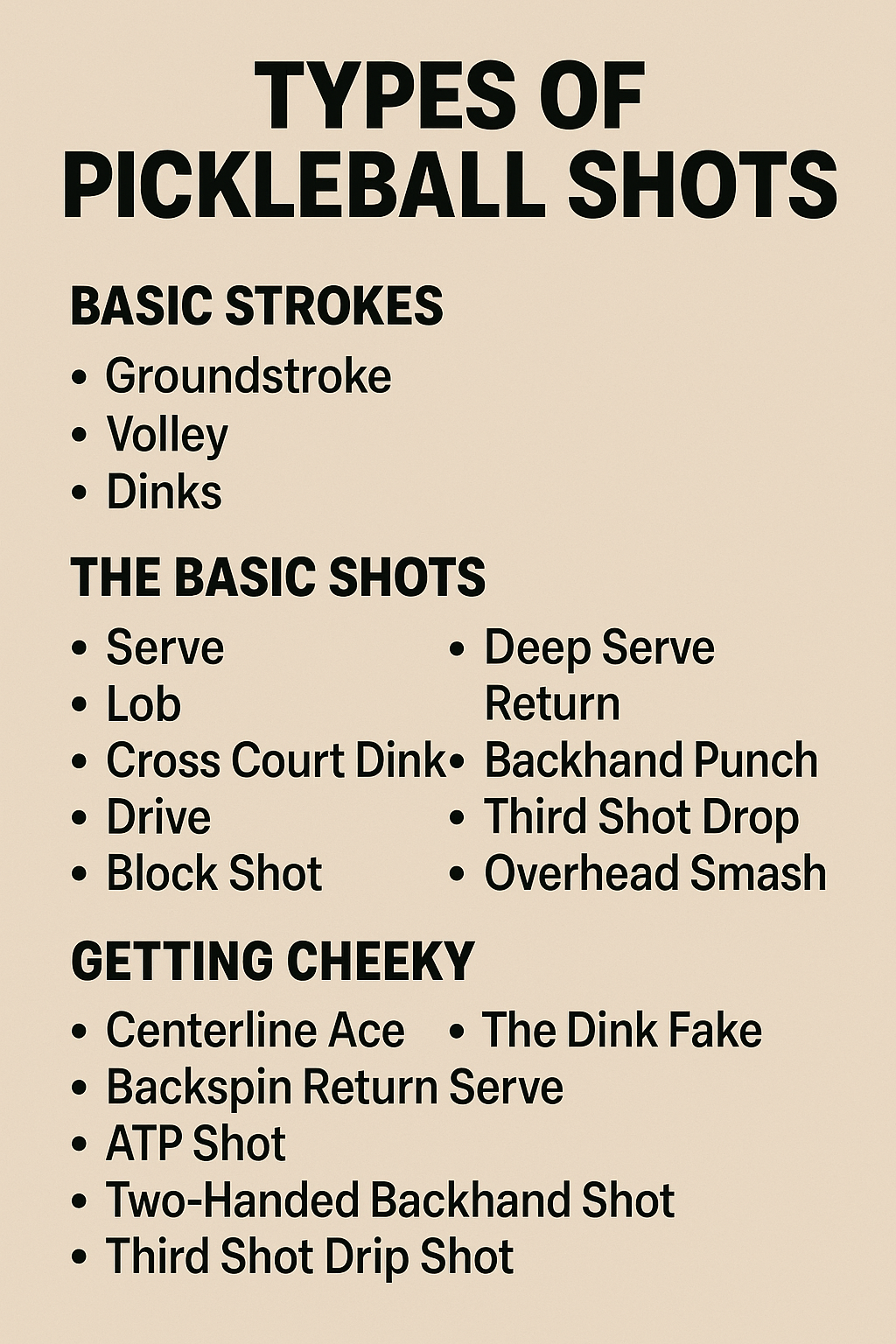
    Pickleball shots are traditional, yet evolving, so what’s better than having a shot named after you, am I right? To answer this question, I will first list and explain all the basic strokes, along with the names of all pickleball shots.

    Once you have learned about all the shots you can play, you can vote below on what is better, is it basic shots or innovative shots? Now Let’s play pickl…. I mean lets take a look at the types of Pickleball shots

    Basic strokes

    A lot of players feel stroke and shot refer to the same this. Knowing the difference between a stroke and a shot will help you with better shot selection and choices. A stroke is basically the action that you perform before making contact with the ball whereas a shot is the aftermatch of a stroke. Strokes in pickleball are of three types: 

    Groundstroke

    Groundstroke is the most common stroke in pickleball as it is a shot you make after the ball has bounced once. Dinks, third shots drops and speed up off the bounce are examples of groundstrokes.

    Volley

    Any shot that is made by directly taking it from the ait is a volley shot. Whether you hit the ball over your head or just near the ground, its a volley as long as the ball does not bounce. Volley strokes will help you return the ball with much more speed towards the opponent, and as we all know the overhead smash is an all time favourite stroke for all pickleball players. However, do not forget the golden rule of Pickleball, No volleying in the kitchen. 

    Dink

    A dink is a type of groundstroke that is exclusive to Pickleball. Dinking is the act where a player aims to land the ball in the opponents kitchen area with the softest of touches.In a match you can use dinking to outplay even the pros, which is one of the reasons why Pickleball is such a high IQ sport.

    If you are new to the game or even a seasoned pro, do check out this complete dink guide that I have curated with the help of some seasoned pros. The guide will surely help you think like the pros when it comes to playing pickleball. Now just to explain in brief, i’ll try to sum up what is dinking in a small paragraph here.

    In pickleball, dinking will help you with resetting the point, regaining momentum of the point and even tire out your opponent into making more errors. To dink a ball correctly all you need to do is push the ball as gently as possibly so that it just falls over the net and lands inside the opponents kitchen area. At first it may feel like a boring stroke but once you start understanding when and why to dink, you will end up doing more dinking drills then any other drills. 

    Golden giveaway on how to think of a dink (the pro’s would charge you $1500 for this), “Use the dink not as a winner but as a stroke that will never lose you a point.”

    How to hit a clean dink? 

    Again, I have compiled a detailed guide on how to hit a clean dink which you would not want to miss out on. The reason I have multiple guides about dinking is because it is the heart and soul of Pickleball, you will find most of the pros to have some sort of racket sport background, so adding a masterful dinking game in your arsenal will ensure an even playing field every time you enter a Pickeball court.

    In a gist, hitting a dink should almost be a soft pushing motion from down to up. You need to be gentle yet sturdy and accurate, similar to a surgeon’s precision. It may sound like a lot and don’t be disheartened if every now and then you offer your opponents a pop-up, remember, Practise is what makes you perfect. 

    The basic shots

    Stick to the basics! This rule also applies to Pickleball, what I mean by that is while Pickleball as a game is evolving with every passing year, i cannot emphasis enough on the importance of mastering the basic strokes of Pickleball. Whether you plan on playing a tournament only once a while or plan on competing every weekend or just want to enjoy a good game of pickleball you need to master the basic strokes.

    The basic strokes include a serve, a forehand drive, a forehand dink, a back hand drive and a back hand dink

    The serve

    Just like any other racket sport, a serve is the first shot that is played in Pickleball. Its the shot that starts the point. As a server all you have to do is perform a underhand motion and hit the point to opponents diagonal box. The ball should bounce ahead of the kitchen line and within the sideline and byline for it to be a legal serve. 

    Once you start getting comfortable with your serves, you will realize it is the shot that will help you set up the entire point, i have written about different service strategies, that you can use to help you take control of a point just with your serve.

    The lob

    The lob shot in pickleball is the rebel child of basic shots. If the execution of a lob is correct it will help you take control of the point but the downside is due to its loopy nature a good opponent can identify it as an easy put away. Hit a lob only when you know you are in a position to deceive your opponents, consider this shot as the least used basic shot on pickleball. 

    How to hit a lob?

    A lob shot is when you you hit the ball high up into the air with the aim of it going over the heads of your opponents and landing inside the court. When your opponents are dominating the kitchen line a lob shot can be your perfect weapon to force your opponents backwards so you can come forward and take control of the kitchen area. However, I strongly advise using the lob once once a while as its success depends on how well you are able to deceive your opponents, lobbing repeatedly will let your opponents read it well and end up hitting easy overhead smashes. 

    Cross-court dink

    Cross-court dink is a shot where you hit the ball on the opposite side of the opponent’s court. It’s call cross court dinking as you aim to land the ball in the opposite kitchen area.

    While the pro’s make it look easy, cross court dinking is actually one of the mist difficult shots to master in Pickleball. You can easily identify the skill level of a player by the way they hit their cross court dinks. This stroke is so important and effective that it also brough about the invention of a two handed cross court dink.

    The drive

    A drive in Pickleball is a shot that you hit with power, whenever you hit groundstroke or volley with power it is a drive shot.

    Drives are the most popular shots in pickleball as everybody fancies their chances when they get an opportunity to hit the ball as hard as possible. But the real trick to hitting a clean drive is use only 70% power and 100% placement. 

    Block shot

    The block shot in pickleball simply refers to a shot which is used to counter third shot drives or just regular drives and force your opponents to stay as far away from the kitchen line as possible. Most pickleball players possess a good drive shot so drilling a block shot will give you an added advantage out on the court.

    Hitting a block shot requires courage and that’s it. All you need to do is stand outstretched and face your paddle in a backhand position towards an incoming drive, have a premeditated position where you want to land the ball in the opponents court and thats it. Use the incoming ball’s power to hit a block shot, you do not want to use any force at all. Hold the paddle loose but keep your wrist cocked. At first you may seem weary of doing this so drill this scenario with a partner to build up that confidence of hitting block shots

    Deep return serve

    As the name reads, A deep return serve shot means you are hitting a serve return deep into the opponents court.

    A deep return of serve does not need to be a powerful shot, infact it is better if it is loopy and as close to the base line as possible. Read these two guides on understanding advances pickleball strategies and How to return a serve deep in Pickleball to learn more on this.

    The easiest way to begin is to have a friend/coach place cones in their court at different positions then hit a serve at you and you return the serve near those cones.

    Backhand punch

    In pickleball most shots are named after its literal meaning and a backhand punch shot follows this trend. When you are at the net and it is possible to take the ball out of the air simply hold your paddle in a backhand position and punch facing the paddle head downwards. This shot gives you the opportunity to hit a potential winner as it catches your opponent offguard. If not a winner, since you are targeting the opponents feet, they will be forced to hit down to up leading to an easy put away ball which you can finish with the next shot.

    Overhead smash

    Ah yes, the one shot which makes us feel on top of the world. I don’t think this shot needs any describing but for the sake of professionalism I need to write a few words about it. The overhead smash is a shot that is made by taking the ball on the volley and smashes into your opponents court, but do remembed you cannot hit a volley by stepping in the kitchen, even your follow through after hitting a volley cannot enter the kitchen orelse the point is rewarded to your opponent. 

    If your overhead smashes lack power or accuracy it maybe due to wrong mechanics, but ofcourse I have  solution for it, read my overhead smashing guide and in no time you will transform it as a winner shot.

    Third shot drop

    As the game evolves, players and coaches now recommend a fifth shot drop rather than a third shot drop, that being said, I still recommend utilizing the third shot drop almost everytime especially if you have just made that jump to advanced pickleball play. This shot is hit in a soft arc with the goal to land the ball in the opponents kitchen, if done correctly it will force the opponents to wait for the ball to bounce, and you will get an easier return and, in turn, take control of the point. Initially, you will hit a lop of loppy balls when you try a third shot drop but like any other skill, with practice and confidence, you will soon be hitting clean third shot drops. 

    Advanced level drop shot tips: When you are at the baseline, hit the ball 6ft high in the air with a soft touch; mathematically, it has to land in the opponent’s kitchen area. There are many more such tips which I couldn’t fit in this article, so I compiled a complete third shot drop shot guide which will help you think like a pro pickleball player

    Getting cheeky

    Before reading further, pay emphasis on the word ‘cheeky,’ these are the shots that would give you a Gael Monfils reputation on a Pickleball court, they are unorthodox, deceptive, and ensure you have the most fun on court while still managing to win the point. Use these shots sparingly, as they are high risk high-reward shots. Even the pro players stick to the basic first and only then go for the cheeky shots

    Centerline ace

    This shot is a serve in which you hit the ball with power while applying heavy topspin on the ball, if done correctly the ball will land low on the centerline and takes off after bouncing which makes it difficult for your opponent to return the serve. It’s most effective when you are constantly serving to the opponents backhand so to protect their backhand they leave a big gap open down the middle.

    There are times your opponent will not even move if your serve is accurate enough, out of all the cheeky shots, I highly recommend that you practise this shot.

    The dink fake

    Just like the name states, a dink fake is when you act like you are going to hit a simple dink but instead you hit a heavy drive which catches your opponent off guard, resulting in them making an unforced error. 

    If you are able to make this shot correctly it can be your x factor shot in Pickleball doubles. The reason it is difficult to make this shot is because a good dink fake requires minimum backswing, so not too many players are able to generate enough topspin and power with less backspin.  

    The key factors for you on when to hit this shot are

     1. Ensure that the ball is just above net height after it has bounced

    2. The ball does not have any spin on it (better if it is a dead dink)

    3. Your body position needs to resemble that of when you hit a dink

    4. Where you aim the speedup off the bounce is important; the safest option is on the body of your opponent, so even if your shot is going out, they have less time to duck and leave it.

    Backspin return serve

    A backspin return serve is when you return the turn with a top to down motion rather than the down to top swing. It is similar to a slice return expect that with this shot the ball will have more backspin to it.

    This shot is effective when you realize that your opponents serves are high and slow. If you hit this shot correctly, the ball will have a lot of sidespin to it which will make even the best of players hit a foolish looking shot, this will give you a great advantage on the next shot or it can even lead to a direct point. 

    The perfect place to land this shot is for you to aim it at the extreme corners of the opponents kitchen area. If you have a super spinny paddle then you should definitely try making this shot.

    Around-the-post shot

    When you go around the post and make a shot you will have hit an ATP which will make you the most popular pickleball player in your picklers group. Pro players hit this shot with ease and by now we should not be surprised that 4 out of 10 ATP’s are countered quite easily. This is because pickleball players today focus more on fitness and do many pickleball agility drills to be so nimble on court.

    If you want to feel like a gladiator wosrshipped in the colosseum then hit an ATP in front of all the people in the stands, be it 2 or 200 , I can bet that all of them will clap in awe. But remember, the only time you want to be hitting this shot is when an opponent it constantly cross court dinking with you, simply let the ball go as far as possible from the net and then make contact with the ball just before it is about to touch the ground, the low angle will force your opponents to backpedal resulting in them making an error. The key to hitting a perfect ATP is to wait for the right cross court dink and perfect footwork.

    You dont want to be attempting atp’s to every cross court dinks as most have heavy spin on them which will ntomally force your shot onto the side post.

    Two-handed backhand dink

    This shot is just like a two-handed drive, except you hit it as a dink, it is the most effective dink shot for placement and accuracy. If you hold your paddle with its head upright, you can also add a lot of top spin to your dink. 

    When you are stuck cross court dinking with an opponent who is sending their dinks with heavy top spin, a two handed backhand dink is arguably the best defence you could ask for. Fair warning, though, to perfectly execute this shot you need to have good footwork. 

    Third Shot Drip shot

    A third shot drip shot is a hybrid of a third shot drop shot and a third shot drive. If executed correctly, it will land in the kitchen area with a lot of speed, this catches your opponent off guard and forces then to hit the ball into to net or offer a pop up.

    The third shot drip shot is quickly becoming a fan favorite and the go to third shot for the next generation pickleball players.