Category: Paddle Review

Find the perfect paddle for your play style by exploring in-depth reviews, comparisons, and expert insights to help you choose the best suited paddle just for you.

  • Explaining How Pickleball Paddles Are Made

    Pickleball paddles may look simple on the surface, but there’s a surprising amount of engineering packed into each one. Behind the graphics and marketing claims, paddle performance is shaped by a series of deliberate design choices, such as how the core is built, how the face layers are stacked, how weight is distributed, and how everything is bonded together.

    Today, there are roughly twenty major paddle brands and countless off-brand manufacturers producing hundreds of paddle models. While many of them use similar language to describe power, control, and spin, the actual differences come down to how the paddle is made, not how it’s marketed.

    This guide is not a paddle buying guide. Instead, it’s a technical breakdown of how pickleball paddles are constructed, written to help you understand what’s happening inside the paddle and not just how it feels when you hit with it. By the end of this article, you’ll know how to read a paddle spec sheet, understand common construction terminology, and recognize how specific materials and build methods influence performance on the court.

    This is a detailed, behind-the-scenes look at paddle design, so if you enjoy learning how equipment works at a deeper level, you’re in the right place. And if you’d rather skip the engineering side and focus purely on choosing the right paddle for your game, I also have a separate guide that covers that approach in a more performance-driven way.

    The Core Elements That Define Pickleball Paddle Construction

    After reviewing and testing paddles consistently since 2024, I’ve found that five factors account for the vast majority of how a paddle performs. While marketing materials often emphasize surface grit or cosmetic design, these five elements tell you far more about real-world playability:

    1. Core thickness and core material
    2. Paddle shape
    3. Facing materials and layup configuration
    4. Weight distribution (static weight, swingweight, twistweight)
    5. Construction method

    When you understand how these elements work together, you can look at almost any paddle spec sheet and form a very accurate expectation of how that paddle will feel and perform.

    Core Thickness and Core Material (The Most Important Spec)

    If you only focus on one paddle spec, it should be the core. Core thickness and material influence feel, control, forgiveness, stability, and power more than any other factor.

    Core Thickness Explained

    Most modern pickleball paddles range from 10mm to 20mm thick, but the vast majority fall into either the 14mm or 16mm categories.

    Thick Core Paddles (16mm and Above)

    A 16mm core is widely considered the modern standard. Thicker cores absorb more impact energy, resulting in:

    • A softer feel
    • A larger sweet spot
    • Better stability on off-center hits
    • Reduced vibration and shock

    Also Read: Best 16mm core paddles

    These paddles are generally easier to play with, especially in doubles, kitchen exchanges, and defensive situations. The tradeoff is reduced maneuverability and slightly less pop on quick hands battles.

    Paddles thicker than 16mm are uncommon but can be useful in edge-guard-less designs where additional thickness adds stability.

    Thin Core Paddles (14mm)

    Fourteen-millimeter paddles feel faster and more responsive. They offer:

    • Increased pop and ball speed
    • Better maneuverability
    • Quicker reaction at the net

    However, thinner cores usually sacrifice forgiveness and stability, especially on mishits. They tend to suit aggressive players who generate their own control and value speed over plush feel.

    General rule:

    • Thicker core = control, forgiveness, comfort
    • Thinner core = speed, pop, offense

    Also Read: Best 14mm core paddles

    Core Material Types

    Core material determines how impact energy is absorbed and returned to the ball.

    Polypropylene (Polymer) Honeycomb Core

    Polypropylene honeycomb cores have dominated pickleball paddle construction for years. While they all look similar, performance varies based on several internal factors:

    • Honeycomb cell size:
      Larger cells increase rebound and power but reduce consistency. Smaller cells feel denser and more controlled.
    • Cell wall thickness:
      Thinner walls increase pop; thicker walls dampen power.
    • Polymer density:
      Softer polymers feel livelier, while rigid polymers feel muted and controlled.

    Manufacturers rarely disclose all of these details, which is why two polymer paddles with identical thickness can feel completely different.

    Some paddles also include foam injected around the perimeter of the polymer core. Depending on placement and density, foam can improve stability, reduce vibration, or slightly increase power.

    Full Foam Core Paddles

    Introduced in 2025, full foam core paddles replace the honeycomb structure with a solid foam interior. This design offers:

    • A softer, more consistent impact feel
    • Improved durability
    • Better retention of performance over time

    While foam cores are still evolving, early designs suggest they may solve long-standing durability issues seen in polymer cores.

    Paddle Shape and How It Affects Performance

    Paddle shape directly impacts reach, forgiveness, swing feel, and balance. According to USAP rules, the combined length and width of a paddle cannot exceed 24 inches. Within that limit, three dominant shapes have emerged.

    Common Pickleball Paddle Shapes

    Elongated Paddles (≈16.5” x 7.5”)

    Elongated paddles offer:

    • Extra reach
    • Higher swingweight
    • Increased leverage for power and spin

    The downside is reduced forgiveness and increased head heaviness, which can make them more demanding to use.

    Hybrid Paddles (≈16.25” x 7.5–7.7”)

    Hybrid paddles balance reach and forgiveness. They:

    • Feel more neutral in hand
    • Offer good power without extreme head heaviness
    • Work well for both singles and doubles

    Widebody / Standard Paddles (≈16” x 8”)

    Widebody paddles prioritize:

    • Forgiveness
    • Maneuverability
    • Larger sweet spots

    They sacrifice some reach but are excellent for control-oriented players and fast hands at the net.

    Shape Recommendation

    For most recreational and intermediate players, hybrid and widebody paddles are the best choice. Paddle technology has advanced to the point where power is available in every shape, making elongated paddles less necessary unless extra reach is a priority.

    Also Read: Best Paddles for Beginners

    Paddle Face Materials and Layup Design

    The paddle face determines how the ball interacts with the surface, influencing feel, spin, and power.

    Common Facing Materials

    • Carbon Fiber: Best balance of control, spin, and consistency. T700 carbon fiber is the current gold standard.
    • Fiberglass: The most powerful material, but harsh feeling with a smaller sweet spot.
    • Kevlar (Aramid): Slightly more powerful than carbon fiber with a firmer feel.
    • Titanium (Polyester Weave): Softer, muted feel with reduced pop—ideal for control paddles.

    Facing Layups Explained

    Most paddles use multiple layers of material. Common configurations include:

    • Carbon / Carbon / Fiberglass: Control on soft shots, power on full swings
    • Carbon / Fiberglass / Carbon: Easier access to pop
    • Carbon / Carbon / Carbon: Maximum consistency and sweet spot size

    Layup design allows brands to fine-tune how a paddle behaves across different shot types.

    Weight Distribution: Static Weight vs Swingweight vs Twistweight

    Static weight tells you how heavy a paddle is overall, but swingweight and twistweight are far more important.

    • Swingweight: How heavy the paddle feels when swinging. Higher = more power, slower hands.
    • Twistweight: Resistance to twisting on off-center hits. Higher = larger sweet spot.

    Ideal Ranges for Most Players

    • Swingweight: 112–118
    • Twistweight: 6.0 or higher

    Elongated paddles usually have higher swingweight and lower twistweight, while widebody paddles feel quicker and more forgiving.

    Pickleball Paddle Construction Methods

    Construction method influences feel and durability, but should not outweigh core, shape, or weight distribution.

    • Cold Pressed (Gen 1): Plush feel, excellent durability
    • Light Thermoformed (Gen 1.5): Added foam perimeter, control-focused
    • Full Thermoformed (Gen 2): More power and rigidity
    • Dual Foam Edge (Gen 3): Increased perimeter stability
    • Full Foam Core (Gen 4): Enhanced durability and feel consistency

    Newer does not always mean better; each method serves different play styles.

    Final Thoughts

    Modern pickleball paddles are far more complex than they appear. What looks like a simple slab of composite material is actually a carefully engineered system built from specific core materials, layered face constructions, controlled weight distribution, and distinct manufacturing processes.

    Understanding how pickleball paddles are made removes much of the mystery behind why paddles feel different from one another. Core thickness explains softness and stability. Face materials determine feel and spin. Weight distribution dictates maneuverability. Construction methods also influence durability and long-term performance.

    You don’t need to memorize every specification to appreciate paddle design, but knowing how these elements work together gives you a clearer picture of what’s happening inside the paddle every time the ball makes contact.

    As paddle technology continues to evolve with foam cores, new face materials, and hybrid construction methods the best way to stay informed is to understand the fundamentals of paddle manufacturing. Once you do, spec sheets become meaningful, marketing claims become easier to evaluate, and paddle innovation starts to make a lot more sense.

    FAQ’s

    What materials are pickleball paddles made from?
    Most paddles use a polymer or foam core combined with carbon fiber, fiberglass, kevlar, or titanium face layers.

    How are paddle layers bonded together?
    Layers are bonded using pressure and heat (thermoforming) or adhesives (cold pressing).

    Why do some paddles lose performance over time?
    Polymer cores can collapse slightly with repeated impact, reducing pop and feel.

    Are foam-core paddles more durable?
    Early data suggests foam cores retain their shape and performance longer.

    Does thermoforming make a paddle better?
    Not necessarily. It changes feel and power, but doesn’t guarantee better performance for every player.

  • Detailed Review of the PaddleTek Bantam TKO-CX

    Detailed Review of the PaddleTek Bantam TKO-CX

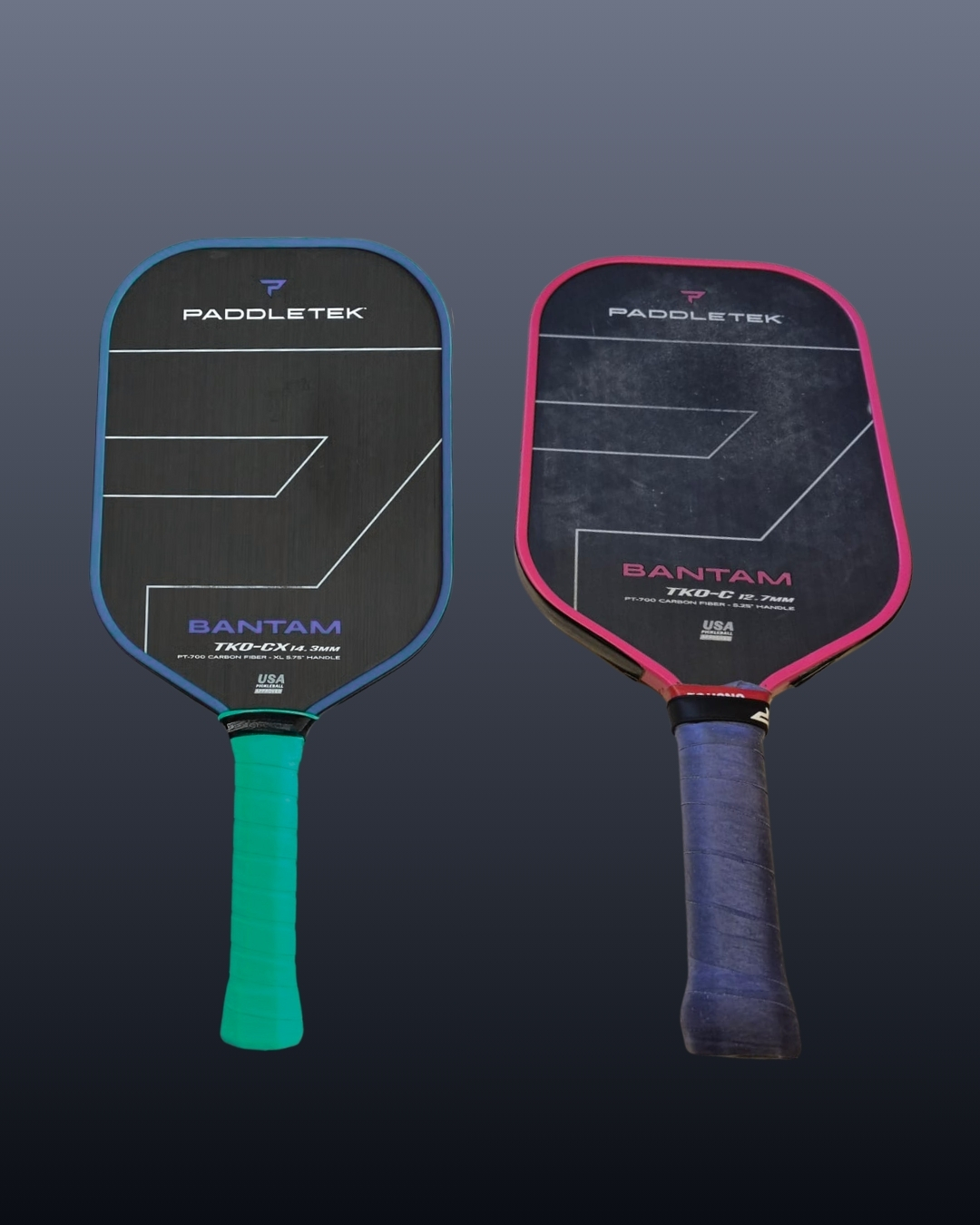
    I used both the 14.3mm and 12.7mm versions of the Paddletek Bantam TKO-CX, and hands down, this is one of the most stable pickleball paddles I’ve used to date. At its price point, it’s a serious dark horse among professional paddles, especially for players who value consistency and predictability under pressure.

    This paddle doesn’t rely on hype or exaggerated power numbers. Instead, it delivers something far more valuable: trust. Whether you’re blocking at the kitchen or driving from the baseline, the paddle behaves the same way every time.

    To test the Bantam TKO-CX, I used both the 12.7mm and 14.3mm models for about two weeks. During the course of this period, I did several drills as well as played rec games with it. Since a local tournament organized by my buddy also took place during the two weeks, I ended up playing a 4.5 DUPR-rated singles tournament with the 12.7mm version as well. I’ll discuss the specs below in this article, but that apart from that, solely based on personal use, I personally would recommend this paddle to players of all levels and particularly to those players who need a paddle that is durable even after playing in competitions.

    First Impressions on Court

    The first thing I noticed was the twist weight. Even on off-center hits, the paddle face stayed remarkably square. There was no flutter, no unexpected deflection, just clean contact.

    The elongated shape adds reach, but what stood out more was the balance. Neither version felt overly head-heavy or whippy, which made transitions at the kitchen feel natural.

    But as you all know, I love customizing all the paddles I use, so I did add tungsten tape to the throat of this paddle as well, at first I did add tungsten tape to the top half of the 12.7 version, but it wasnt needed, as I did not feel any visible difference in dead spot contacts. Overall, right from the get-go, both versions of the PaddleTek Bantam TKO-CX performed well, and I did not feel the need for a break in period with them.

    12.7mm Version

    The 12.7mm Bantam TKO-CX is the more aggressive of the two. You’ll need some time working on dropshots and dinks, but if you are getting caught often during fast hands, this is the tool that will help you fix it.

    • Swing Weight: Medium, quick through the air
    • Dwell Time: Shorter, more direct
    • Twist Weight: Excellent for a thinner core

    Baseline drives came off crisp and penetrating, but never out of control. Counter-attacks felt sharp, especially on backhand punches. You do feel the ball leave the face quicker, so touch shots require a bit more discipline.

    This version suits players who like to dictate rallies without using a paddle that feels jumpy.

    14.3mm Version

    The 14.3mm version is where the paddle truly shines for doubles play. Although it is a head-heavy paddle, I would not recommend it if you have wrist issues or a weak wrist in general.

    • Swing Weight: Slightly higher but still very manageable
    • Dwell Time: Noticeably longer
    • Twist Weight: Outstanding

    Dinks stayed low. Drops landed exactly where I aimed them. Blocks against hard speed-ups felt effortless, and backhand counters stayed compact instead of flying long.

    If you spend most of your time at the kitchen or rely on resets and placement, this is the safer and smarter choice.

    Dwell Time, Twist Weight & Swing Weight Explained

    One of the reasons the Bantam TKO-CX plays so consistently is how well these three factors are balanced:

    • Dwell Time: Enough to guide the ball without feeling mushy
    • Twist Weight: Keeps the paddle face stable on mishits
    • Swing Weight: Balanced so you don’t feel rushed in hands battles

    This combination makes the paddle extremely forgiving, especially late in long matches.

    Materials and Paddle Technology

    PT-700 Raw Carbon Fiber Face

    The unidirectional PT-700 carbon face provides a clean, predictable response. Spin is solid without feeling overly gritty, and the feedback is crisp without being harsh.

    Bantam QRT Polymer Core

    Paddletek’s Quick Response Technology polymer core activates progressively. Swing harder, and you get power; gear down, and you get control. This is why both thicknesses feel usable across different play styles.

    PT-07 Matrix Stabilization Layer

    This internal layer improves consistency across the face and plays a major role in the paddle’s high twist weight and stability.

    Edge Guard & Construction

    The shock-absorbing edge guard reduces vibration and adds durability without deadening the feel.

    What I really like about PaddleTek is that they offer an additional discount for US Army officials, which is a good gesture, as Pickleball is all about spreading joy in the world. Apart from this, from a customer perspective, I really like the price point of the Bantam TKO series. Without being biased, this paddle is truly one of the best on the market.

    Please note: Here, I am not describing what the technology does; I am explaining how the paddle performs due to the technology that is used.

    Handle, Grip, and Ergonomics

    The 5.75″ handle is a big plus, especially for players using two-handed backhands. It adds leverage on drives and helps with reach without sacrificing control.

    Grip circumference sits around 4.25″, which works well for most players. The stock grip has good tack and cushioning, though adding an overgrip fine-tunes the feel even more.

    Pricing

    In terms of pricing, the Paddletek Bantam TKO-CX typically retails at $249.99 USD for both the 12.7 mm and 14.3 mm models, which places it squarely in the pro-level pickleball paddle category. That price reflects its premium carbon construction, elongated shape, and performance-focused design. At the moment, the PaddleTek website is running a $50 off, offer, dropping the price to the $199–$200 range. At that discounted rate, the TKO-CX stands out as exceptional value, especially when you consider that many paddles with comparable technology and build quality are priced well above $250. For players looking for a reliable, tournament-ready paddle without paying top-tier prices, this deal makes the Bantam TKO-CX a very smart buy.
    Please Note: Mentioning the prices in dollars as the paddle is currently not sold outside the US.

    Who Should Use the Paddletek Bantam TKO-CX

    • Doubles players who value stability and resets
    • Players who struggle with paddle twisting on mishits
    • All-court players who want a predictable response
    • Anyone looking for a pro-level paddle without paying premium prices

    Bantam TKO-CX vs Joola Perseus 3s vs Engage Pursuit Pro 1 Innovation vs Six Zero Double Black Diamond

    PaddleCore ThicknessPerformance FocusBest ForApprox. Price
    Paddletek Bantam TKO‑CX 12.7 mm12.7 mmQuick, poppy power + stable spinAggressive baseline / speed playMid-High
    Paddletek Bantam TKO‑CX 14.3 mm14.3 mmBalanced power + finesse, more dwellAll-court playersMid-High
    Engage Pursuit Pro1 Innovation12.7 / 15.2 mmSpin + variable power controlVersatile playersMid-High
    Six Zero Double Black Diamond~16 mmTouch + controlKitchen dominanceMid
    JOOLA Perseus 3SPremium corePower + spin mixPower playersPremium

    Final Verdict

    The Paddletek Bantam TKO-CX is quietly one of the most dependable paddles on the market. It doesn’t chase trends, but it absolutely performs where it matters consistency, stability, and confidence in tight moments.

    If you’re tired of paddles that feel unpredictable under pressure, the TKO-CX is worth serious consideration.

    FAQ

    Is the Paddletek Bantam TKO-CX good for beginners?

    It’s better suited for intermediate to advanced players, but confident beginners who value control and stability can grow into it.

    Which version is better: 12.7mm or 14.3mm?

    The 12.7mm offers more pop and quicker response. The 14.3mm provides better touch, control, and forgiveness — especially for doubles.

    Does the TKO-CX have good spin?

    Yes. The raw carbon face provides reliable spin, though it’s more about placement than extreme RPMs.

    Is this paddle head-heavy?

    No. Both versions feel well balanced with controlled swing weight.

    Is the handle good for two-handed backhands?

    Absolutely. The 5.75″ handle length is one of its strengths.

    How durable is the Paddletek Bantam TKO-CX?

    Very durable. The carbon face and core hold up well over extended play with minimal performance drop-off.

    Is the paddle worth the price?

    At its price point, it offers excellent value compared to many higher-priced “power” paddles.

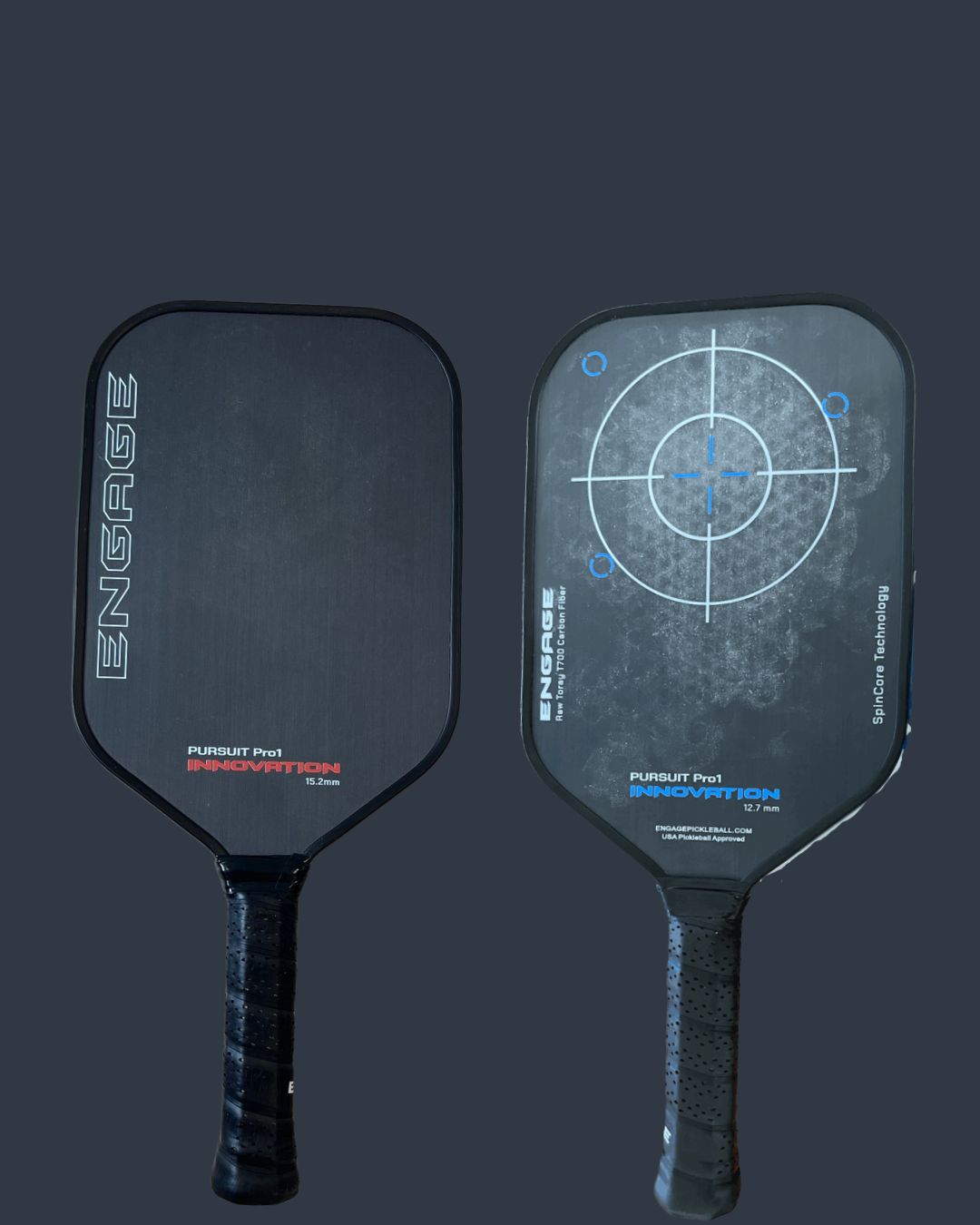
  • Detailed review of the Engage Pursuit Pro1 Innovation paddle

    Detailed review of the Engage Pursuit Pro1 Innovation paddle

    I spent a little over two weeks switching between the 12.7 mm and 15.2 mm Engage Pursuit Pro1 Innovation paddles, and my experience with the two couldn’t have been more different. I’ll start with the obvious: the 12.7 mm is noticeably more head heavy, and because of that, I naturally gravitated toward it for singles. The 15.2 mm, on the other hand, felt surprisingly lighter in hand, well, not actually lighter in weight, but much better balanced, making it the easy pick for doubles pickleball

    First Impressions

    The first thing that caught me off guard was the handle. It’s thinner than almost anything else I’ve used, and I ended up putting an overgrip on it immediately. Without it, my hand felt like it was pinching the paddle instead of holding it. The shape is nice, the length is good, but out of the box, the grip is lean.

    Once I got past that, the differences between the two models started showing quickly.
    Another modification that I made was to add lead tape to the throat of both versions of the paddle, as I am a control-oriented player you will find that I make this modification to all the paddles I use while collecting data for my review articles. For the 15.2mm paddle I ended up using tungsten tape and added strips from the throat to the center of the paddle as this allowed me to unlock a larger sweet spot on the paddle while maintaining control as well.

    12.7 mm — The Baseline Bully

    This version really shines from the back of the court. The extra head weight gives you that satisfying snap on drives, and you can shape the ball into some wicked corners if you get the timing right. During singles, I was hitting those deep heavy drives that force your opponent off balance, exactly what you want.

    However, the trade-off shows up immediately when you move into the soft game.

    My dinks started floating higher than I wanted, my drops weren’t dipping enough, and during fast-hand battles, the head weight made me feel just half a beat slower. Not slow-slow, but just enough to lose exchanges I’d normally win.

    For singles, though? I loved it. It felt like a weapon. You need to be comfortable sacrificing a bit of touch.

    15.2 mm — The Doubles Workhorse

    Switching to the 15.2 mm was honestly a little confusing at first because it felt lighter than the 12.7 mm, which is the opposite of what you’d expect. But it comes down to how evenly the weight is spread out. It doesn’t tug your arm forward the same way, and because of that, it’s a lot easier to control on short balls.

    I noticed the difference in touch right off the bat (pun intended). My dinks stayed low, my drops actually landed where I wanted, and my backhand punches didn’t sail long the way they sometimes do with stiffer paddles. And when the game sped up, this version really came alive. My hands felt quicker, cleaner, and more in control.

    Power-wise, it’s not as naturally explosive as the 12.7 mm. Drives and serves still carried good depth, but you don’t get that automatic “ball jumps off the face with shape” feeling. But honestly, for doubles, I’d rather have control than violent power, and that’s what the 15.2 mm gives you.

    Technology Breakdown

    Engage packs a lot of tech terms into their marketing, but here’s what actually matters on court:

    Power Flex Polymer Core

    This is the heart of the paddle. It gives the paddle a slightly longer dwell time, meaning the ball lingers for a split second. Not mushy, not overly soft — just enough to help with control. It takes a couple of sessions to fully get used to, but once you do, it becomes predictable in a good way.

    Raw Toray T700 Carbon Fiber Face

    Great spin, great ball bite. You’ll notice it more on drives and heavy drops than on trick shots.

    Optimized Twist-Weight & Torque Acceleration

    This helps with stability on off-center hits and contributes to the pop on the 12.7 mm version. It cuts down the vibration and gives the paddle a very “connected” feel.

    Durability

    Engage paddles have always held up well for me. With this one, I’ve seen people get a year or more comfortably. Grit starts wearing around month eight, but it’s still very playable. For the price (especially when discounted), it’s a solid long-term paddle.

    Comparison With Similar Paddles

    PaddleStrengthsWeaknessesBest For
    Engage Pursuit Pro1 Innovation (12.7/15.2)Great spin, choice of power vs control, excellent dwell timeThin handle, 12.7 mm soft game needs practiceSingles (12.7 mm), Doubles (15.2 mm)
    Paddletek BantamSolid feel, dependable controlNot as much spin or shaping abilityPlayers who want a classic feel with modern pop
    Six Zero Double Black DiamondInsane stability, clean controlNot the most powerful paddleControl-heavy, doubles-focused players
    JOOLA Perseus 3SBig power + modern carbon faceCan feel stiff to some playersPlayers who like a firmer, more aggressive paddle

    Please note: I have made this comparison table based on how similar the Engage Pro1 Innovation paddles feel to the paddles I have used

    Final Thoughts

    What I liked most about the Pro1 Innovation line is that the two thickness options feel like two genuinely different paddles, not just “more or less foam.”

    • If you’re a singles player, the 12.7 mm does almost all the heavy lifting for you.
    • If you’re a doubles player, the 15.2 mm gives you control and confidence exactly where you need it.

    At its discounted price point, it’s an easy paddle to recommend — especially if you’ve been wanting something that blends modern spin with a clean, controlled feel.

    FAQs

    Is the Engage Pursuit Pro1 Innovation USAP approved?

    Yes, the Pro1 Innovation line is USAP-approved for competitive play. Both the 12.7 mm and 15.2 mm models meet approval standards.

    What’s the difference between the 12.7 mm and 15.2 mm versions?

    The 12.7 mm is more head-heavy, offering more pop and shape on drives, making it better for singles. The 15.2 mm has a more even weight distribution, giving you better touch, softer control, and quicker hands for doubles.

    Which version is better for spin?

    Both use a Raw Toray T700 carbon face, so spin is strong on both. The 12.7 mm may feel slightly spinnier on aggressive swings due to its head-heavy balance.

    Is the handle comfortable?

    The handle is on the thinner side, and many players add an overgrip immediately for comfort and better hold.

    How does the paddle perform in the soft game?

    The 15.2 mm performs noticeably better for dinks, drops, resets, and fast hands. The 12.7 mm can make soft play trickier due to its swing weight.

    Does the Engage Pursuit Pro1 Innovation have good power?

    The 12.7 mm definitely does it produces crisp drives and deep serves. The 15.2 mm has controlled power, not overwhelming, but enough for consistent depth.

    How long does the paddle last?

    Expect well over a year of durability. Surface grit starts wearing after 7–8 months, depending on play volume, but the paddle remains very playable.

    Is the Pursuit Pro1 Innovation good for beginners?

    It can be, but beginners may find the 12.7 mm a little too lively. The 15.2 mm is friendlier thanks to its control-focused feel and stability.

    How does the paddle compare to other top paddles?

    It offers more customization (power vs control versions) than most, strong spin, and one of the more predictable cores. If you like a paddle with a balanced feel and modern carbon performance, it competes well.

    Is it worth the price?

    At its retail price itself, I would recommend this paddle, and at discounted pricing, it’s a great value, especially for beginners and intermediate players

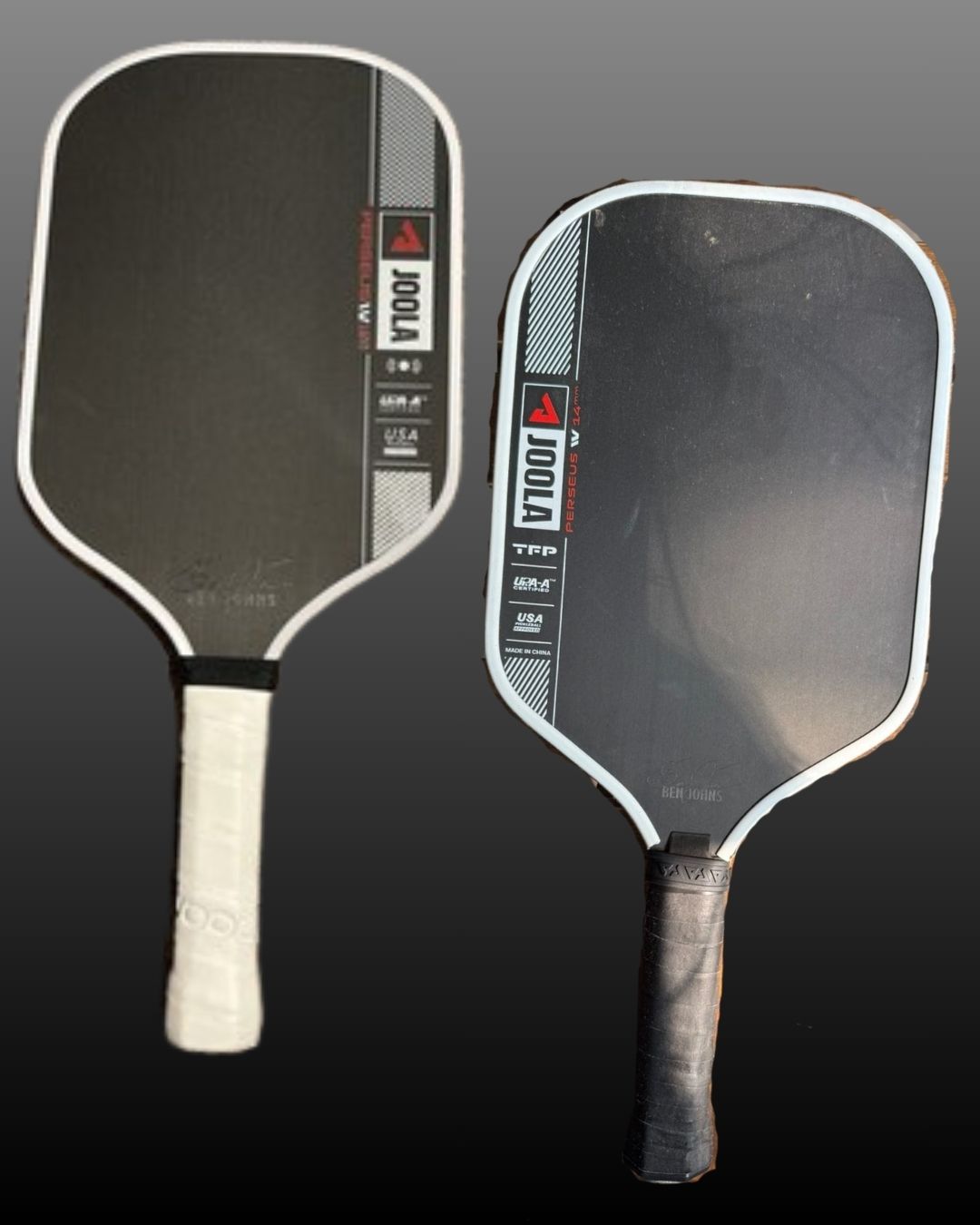
  • Detailed review of the Joola Ben Johns Perseus IV paddle

    Detailed review of the Joola Ben Johns Perseus IV paddle

    After putting both the 14mm and 16mm Joola Perseus Pro IV paddles through six months of hard, competitive use, combined with regular drilling sessions, rec play, and even a few tournaments I feel confident saying this: these paddles are not everyone’s cup of tea, and yes even a pro player will need time to adapt to this paddle. However, once you find your rhythm with this paddle, you will begin to love the game even more.

    Both versions require a genuine break-in period, which honestly caught me off guard at first. The first few sessions felt stiff, almost like the paddles were holding back their real personality. But once you push through that 5–6-session drilling phase (yes drills, not just casual games), the Perseus Pro IV becomes a completely different beast.

    And the sound I have to give it to Joola, no other paddle comes close to that crisp silenced gunshot like sound when a pickleball meets the sweet shop of the Perseus pro IV. There is no better feeling than when your paddle makes good connection with a pickleball.

    On-Court Performance After Break-In

    Once fully broken in and dialed, both the 14mm and 16mm models of the Joola Perseur Pro IV really start to shine. Drives effortlesly sail off the paddle with serious pace and low trajectory. Baseline serves flatten out naturally which gives you more confidence to control the rally right from your serve. Dinks pick up a little extra spin without much extra hand action which makes it easier for you to disguise your speedups, And putaways? Let’s just say you do feel like Ben Johns while hitting them.

    A lot of reviewers claim there’s a big difference between the 14mm and the 16mm versions. In my experience, they actually play more alike than most people think. The core feel is similar, the performance ceiling is similar, and the forgiveness is pretty close too.

    If I had to pinpoint differences this is what I would have to say:

    • 14mm Perseus Pro IV:
      Slightly lighter, easier to whip, ideal for players whose natural hip rotation or kinetic chain isn’t super strong. I did add tungsten tape from the throat to the sweet spot on both sides which gave it better stability without making it too heavy. This model is definitely a bit lighter on the wrist as well.
    • 16mm Perseus Pro IV:
      Surprisingly complete right out of the box, even before adding any weight. This is actually one of the rare paddles where I didn’t feel the need to reach for tungsten tape which says a lot for me who is a control oriented player who needs more stability on the throat area of all my paddles. The Perseus Pro IV 16mm however has that ready-to-go stability that’s perfect for doubles.

    Both versions have one design note which i would like to see be made better is that the handle could use a few more millimeters. If you rely on two-handed backhands, you’ll understand what I am referring to.

    Which is the best fit for you?

    • Pick the 16mm if:
      You’re a doubles-first player who values stability and clean resets. It has that “plug and play” steadiness that makes it feel more tournament-ready.
    • Pick the 14mm if:
      Singles is your main game, or you prefer something a bit faster through the air. It still performs well in doubles once weighted properly.

    Pricing

    At $280, the Joola Perseus Pro IV definitely sits on the premium end of the pickleball paddle market. And here’s the honest truth durability can vary based on how often and how hard you play. If you like switching paddles every 4–6 months, or if money isn’t a concern, the price might not bother you. But if long-term value is a priority, there are more durable options out there with the same paddle features.

    For players entering higher-level tournaments or aspiring to play pro-level events, though, this paddle has the firepower and touch to justify the price tag.

    Customer Service

    Joola is known to be actively responsive to customer greivances which is evident in the manner of how they responded to the infamous Joola Mod15 Paddle incident, in general among my local pickleball community too there have not been any complains by any player who has used Joola Paddles, so overall I can say that Joola does care about its customers and once they do find a way to make their paddles more durable they would definitely dominate the paddle market globally.

    Dwell Time

    One thing that genuinely surprised me about the Joola Perseus Pro IV both the 14mm and 16mm models is the dwell time which is why I had to dedicate a seperate paragraph for it.

    At first, especially during the break-in period, the paddle can feel a bit stiff and almost too responsive, like it wants to fire the ball off quicker than you’re ready for (trampoline effect). But once you put in those 5–6 drilling sessions, the face starts to settle in beautifully. The ball stays on the paddle just long enough to give you that extra sense of control on dinks and counters, without ever feeling lul or dead. In fast-hands exchanges, the dwell time gives you confidence to redirect pace, and on topspin drives it allows you to really feel the ball sink into the surface before ripping through it. The 16mm version naturally offers a touch more grab and stability, but the 14mm equally matches up with a few customizations. Overall, the dwell time feels intentional, refined, and one of the reasons this paddle becomes so dangerous once you truly dial it in.

    FeaturePerseus Pro IV 14mmPerseus Pro IV 16mm
    Thickness14mm16mm
    FeelFast, crispPlush, controlled
    StabilityModerate (with tungsten becomes excellent)High
    Best ForSingles & fast hand battlesDoubles & stability seekers
    Break-In Time5–6 drilling sessions5–6 drilling sessions
    PowerHighHigh
    ControlVery goodExcellent
    Adds Swing Weight Easily?YesNo need
    Handle LengthSame (slightly short)Same (slightly short)

    Final Thoughts

    If you’re willing to put in the drilling time, the Perseus Pro IV rewards you with explosive power, excellent spin, and a crisp feedback that just feels addicting. It’s not the easiest paddle to pick up and instantly master—but once you get over that learning curve, both the 14mm and 16mm versions deliver top-tier performance that absolutely holds up in competitive play.

    Joola Perseus Pro IV vs Selkirk Boomstick vs Six Zero Opal vs Gearbox GX2

    Feature / PaddleJoola Perseus Pro IV (14mm)Joola Perseus Pro IV (16mm)Selkirk BoomstickSix Zero OpalGearBox GX2
    Typical feelSlightly quicker, lighter to rotate; more forgiving for singles footwork.Plum-ier feel, more stable at the kitchen; slightly more dwell.Solid, crisp, designed for power with a firm face.Balanced control-focused feel; great for dinks and resets.Modern hybrid feel: good control with a pop when wanted.
    Break-inNeeds break-in (a few drilling sessions) to open up.Same warms up in 4–6 sessions but feels great afterwards.Break-in tends to be shorter; responsive early.Moderate break-in; predictable quickly.Moderate; performs well after a week of regular use.
    Sweet spotGood; benefits noticeably from light tungsten on throat→sweet spot.Wide and forgiving; performed well without extra tape for the user.Generous sweet spot but can feel head-heavy on mishits.Focused sweet spot excellent control in center.Large sweet spot engineered for consistency.
    Power vs ControlMore control; less raw pop unless taped/weighted.Adds a touch more stability and power great for doubles.Leans power-forward superb drives and flat serves.Control-first dinks and resets shine.Versatile: strong drives and solid control for net play.
    Handle / GripHandle felt short for two-handers (user note).Same shorter handle; stable grip.Typically comfortable length; user preference varies.Usually good grip/length for two-handers.Ergonomic design; comfortable for long sessions.
    Tungsten tape needed?User added tungsten (throat→sweet spot) to improve stability.User didn’t feel it was necessary on 16mm.Often not needed; some players add small amounts to tune.Rarely needed; already control-oriented.Optional for fine tuning.
    Best forSingles players who want lighter rotation + doubles players who like a nimble blade (if taped).Doubles specialists and players who want added stability & dwell.Power players, baseline hitters, big drives.Players who prioritise control, dinks and resets.All-rounders who want a modern hybrid feel.
    Durability4-6 months4-6 months12 months or more10-12 months6-8months
    Price (approx)$280$280$333$250$279
    User takeaway (from your notes)Great for players wanting a lighter option but who don’t mind adding tape to stabilize.User favorite for doubles; felt complete without major mods.Powerful weapon with strong drives; needs adaptation.Superb for dinking and resets; less pop than power paddles.Balanced performerversatile for both singles/doubles.

    Please note: Durability is subject to how you use the paddle, I based my analysis considering 2 drill sessions and 3 rec plays in a week

    FAQs

    Does the Perseus Pro IV actually need a break-in period?

    Yes. Both the 14mm and 16mm versions improve dramatically after several drilling sessions.

    Is the Joola Perseus Pro IV14mm or 16mm better for beginners?

    The 16mm is more forgiving. However, neither version is “beginner-friendly” in the traditional sense.

    Is tungsten/Lead tape necessary?

    For the 16mm, not really. For the 14mm, tungsten tape on the throat and sides improves stability and enlarges the sweet spot.

    How is the durability compared to other premium paddles?

    Durability is decent but not exceptional. Players who hit hard daily may need to replace it within 6–9 months.

    Can I use this paddle for both singles and doubles?

    Yes, but singles players may prefer the quicker 14mm version.

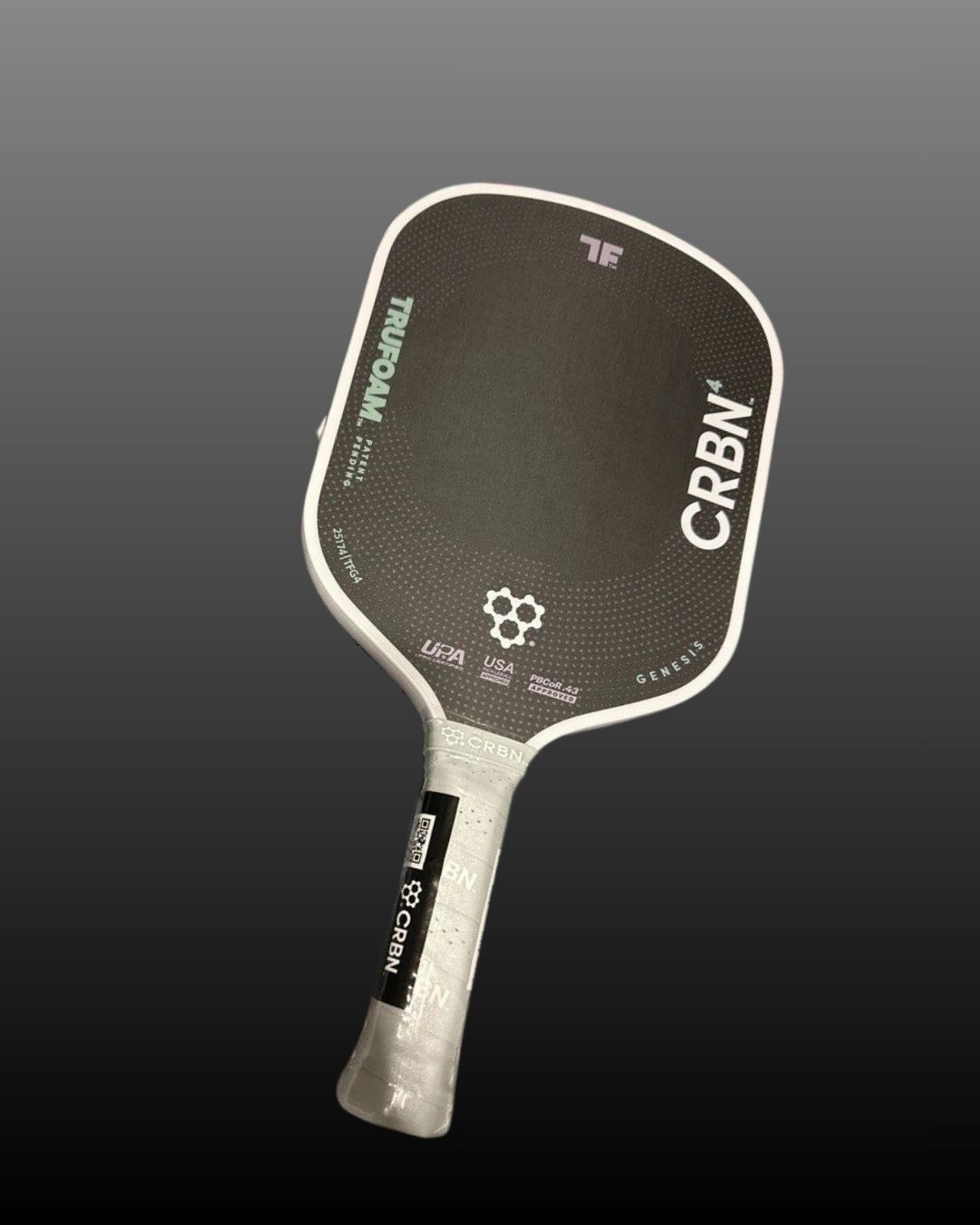
  • Detailed review of the CRBN4 Genesis Trufoam

    Detailed review of the CRBN4 Genesis Trufoam

    If you enjoy paddles that look premium, feel premium, and perform with a balanced blend of control and spin, the CRBN4 TruFoam Genesis Hybrid might be exactly what you’re hunting for. After testing it for a full week, I can confidently say this paddle turns heads on the court not just because of its sleek aesthetics but also because of the unique engineering behind it. The 14mm core, strategic fiberglass sweet-spot patch, and CRBN’s proprietary 100% TruFoam work together to create a paddle that feels modern, stable, and incredibly refined for doubles players.

    The first thing you notice is the premium build. It immediately sets itself apart visually, and the gritty surface neither overdone nor underwhelming is tuned just right. If maintained properly, it will almost certainly outlast most other brands. A simple routine of a paddle eraser after every three indoor sessions (and after each outdoor session) will keep the grit sharp and effective.

    While the handle does feel slightly shorter than other hybrid paddles, it surprisingly wasn’t a dealbreaker. I could still execute two-handed shots comfortably. However, because the Genesis features a square fiberglass reinforcement patch right on the sweet spot, off-center shots won’t always fire off with ideal pace or direction. To counteract that, I applied tungsten tape on both sides, which significantly expanded the sweet spot without affecting swing weight. And since this version only comes in 14mm, I added a bit of tungsten on the throat toocthis helped increase twist weight and gave me more stability on blocks and counters without making the paddle sluggish.

    Now, the real magic is CRBN’s proprietary TruFoam technology, which genuinely sets this paddle apart. The dwell time is comfortably long, which makes counters, resets, and defending against heavy topspin balls feel smooth and consistent. For doubles, this paddle shines bright, giving you the advantage in intermediate and advanced tournaments. I’d even say it’s a solid option for pro-level doubles. But for singles? Probably not the ideal choice, as it’s not head-heavy enough for those long, punishing drives.

    Please Note: I was only able to test the hybrid version of the CRBN4 Genesis paddle, once I get my hands on the elongated and widebody, I will write a seperate review about them So CrbnPickleball , if you guys are listening do reach out at homeforpickleball@gmail.com

    Pricing

    At 25,600 INR or $285, this is undeniably a premium paddle. But unlike many others in this price tier, the CRBN4 TrueFoam Genesis is more durable and better engineered to last. For that reason, I’d recommend it for beginners, intermediate, and advanced players. If you’re aiming to go pro, you will likely switch paddles every 6 months anyway so if pricing isn’t a concern, this is still a reliable option even at the highest levels.

    Durability

    The Genesis is one of the most durable paddles on the market, thanks to its proprietary 100% TrueFoam core. Unlike traditional honeycomb cores that soften, dent, or deaden over time, the TrueFoam design holds its structure longer and maintains performance even after months of play. This is one of the key reasons many competitive players gravitate toward CRBN paddles they simply last longer than most.

    CRBN4 TrueFoam Genesis Paddle Variants – Side-by-Side Specs

    FeatureHybridElongatedWidebody
    ShapeHybrid SquareSlightly Extended FaceBroader Face for Larger Sweet Spot
    Core14mm TrueFoam14mm TrueFoam14mm TrueFoam
    Surface GritLong-lasting Raw CarbonLong-lasting Raw CarbonLong-lasting Raw Carbon
    Sweet Spot FeelMedium-Focused (upgradable with tungsten)Mid-High Sweet SpotLargest Sweet Spot
    Handle LengthSlightly ShortStandardStandard
    Best ForDoubles, control playersBalance of reach + controlStability, block/counter specialists

    Please Note: I had to rely on the inputs of my Pickleball network to get feedback on the Widebody and Elongated models, this comparison is made after finding consistency between 8 paddle owners.

    CRBN4 Genesis vs Six Zero Ruby VS Joola Perseus IV

    FeatureCRBN4 TrueFoam GenesisSix Zero RubyJOOLA Perseus Pro 4
    Core100% TrueFoamHoneycomb + Foam WallsChargedCarbon Surface + Propulsion Core
    FeelPlush dwell time, great for resetsPower-forward, crisp contactElite control + pro-level stability
    Sweet SpotMedium (expandable with tungsten)LargeLarge and forgiving
    Best UseAdvanced doublesSingles + power playAdvanced/pro players valuing consistency
    SurfaceLong-lasting carbon gritHigh-spin raw carbonJOOLA’s pro-grade carbon friction surface
    DurabilityVery highModerateHigh
    Head HeavinessNeutralSlightly head-heavyNeutral-to-head-heavy depending on version

    FAQs

    Is the CRBN4 TrueFoam Genesis good for beginners?

    Yes. Even though it’s a premium paddle, its control-oriented feel makes it beginner-friendly. The stability and dwell time help new players develop soft-touch skills faster.

    How does the grit hold up over time?

    The grit lasts longer than most raw-carbon paddles. Using a paddle eraser every few sessions keeps it performing like new.

    Can I use this paddle for singles?

    You can, but it’s not ideal. It’s not head-heavy enough for long drives, and players who favor power in singles may prefer a heavier or power-oriented paddle.

    Will tungsten tape ruin the swing weight?

    Not if applied correctly. For this paddle, tungsten on both sides and a small amount on the throat improves sweet spot and twist weight without slowing down your swing.

    Is the Genesis more durable than standard honeycomb paddles?

    Absolutely. CRBN’s proprietary TrueFoam core holds its shape significantly longer than traditional polypropylene cores.

    Is the handle too short for two-handed backhands?

    It’s shorter than average, but still manageable for most players. Some may need an adjustment period.

  • Detailed review of the Bread & Butter Loco Paddle

    Detailed review of the Bread & Butter Loco Paddle

    Every now and then, a paddle enters the pickleball world that forces players to pause, rethink, and recalibrate what they thought they knew about power paddles. The Bread & Butter LOCO has quickly become one of those paddles. On paper, it already stands out—full EPP foam core, EVA foam perimeter, and three distinct shapes (Elongated, Hybrid, and Widebody), giving players options depending on how they construct their game. But after spending hours drilling, testing, and matching up against players using their preferred weapons, I realized this paddle has much more depth than the marketing claims.

    As a coach, I always tell players that a paddle should fit you, not the other way around. The LOCO is interesting because at first, it feels unapologetically powerful and similar to the Boomstick, but with a more nuanced touch once it breaks in. During my first 2-hour drill session, the paddle felt noticeably stiff and very lively off the face. However, by session number three, the feel mellowed out and the foam core opened up beautifully. That’s when the controlled drives, buttery drops, and consistent resets started coming alive. I felt like the paddle went from “well this is a bit rigid” to “okay, now we’re cooking” over the course of about 6 total hours of hitting.

    One thing that instantly caught my attention was how maneuverable the LOCO feels. Despite being a full-foam build, something that usually increases swing weight, the twist weight is quite easy on the wrist. Even during fast hands exchanges, I was matching blow-for-blow against players using their regular paddles. This surprised me because generally full-foam paddles tend to feel bulkier in hand but this one somehow don’t.

    However, the one drawback I personally noticed was dwell time. The LOCO has more dwell time than I typically prefer in a hand battle. While this helps with control and shapes your soft game beautifully, in rapid exchanges it sometimes made me feel a half-step behind. Due to this I had to recalibrate my swing path and timing which caused some unforced errors at first (Yes, im blaming the paddle.) But when I asked power players those who hit big drives to try this paddle, they did not find any lack of pop due to dwell time. In fact, they mentioned that unlike other foam paddles, the LOCO doesn’t need tungsten tape at the head or near the sweet spot to unleash its full potential.

    But me being a control-oriented player, I always add tungsten tape at the throat of any power paddle so I did the same with the Loco as well. Through this customization I noticed improved stability, and I was also able to generate the right amount of counter-punching ability without sacrificing maneuverability. So my conclusion is that power players may love the stock setup, control-first players might prefer a bit of customization.

    Overall, the Bread & Butter LOCO is an exciting addition in the ‘Power Paddles,’ segment and at $200 it is in my opinion quite reasonably priced . It’s explosive, highly customizable, and available in shapes that allow players to tailor the paddle to their game. If you are looking for a paddle similar to the as the Boomstick or the Gearbox GX2 then the LOCO deserves a test hit at the very least.

    Bread & Butter LOCO Paddle Specs Comparison

    FeatureElongated LOCOHybrid LOCOWidebody LOCO
    ShapeLongest reach, best for drivesBalanced length + widthLargest sweet spot
    Core ConstructionFull EPP foam + EVA perimeterFull EPP foam + EVA perimeterFull EPP foam + EVA perimeter
    Power★★★★★ (Maximum)★★★★☆★★★★☆
    Control★★★☆☆★★★★☆★★★★★
    Spin PotentialHighHighModerate–High
    ManeuverabilityVery goodExcellentGood
    Sweet Spot SizeMediumMedium–LargeLargest
    Best ForAggressive countering, singles, hard drivesAll-court players, doublesControl players, blockers, defenders

    Please Note: I personally only tested the elongated version of the BnB Loco, for the hybrid and widebody versions I asked around in my network for the data, the data displayed on this table is consistent with 7 opinions which is why I can publish it. If any one of you would like for a detailed paddle review do reach out at homeforpickleball@gmail.com

    Bread & Butter LOCO Paddle Specs (Elongated)

    Power

    If you want power, this paddle delivers it without hesitation. The combination of EPP core and EVA foam perimeter creates a trampoline-like rebound that feels very similar to the Boomstick but with a slightly more predictable response once broken in. The Elongated version, in particular, hits like a hammer.

    Control

    Control comes alive after the break-in period. Once the stiffness settles, the foam engages more consistently and the paddle becomes surprisingly touch-friendly. By session number three, my drops, resets, and dinks were landing exactly where I wanted. I was able to alter between dead dinks and topspin dinks at will.

    Spin

    The raw surface combined with longer dwell time makes the LOCO a top-tier spinner. Rolls, topspin drives, and dipping counters are easy to generate.

    Maneuverability

    A big highlight. The paddle swings lighter than most full-foam builds. Even in the Elongated shape, the twist weight is tuned tightly enough to allow fast exchanges and reactive blocks.

    Durability

    Bread & Butter paddles have generally held up well long-term, and the LOCO feels no different. Foam paddles can be prone to early breakdown, but this one shows no signs of softening too quickly.

    Selkirk BoomStick vs Gearbox GX2 vs Bread & Butter LOCO – Spec Comparison Chart

    SpecSelkirk BoomStickGearbox GX2Bread & Butter LOCO
    Weight Range227–235 g224–230 g224–230 g
    Core TypePolypropylene Honeycomb3K Carbon w/ Patented SST Core (Solid Span Technology)EPP Foam Core + EVA Foam Perimeter (Full Foam)
    Face MaterialRaw QuadCarbon FaceToray T-700 Carbon FiberRaw Carbon Fiber
    Paddle ShapeElongatedTraditional / Control ShapeElongated, Hybrid, or Widebody
    Length17 in16.5 inVaries by shape (typically 16.3–17 in)
    Width~7.4 in~7.375 inWidebody ~8 in, Hybrid ~7.6 in, Elongated ~7.4 in
    Grip Length5.75 in~5.5 in~5.3–5.5 in depending on shape
    Grip Circumference4.25 in4 in (smaller profile)4.25 in
    Swingweight~125–128~113–116~118–121 (varies by shape)
    Twistweight~6.5–7.5~5.8–6.2~6.0–7.0
    Power Rating⭐⭐⭐⭐⭐ (Very High)⭐⭐⭐⭐☆ (High)⭐⭐⭐⭐⭐ (Very High)
    Control Rating⭐⭐⭐⭐☆⭐⭐⭐⭐⭐⭐⭐⭐⭐☆
    Spin Potential~1,900–2,000 RPM~1,900–2,100 RPM~1,800–2,000 RPM
    Notable FeatureMassive power + longest reachOne-piece molded core + consistent feelFull-foam core for max pop + adjustable feel after break-in
    Break-In TimeMinimalNone needed (solid core)4–6 hours of drilling
    Ideal ForPower players, Bangers, SinglesControl players, Precision hittersPower players, foam-core lovers, hybrids who want power + forgiveness

    FAQs About the Bread & Butter LOCO Paddle

    Is the LOCO good for beginners?

    It can be, but it’s designed primarily for intermediate to advanced players who want power and shaping ability.

    Which LOCO shape should I choose?

    • Elongated → Maximum reach & power
    • Hybrid → Balanced power and control
    • Widebody → Largest sweet spot & best soft game

    Does the LOCO need lead or tungsten tape?

    Power players generally say no, but control players may benefit from adding tungsten at the throat, not the head.

    How long does the LOCO take to break in?

    Around 5–6 hours of drilling. It starts stiff but becomes more consistent and soft-feeling with time.

    Is this similar to the Boomstick?

    Yes, in terms of raw power and foam construction. But the LOCO feels slightly more maneuverable.

    Is the LOCO good for hand battles?

    It’s solid, but the dwell time may feel long for some players. If you rely heavily on fast counters, you may prefer adding weight.

    Does the LOCO come in 14 mm thickness?

    No, the BnB Loco only comes in a “16mm” model for all its shapes the elongated, widebody and hybrid.

    Does the Bread & Butter LOCO paddle come with a warranty?

    Yes, the Bread & Butter generally offers a limited manufacturer warranty on their paddles (including the LOCO), covering defects in materials and workmanship. However, coverage terms (such as duration and what counts as a defect) may vary depending on where you purchase it, so it’s best to check with the retailer or the official Bread & Butter website for the exact warranty details before buying.

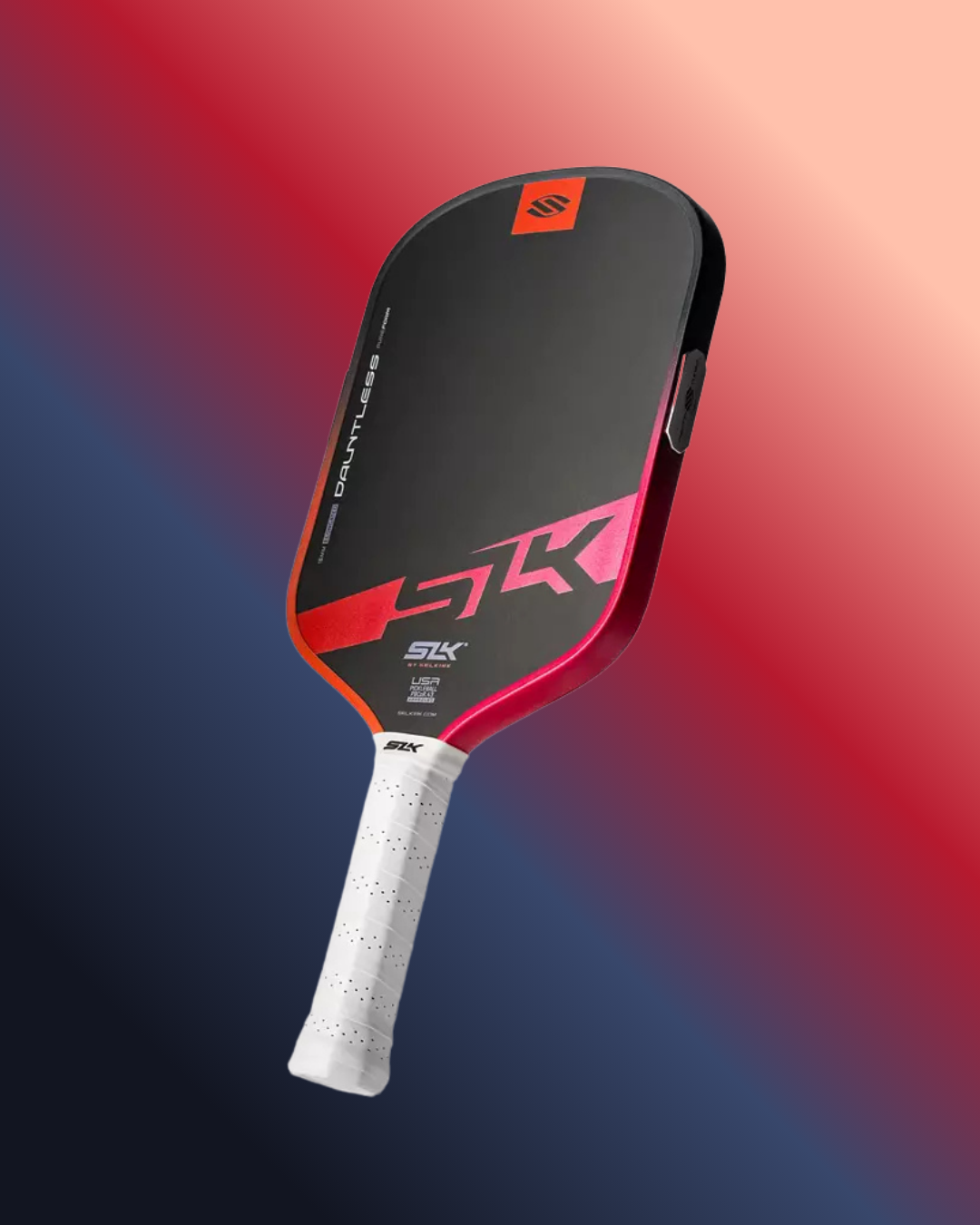
  • Detailer review of the Selkirk SLK Era Power Paddle

    Detailer review of the Selkirk SLK Era Power Paddle

    If you’ve been around my blog for a while, you already know I’ve always leaned toward control paddles. I like feeling the ball linger on my paddle just a little longer, shaping each shot like I’m painting strokes on a canvas. So when I first picked up the SLK Era Power, I was not expecting to fall for it the way I did, however, just a couple of sessions with the paddle had me sold. Personally, I will be using the paddle in a few upcoming tournaments as well.

    First Impressions

    Right out of the box, the Era Power felt solid and not overly head-heavy, but with enough swing weight to give my drives some serious pop. The carbon face gives it that crisp, confident sound when you connect cleanly, and I immediately noticed how easily I could drive through the ball without losing control.

    If you’ve played with softer paddles before, you’ll likely appreciate how SLK has found a middle ground here. You’ll find there’s power when you want it, but enough feedback to keep your touch shots in check.

    Power With Purpose

    The drives are where the SLK Era Power truly shines. The paddle gives you that little extra “pop” without requiring you to swing harder it feels like the paddle itself wants to help you finish the point. My overheads, in particular, started landing with more speed and bite. It’s one of those paddles that makes you feel rewarded for stepping in aggressively.

    On the backhand punches, I noticed a distinct jump in pace. The ball just springs off the face faster, and those quick exchanges at the kitchen become easier to win.

    That said, the extra power means you’ll need to recalibrate your soft game. My first few dink battles were honestly a mess since I was overshooting a bit and struggling to control the touch. But after a few sessions, once I found my rhythm, I could add extra spin and revs to my dinks. Once those aggressive roll dinks started dipping right at my opponents’ feet I really began to appreciate what this paddle could do.

    Customization Tip: Add Lead Tape Near the Handle

    As a player I have always preferred a more controlled feel, hence I applied a bit of lead tape near the handle, and it completely changed the balance. The paddle felt more stable on blocks and softer on resets. For anyone transitioning from a control paddle, I strongly recommend this tweak as it keeps the power while giving you the familiar balance that you are used to.

    Who This Paddle Is For

    The SLK Era Power is ideal for players who are ready to step up from a control-oriented setup but aren’t ready to go full throttle into a raw power paddle. It rewards clean technique, quick reflexes, and confidence in your offensive shots, but it still gives you the finesse you need in longer rallies.

    If you love playing aggressive doubles and enjoy finishing points with authority, this paddle will feel like a natural extension of your hand.

    Final Thoughts

    The SLK Era Power isn’t just about hitting harder, it’s about hitting smarter. Once you dial in the touch, this paddle becomes an all-court weapon. From explosive drives to rolling dinks, it’s arguably one of the most versatile options for intermediate to advanced players looking to find that sweet balance between control and power.

    Would I recommend it? Absolutely. Especially if you’re coming from a control paddle background like me, just add a little lead or tungsten tape near the handle and let this beauty do its work.

    Comparison Chart: Black Opal vs ERA Power vs Perseus Pro IV

    PaddleCore / ConstructionTypical SpecsBest ForConsiderations
    Six Zero Black OpalFull-foam or advanced foam core, textured face for spin/control(14 mm version) premium build, balanced weightPlayers wanting a mix of control + pop, upgrading from beginner gearPremium price, may require clean technique to fully benefit
    SLK ERA PowerDynamic Fusion Core (polypropylene + EVA foam) + 3-layer face of T700 raw carbon/fiberglassWeight ~7.9–8.4 oz, core thickness ~16 mm in many versions, two shapes (Elongated & Widebody) (Pickleball Warehouse)Intermediate to advanced players who hit drives, want pop + versatilitySlight learning curve in soft game; aggressive style benefits more
    JOOLA Perseus Pro IVAdvanced carbon friction surface + hybrid core constructionTop tier specs, higher price pointAttack-oriented players, spin/drive-specialistsLess forgiving if your technique is inconsistent; cost is high

    Key takeaway:

    • If you’re shifting from basic gear and want a all-round upgrade, Six Zero Black Opal is strong.
    • If you’ve moved toward driving, finishing points and want a paddle that supports that style, SLK ERA Power fits very well.
    • If you’re already high level and want near-elite performance with spin/power focus, Perseus Pro IV is the match.

    FAQs for the SLK ERA Power Paddle

    What core thickness does the SLK ERA Power use?
    The ERA Power is available in 16 mm core thickness in many of its versions (especially the Widebody) which gives a thicker feel and more “meat” behind the hit.

    What shapes does the ERA Power come in?
    It comes in at least two shapes: Elongated (for extra reach/power) and Widebody (for a larger sweet spot and more forgiveness).

    What is the typical weight range for this paddle?
    Specs list weight ranges around 7.9 oz to 8.4 oz depending on model/shape.

    How did I find the paddle’s performance for drives and overheads?
    In my use, I found the ERA Power gave noticeably more “pop” on drives and faster overhead finishes, the paddle communicated that extra speed and bite.

    How did it feel in dink exchanges / soft game?
    Initially it took me some time to adapt in dink battles because the paddle is more power-oriented. Once I settled in, I could use it to roll aggressive dinks and add more revs, making my opponents hesitate.

    Does it work for a player coming from a control paddle background?
    Yes, if you are coming from a control paddle, you’ll benefit from the power the ERA Power offers, but you may want to adjust your soft-game and strikes. Also adding lead tape near the handle (as you did) can help fine-tune the feel.

    Can I customize the weight/balance of the paddle?
    Yes, the manufacturer and user community suggest you can apply lead or tungsten tape (especially near the handle/perimeter) to alter swing weight and balance.

    How forgiving is the paddle on off-center hits?
    The Widebody shape version in particular is noted for having a larger sweet spot and better forgiveness on off-center hits thanks to its Dynamic Fusion Core design.

    What level of player is this paddle best for?
    It’s best suited for intermediate to advanced players who are comfortable with clean strikes, drives, and want a paddle that delivers power + spin. If you’re still heavily relying on arm/wrist-only shots, you might not yet unlock full benefit.

    Is the paddle approved for tournament play?
    Yes the SLK Era is USAPA/APP approved for tournament use. Both, the widebody and elongated shape are approved.


  • Detailed review of the Six Zero Black Opal

    Detailed review of the Six Zero Black Opal

    As someone who came to pickleball without a racket-sport background (yes, that’s me!), I’m always on the lookout for gear that helps me “feel” the game better. After spending several sessions with the Six Zero Black Opal paddle in my hands, here’s what I found and how it stacks up to my expectations.

    First Impressions: Looks & Feel

    Straight out of the gate, the Black Opal stood out. The matte black finish with subtle iridescent accents gave it a premium look no flashy graphics screaming “look at me,” just clean and sleek. The weight felt nicely balanced in my hand, and the grip size suited my palm well without feeling bulky.

    Because I’m still refining my strokes, grip comfort matters a lot. The grip on the Black Opal felt slightly more cushioned than some entry-level paddles I’ve tried, and that extra comfort translated into less wrist tension during longer rallies.

    On-Court Performance

    Control & Touch

    One of my biggest takeaways: the paddle gave me excellent control. During soft exchanges near the NVZ line, I noticed I could place the ball where I wanted rather than just lumping it deep. For players like me who are still mastering placement over sheer power, that is a big win.

    Power & Pop

    Now, I didn’t become a monster server overnight, but I did feel more pop than I expected for a paddle in this category. When I rotated my body and used my legs (yes, I remembered Tip #1), I could feel the paddle respond with a crisp hit. The Black Opal rewarded good motion it wasn’t “forgiving to sloppy swings,” but that’s not necessarily bad if you’re on the learning curve and want to improve your mechanics.

    Spin & Versatility

    The slightly textured face of the paddle gave me the ability to add a bit more spin than my previous gear. On drives and returns I could feel the difference. While I wouldn’t call it a dedicated “spin machine,” it’s definitely better than many basic paddles. If you’re working toward more advanced shots, this is a nice bonus.

    What I Liked Most

    • Balanced performance: Great mix of control + pop.
    • Comfortable grip: Less fatigue during longer sessions.
    • Premium build aesthetic: Looks as good as it feels.
    • Progress-friendly: I felt like my weaknesses were highlighted—meaning I learned more, not just got an “easy” paddle.
    • Final Verdict

    Comparion with arguably the most common competitors

    While I do not own all three paddles (as of yet!), I borrowed the paddles on seperate occasions, from my friends/slash players who have been using the paddles for a good 3-4 months. I played with each paddle for a week and came up with this comparison. I should also mention that each paddle was modified by my friends, for eg: overgrips of different companies and lead tape.

    PaddleSpecs / MaterialsBest ForTrade-Offs
    Six Zero Black OpalReported weight: ~8.0-8.3 oz
    Core: Full-foam floating core, “G4” / advanced foam layer Surface: Diamond Tough™ texture designed for spin/precision
    Players ready to upgrade beyond basic gear, seeking a paddle that offers both spin and pop with premium feel.Premium price. Because the build rewards good mechanics, if your technique is still very basic you might not unlock its full advantages yet.
    SLK ERA PowerWeight: ~8.0-8.4 oz depending on shape
    Core: 16 mm polypropylene + EVA foam (in many versions) Face: High-end carbon fiber (T700 in widebody version)
    Intermediate to advanced players who want strong power-oriented performance with good tech and two shape options (Widebody vs. Elongated) to match playing style.Because it’s designed for power, control at the kitchen line or in tight soft-game situations may require more finesse. Also slightly heavier feel for players accustomed to ultra-light paddles.
    JOOLA Perseus Pro IVWeight: ~7.9–8.1 oz depending on thickness (14 mm or 16 mm) Core: Polypropylene with dual-layer foam (varies by version)
    Surface: Textured carbon fiber friction surface built for pop/spin
    Players who love aggressive attacking, drives and spin and are comfortable with a paddle that can deliver serious pop.Less forgiving if your timing or technique is inconsistent; may be more paddle than needed for someone focused mainly on control or that soft game.

    How to Use This Comparison

    If you’re an attack-focused player, want max pop and spin, and are comfortable with less forgiveness: the JOOLA Perseus Pro IV may be your match.

    If you’re still mastering your fundamentals and want a great “next-level” paddle that offers both spin control and power: consider the Black Opal.

    If your game is moving into power territory, you play aggressive, hit drives often, and want shape choices: the SLK ERA Power is a strong pick.

    Frequently Asked Questions

    Is the Black Opal available in both 14 mm and 16 mm core thicknesses?
    No, based on the current listings, the Black Opal is listed as the 14 mm version (for example, the product page shows “Black Opal 14mm”). I could not reliably find a 16 mm offering of this specific model during my review period. If you’re seeing “16 mm” listed somewhere, check carefully (model variant, stock, region). For now, I’d treat the 14 mm as the standard for this paddle unless clarified by the brand.

    What happens if I switch to a thicker 16 mm core version would that give more power or different feel?
    Since I reviewed only the 14 mm version of the Black Opal, I can’t speak from direct experience to a 16 mm variant of this model. However, in general with paddle design, a thicker core (16 mm vs 14 mm) usually means more “meat” behind the hit typically more pop/power but slightly less finesse and touch. If Six Zero did release a 16 mm version later, it might shift the feel in that direction. So if you prioritise control, placement and finesse, the 14 mm works very well. If you want maximum pop and you’re comfortable with faster swings, a hypothetical thicker version would lean that way.

    How durable is the surface and material on the Black Opal will it hold up over time?
    From my play sessions, I’ve been genuinely impressed with the build quality. The paddle advertises a “Diamond Tough” surface texture and high-density foam core, which gave the Black Opal a premium feel. After multiple hours of rallying and aggressive drives, I didn’t notice any major marring or dead-spots yet. Of course, long-term durability depends on how you store it, how often you use it, and whether you hit hard or soft. But if you maintain it, I’d expect it to hold up well.

    For someone coming from no racket background (like me), will the Black Opal be too “advanced”?
    That’s a great question. As someone who also started without a racket-sport background, I found the Black Opal to be very usable especially because it rewards good technique rather than penalising beginners severely. If your basics (stance, swing path, using body) are in place, this paddle will work nicely. That said, it does reward you for using your kinetic chain (legs, core, rotation) and good contact point. If you were relying purely on your wrist or arm, you might not feel the full benefit immediately. So yes it may be a bit “advanced” in that sense, but not off-limits. It’s arguably an ideal paddle for someone ready to take that next step.

    What grip size fits this paddle best?

    For my hand size (medium to average), I found the standard grip on the Black Opal comfortable right out of the box no over-grip necessary. If your hands are larger, adding an over-grip is an easy fix, and it didn’t impact the feel for me. The paddle’s balance remains solid, so changing grip size didn’t throw off my play.

    Is this paddle approved for tournament play (USAPA/APP)?
    Yes according to the manufacturer’s spec listing, Six Zero paddles (including the Black Opal) are labelled as “USAPA-approved.” From my own experience in local tournaments, I’ve used this paddle without any compatibility issues. If you play in competitive events, always check the specific tournament rule sheet though.

    How does the Black Opal compare to my old beginner paddle in terms of feel and forgiveness?
    Compared to my previous budget paddle (which had a “dead spot” feel), the Black Opal felt significantly more responsive. When I hit clean strokes, it rewarded me with a crisp pop and strong sound. But and this is worth knowing when I mis-timed or swung only with my arm, it was less forgiving than the old paddle. So if you’re still relying heavily on arm-only swings, you might want to refine your form before expecting full benefit from this paddle.

    How is the warranty and support?
    Six Zero advertises a 12-month structural warranty on their paddles. In my purchase process, the NFC chip registration (embedded in the paddle) made registering the warranty quick and straightforward. It gives me confidence in the build quality especially if you’re investing in a premium paddle.

    How much vibration or arm-fatigue did I feel using it?
    The Black Opal uses technology like “Shock Shield™” aimed at damping vibration. In my sessions I noticed less forearm fatigue than some other paddles I’ve used especially during aggressive drives. That said, because I started pushing myself (using my legs, core, and rotation more), I still felt normal fatigue after long play but no unusual arm or wrist soreness, which is a good sign.