Category: Pro Level

Explore advanced tactics, precision shot-making, and mental strategies used by top players to dominate every match.

  • Comprehensive Guide on Pickleball Paddle Face Materials

    When players talk about how a pickleball paddle feels, they’re usually describing the response of the paddle face, not the core. While the inside of a paddle controls stability and softness, it’s the surface material that determines how the ball leaves the paddle, how much spin it takes, how firm the contact feels, and how predictable the response is across the face.

    Over the last few years, advancements in pickleball paddle materials have shifted performance dramatically. Carbon fiber has become the standard, fiberglass is still used for power, Kevlar has carved out a niche, and newer surface materials like titanium weaves are changing how control paddles are built.

    This article focuses specifically on pickleball paddle face materials, why manufacturers use them, and how each material influences real-world play.

    Why Paddle Face Materials Matter in Pickleball

    Every shot in pickleball begins with ball-to-surface contact. The face material dictates:

    • How long the ball stays on the paddle
    • How much energy is returned to the ball
    • How predictable off-center hits feel
    • How easy it is to generate spin

    Even two paddles with the same core can feel completely different simply because the face materials and layups are not the same. That’s why surface construction is one of the most important aspects of modern pickleball paddle materials.

    Pickleball Paddle Face Materials Comparison Table

    Paddle Face MaterialFeel at ImpactPower LevelControl & TouchSpin PotentialSweet Spot SizeDurability Over TimeBest Suited For
    Carbon Fiber (T700)Soft, muted, consistentMediumExcellentHighLargeVery goodControl players, all-court players, competitive doubles
    Fiberglass (Composite)Firm, lively, explosiveHighModerateMediumSmallerModeratePower players, aggressive baseline hitters
    Kevlar (Aramid Fiber)Firm but refinedMedium-HighGoodMedium-HighMediumGoodPlayers wanting controlled pop and durability
    Titanium (Polyester Weave)Very soft, dampenedMedium-LowExcellentMediumMedium-LargeVery goodControl-focused players, reset-heavy doubles
    Mixed Layups (Carbon + Fiberglass / Kevlar / Titanium)Tuned by designVariableVariableVariableVariableDepends on buildPlayers wanting balanced, all-court performance

    Carbon Fiber Paddle Faces

    Carbon fiber is the most common paddle face material used today, especially in performance and professional-level paddles.

    Despite being a stiff material structurally, carbon fiber produces a surprisingly soft and controlled impact feel. This is due to how thin the material is and how it interacts with the core beneath it.

    Carbon fiber faces are known for:

    • Large and forgiving sweet spots
    • Consistent response across the surface
    • Strong spin potential
    • Excellent control on soft shots

    Most premium paddles use T700 carbon fiber, which offers better consistency and durability than lower-grade carbon materials often found in cheaper paddles.

    Fiberglass (Composite) Paddle Faces

    Fiberglass, sometimes referred to as composite, is more flexible than carbon fiber. This added flex creates more trampoline effect at impact.

    Fiberglass paddle faces provide:

    • Higher power output
    • Faster ball speed
    • A more explosive feel

    The tradeoff is reduced forgiveness. Fiberglass faces typically have smaller sweet spots and feel firmer on off-center hits. For this reason, fiberglass is often used as part of a layered construction rather than as a standalone face material.

    Kevlar (Aramid Fiber) Paddle Faces

    Kevlar sits between carbon fiber and fiberglass in terms of performance. It offers slightly more power than carbon fiber while maintaining better control than fiberglass.

    Kevlar faces are:

    • Firm but not harsh
    • Slightly more pop-oriented than carbon
    • Durable and resistant to wear

    Some manufacturers favor Kevlar not only for its playing characteristics but also because it allows for more visual customization compared to carbon fiber’s traditional black appearance.

    Titanium (Polyester Weave) Paddle Faces

    Titanium paddle faces do not use actual metal sheets. Instead, they rely on a polyester weave infused with titanium properties.

    These surfaces are:

    • Softer feeling than carbon fiber
    • Less pop-oriented
    • Very control-focused

    Titanium faces are often used in paddles designed for touch, resets, and consistency rather than raw power. They pair well with thinner cores or stiffer constructions to maintain balance.

    How Face Layups Combine Multiple Materials

    Most modern paddles do not rely on a single surface layer. Instead, they use multiple layers arranged in a specific order, known as a layup.

    Common face layup strategies include:

    • Carbon layers over fiberglass for controlled power
    • All-carbon stacks for consistency and feel
    • Kevlar or titanium top layers to soften impact

    Layups allow manufacturers to fine-tune how a paddle behaves on soft shots versus full swings. That’s why some paddles feel muted at the kitchen but lively from the baseline.

    Surface Texture and Spin Potential

    Beyond material choice, surface texture plays a critical role in spin generation. Raw carbon fiber faces with textured finishes tend to produce higher spin rates, while smoother fiberglass surfaces generate less spin.

    Over time, surface wear can reduce spin potential, which is why face material durability matters just as much as initial performance when evaluating pickleball paddle materials.

    Durability of Paddle Face Materials

    Different face materials wear at different rates:

    • Carbon fiber generally maintains performance longer
    • Fiberglass can lose texture faster
    • Kevlar resists fraying but can smooth out
    • Titanium weaves retain feel but reduce pop naturally

    How the face is bonded to the core also affects longevity. Poor bonding leads to dead spots and inconsistent responses.

    Final Thoughts on Pickleball Paddle Face Materials

    Paddle face materials are one of the biggest reasons modern pickleball paddles feel so different from one another. Carbon fiber dominates for its balance of control and consistency. Fiberglass delivers power. Kevlar adds firmness with finesse. Titanium weaves offer a softer, more controlled response.

    Understanding pickleball paddle materials, especially surface materials, gives players insight into why a paddle behaves the way it does. It also explains why two paddles with similar specs can perform so differently on court.

    As paddle technology continues to evolve, face materials will remain a key area of innovation and one of the most important elements in modern paddle design.

    Check out our space where we dedicately review paddles in which we cover every aspect carefully. All reviews are unbiased and non-sponsored, we do place affiliate links with discounts codes so if you decide to buy a paddle we end up making enough to cover our daily court expenses.
    Also Read: Pickleball Paddle Core Materials Explained

    FAQ

    What is the best paddle face material for pickleball?
    Carbon fiber is the most popular paddle face material because it offers a balanced mix of control, spin, and consistency.

    Is fiberglass or carbon fiber better for pickleball paddles?
    Fiberglass provides more power, while carbon fiber offers better control and a larger sweet spot.

    Do paddle face materials affect spin?
    Yes. Textured carbon fiber faces typically generate more spin than smoother fiberglass surfaces.

    Are titanium pickleball paddles good for control?
    Titanium weave faces produce a softer feel and reduced pop, making them well-suited for control-oriented players.

  • Explaining How Pickleball Paddles Are Made

    Pickleball paddles may look simple on the surface, but there’s a surprising amount of engineering packed into each one. Behind the graphics and marketing claims, paddle performance is shaped by a series of deliberate design choices, such as how the core is built, how the face layers are stacked, how weight is distributed, and how everything is bonded together.

    Today, there are roughly twenty major paddle brands and countless off-brand manufacturers producing hundreds of paddle models. While many of them use similar language to describe power, control, and spin, the actual differences come down to how the paddle is made, not how it’s marketed.

    This guide is not a paddle buying guide. Instead, it’s a technical breakdown of how pickleball paddles are constructed, written to help you understand what’s happening inside the paddle and not just how it feels when you hit with it. By the end of this article, you’ll know how to read a paddle spec sheet, understand common construction terminology, and recognize how specific materials and build methods influence performance on the court.

    This is a detailed, behind-the-scenes look at paddle design, so if you enjoy learning how equipment works at a deeper level, you’re in the right place. And if you’d rather skip the engineering side and focus purely on choosing the right paddle for your game, I also have a separate guide that covers that approach in a more performance-driven way.

    The Core Elements That Define Pickleball Paddle Construction

    After reviewing and testing paddles consistently since 2024, I’ve found that five factors account for the vast majority of how a paddle performs. While marketing materials often emphasize surface grit or cosmetic design, these five elements tell you far more about real-world playability:

    1. Core thickness and core material
    2. Paddle shape
    3. Facing materials and layup configuration
    4. Weight distribution (static weight, swingweight, twistweight)
    5. Construction method

    When you understand how these elements work together, you can look at almost any paddle spec sheet and form a very accurate expectation of how that paddle will feel and perform.

    Core Thickness and Core Material (The Most Important Spec)

    If you only focus on one paddle spec, it should be the core. Core thickness and material influence feel, control, forgiveness, stability, and power more than any other factor.

    Core Thickness Explained

    Most modern pickleball paddles range from 10mm to 20mm thick, but the vast majority fall into either the 14mm or 16mm categories.

    Thick Core Paddles (16mm and Above)

    A 16mm core is widely considered the modern standard. Thicker cores absorb more impact energy, resulting in:

    • A softer feel
    • A larger sweet spot
    • Better stability on off-center hits
    • Reduced vibration and shock

    Also Read: Best 16mm core paddles

    These paddles are generally easier to play with, especially in doubles, kitchen exchanges, and defensive situations. The tradeoff is reduced maneuverability and slightly less pop on quick hands battles.

    Paddles thicker than 16mm are uncommon but can be useful in edge-guard-less designs where additional thickness adds stability.

    Thin Core Paddles (14mm)

    Fourteen-millimeter paddles feel faster and more responsive. They offer:

    • Increased pop and ball speed
    • Better maneuverability
    • Quicker reaction at the net

    However, thinner cores usually sacrifice forgiveness and stability, especially on mishits. They tend to suit aggressive players who generate their own control and value speed over plush feel.

    General rule:

    • Thicker core = control, forgiveness, comfort
    • Thinner core = speed, pop, offense

    Also Read: Best 14mm core paddles

    Core Material Types

    Core material determines how impact energy is absorbed and returned to the ball.

    Polypropylene (Polymer) Honeycomb Core

    Polypropylene honeycomb cores have dominated pickleball paddle construction for years. While they all look similar, performance varies based on several internal factors:

    • Honeycomb cell size:
      Larger cells increase rebound and power but reduce consistency. Smaller cells feel denser and more controlled.
    • Cell wall thickness:
      Thinner walls increase pop; thicker walls dampen power.
    • Polymer density:
      Softer polymers feel livelier, while rigid polymers feel muted and controlled.

    Manufacturers rarely disclose all of these details, which is why two polymer paddles with identical thickness can feel completely different.

    Some paddles also include foam injected around the perimeter of the polymer core. Depending on placement and density, foam can improve stability, reduce vibration, or slightly increase power.

    Full Foam Core Paddles

    Introduced in 2025, full foam core paddles replace the honeycomb structure with a solid foam interior. This design offers:

    • A softer, more consistent impact feel
    • Improved durability
    • Better retention of performance over time

    While foam cores are still evolving, early designs suggest they may solve long-standing durability issues seen in polymer cores.

    Paddle Shape and How It Affects Performance

    Paddle shape directly impacts reach, forgiveness, swing feel, and balance. According to USAP rules, the combined length and width of a paddle cannot exceed 24 inches. Within that limit, three dominant shapes have emerged.

    Common Pickleball Paddle Shapes

    Elongated Paddles (≈16.5” x 7.5”)

    Elongated paddles offer:

    • Extra reach
    • Higher swingweight
    • Increased leverage for power and spin

    The downside is reduced forgiveness and increased head heaviness, which can make them more demanding to use.

    Hybrid Paddles (≈16.25” x 7.5–7.7”)

    Hybrid paddles balance reach and forgiveness. They:

    • Feel more neutral in hand
    • Offer good power without extreme head heaviness
    • Work well for both singles and doubles

    Widebody / Standard Paddles (≈16” x 8”)

    Widebody paddles prioritize:

    • Forgiveness
    • Maneuverability
    • Larger sweet spots

    They sacrifice some reach but are excellent for control-oriented players and fast hands at the net.

    Shape Recommendation

    For most recreational and intermediate players, hybrid and widebody paddles are the best choice. Paddle technology has advanced to the point where power is available in every shape, making elongated paddles less necessary unless extra reach is a priority.

    Also Read: Best Paddles for Beginners

    Paddle Face Materials and Layup Design

    The paddle face determines how the ball interacts with the surface, influencing feel, spin, and power.

    Common Facing Materials

    • Carbon Fiber: Best balance of control, spin, and consistency. T700 carbon fiber is the current gold standard.
    • Fiberglass: The most powerful material, but harsh feeling with a smaller sweet spot.
    • Kevlar (Aramid): Slightly more powerful than carbon fiber with a firmer feel.
    • Titanium (Polyester Weave): Softer, muted feel with reduced pop—ideal for control paddles.

    Facing Layups Explained

    Most paddles use multiple layers of material. Common configurations include:

    • Carbon / Carbon / Fiberglass: Control on soft shots, power on full swings
    • Carbon / Fiberglass / Carbon: Easier access to pop
    • Carbon / Carbon / Carbon: Maximum consistency and sweet spot size

    Layup design allows brands to fine-tune how a paddle behaves across different shot types.

    Weight Distribution: Static Weight vs Swingweight vs Twistweight

    Static weight tells you how heavy a paddle is overall, but swingweight and twistweight are far more important.

    • Swingweight: How heavy the paddle feels when swinging. Higher = more power, slower hands.
    • Twistweight: Resistance to twisting on off-center hits. Higher = larger sweet spot.

    Ideal Ranges for Most Players

    • Swingweight: 112–118
    • Twistweight: 6.0 or higher

    Elongated paddles usually have higher swingweight and lower twistweight, while widebody paddles feel quicker and more forgiving.

    Pickleball Paddle Construction Methods

    Construction method influences feel and durability, but should not outweigh core, shape, or weight distribution.

    • Cold Pressed (Gen 1): Plush feel, excellent durability
    • Light Thermoformed (Gen 1.5): Added foam perimeter, control-focused
    • Full Thermoformed (Gen 2): More power and rigidity
    • Dual Foam Edge (Gen 3): Increased perimeter stability
    • Full Foam Core (Gen 4): Enhanced durability and feel consistency

    Newer does not always mean better; each method serves different play styles.

    Final Thoughts

    Modern pickleball paddles are far more complex than they appear. What looks like a simple slab of composite material is actually a carefully engineered system built from specific core materials, layered face constructions, controlled weight distribution, and distinct manufacturing processes.

    Understanding how pickleball paddles are made removes much of the mystery behind why paddles feel different from one another. Core thickness explains softness and stability. Face materials determine feel and spin. Weight distribution dictates maneuverability. Construction methods also influence durability and long-term performance.

    You don’t need to memorize every specification to appreciate paddle design, but knowing how these elements work together gives you a clearer picture of what’s happening inside the paddle every time the ball makes contact.

    As paddle technology continues to evolve with foam cores, new face materials, and hybrid construction methods the best way to stay informed is to understand the fundamentals of paddle manufacturing. Once you do, spec sheets become meaningful, marketing claims become easier to evaluate, and paddle innovation starts to make a lot more sense.

    FAQ’s

    What materials are pickleball paddles made from?
    Most paddles use a polymer or foam core combined with carbon fiber, fiberglass, kevlar, or titanium face layers.

    How are paddle layers bonded together?
    Layers are bonded using pressure and heat (thermoforming) or adhesives (cold pressing).

    Why do some paddles lose performance over time?
    Polymer cores can collapse slightly with repeated impact, reducing pop and feel.

    Are foam-core paddles more durable?
    Early data suggests foam cores retain their shape and performance longer.

    Does thermoforming make a paddle better?
    Not necessarily. It changes feel and power, but doesn’t guarantee better performance for every player.

  • Advanced Pickleball doubles strategies used by Pro players

    Pickleball is arguably the one racket sports that gets more views and attention for its doubles format rather than singles, and yes we said’ ‘racket sports.’ Doubles pickleball opens the door to strategy, teamwork, communication, and that special kind of chaos that makes you laugh even while you’re scrambling for the next shot. It’s social, fast-paced, and incredibly rewarding once you begin understanding how two players can move and think as one unit. As a coach, I’ve seen so many players instantly fall in love with doubles simply because it adds layers to the sport that singles just can’t replicate.

    So let’s break it all down. How do you actually play doubles? What strategies matter most? And how do you become the kind of partner that people want to play with every time? Below, I’ll walk you through everything starting from rules, fundamentals, advanced tactics, all the way to mindset training, so you are always confident stepping onto the court with any partner you play with.

    Understanding the Rules of Doubles Pickleball

    The rules for doubles pickleball are very similar to singles, but there are a few extra details you need to know—especially when it comes to calling the score. In singles, it’s simple: your score first, your opponent’s score second. In doubles, we add a third number: the server position. Before every serve, the server calls out their team’s score, the opponents’ score, and whether they are server 1 or 2 for that rally.

    Throughout the game, both players on a team will get a chance to serve before a side-out occurs. That’s why identifying server 1 and 2 matters. The only exception is the very first service of the match where only one player serves at the start, and a fault immediately results in a side-out. After that, normal rotation takes place.

    It sounds confusing at first, but trust me, it becomes second nature. If you want to fast-track your comfort with doubles, a couple of private lessons or drilling sessions with a local coach can speed up the learning process, only for rules though. To get better and be more consistent you will still have to do drills regularly.

    Basic vs. Advanced Pickleball Doubles Strategies

    When you’re just starting out, your job is simple: get the fundamentals down. You don’t need stacking, crash & drive, or precision poaching right away. Start with consistent serves, cleaner footwork, and reliable shot placement. Get a feel for how the game flows with a partner precisely the timing, the rhythm, and the communication.

    But once those basics feel comfortable, that’s when the fun begins. Advanced doubles strategies like stacking, poaching, and patterned movement add a new dimension to your game. And when you and your partner finally sync up on these concepts? That’s when you start playing real doubles pickleball.

    Now without further adieu, let’s break down the core strategies you should focus on at each stage.

    Getting to the Kitchen Line Immediately After the Return

    The single most important strategy in doubles: advance to the non-volley zone (NVZ) as soon as you return the serve. Almost every high-percentage play happens from the kitchen line. If you stay stuck at the baseline, you’re playing defense the entire point and your chances of winning drop dramatically.

    Good teams sprint to the line together. Great teams know exactly why they’re doing it and even when to stay back, yes you read that right!

    Develop a Reliable Drop Shot

    The drop shot is the bridge between the baseline and the kitchen. When your opponents beat you to the NVZ line, a soft, controlled drop shot forces them to hit up on the ball and gives you time to move forward. A well-executed third-shot drop is often the difference between winning and losing against strong teams.

    Keep Your Opponents Pinned to the Baseline

    Just like you don’t want to stay back, your opponents don’t either. If you can keep them deep while you and your partner control the kitchen line, the point is already tilting heavily in your favor. Use deep drives, heavy topspin, and firm volleys to keep pressure on them and prevent them from advancing. Check out our article on the types of shot to learn how to execute these shots better.

    Aim for the Feet

    Simple but deadly. Shots at the feet force awkward upward contact, which usually leads to a pop-up—your opportunity to finish the point. Whether you’re driving, dinking, or countering, the feet are always a high-percentage target.

    Serve Deep & Consistently

    A deep serve buys you time. It pushes the returner back and prevents them from charging the kitchen too quickly. Instead of overhitting focus on depth, direction, and reliability.

    Stand Behind the Baseline on the Return

    Many new players stand right on the line and end up jammed or forced to backpedal. Standing a couple of feet behind gives you time to react, step into your return, and maintain balance. And remember you must let the serve bounce, so you don’t want to be standing too close to the baseline while receiving a serve.

    Hit Deep Returns

    A deep return of serve keeps your opponent back long enough for you to get to the kitchen line. It also makes their third shot tougher, forcing them into lower-percentage drops or rushed drives.

    Be Intentional With Your Positioning

    Great doubles teams don’t just stand in “their side.” They adjust based on opponent tendencies, partner strengths, and shot patterns. Sometimes that means shifting closer to the middle, shading toward a dangerous shot, or spreading wide to protect angles.

    Win the Race to the NVZ

    Back when I was new at Pickleball, a senior player would always tell me, “take control of the net, take control of the net,” at first I did not realise how important that it but later when I got to higher levels, I realized that almost all points are decided by which team gets to the kitchen first and holds it. So remember, tour mission: get to the kitchen early, make sure you’re partner gets there too, and stay disciplined once you’re in the NVZ.

    Third Shot Options: Drop or Drive

    Your third shot is your first tactical decision as the serving team.

    • Drop when the return is low, short, or when you want to advance safely.
    • Drive when the returner is out of position, when you see a backhand target, or when you want to set up a fifth-shot drop.

    Attack on the Fourth if You Can

    If your opponent fails to get to the kitchen line, the fourth shot can be a fantastic time to go on offense. Keep the ball low, find their weak side which is mostly a player’s backhand, and force them to hit up.

    Use Spin When Appropriate

    Adding topspin, backspin, or sidespin creates unpredictable bounce and trajectory. It doesn’t need to be excessive, controlled, consistent spin is more dangerous than flashy inconsistency.

    Attack the Middle

    Hitting down the middle creates hesitation, confusion, and miscommunication. It also provides plenty of margin for error. If you hear your opponents arguing about whose ball it was, you’re doing something right. Besides aiming for the middle is always a high percentage shot in comparison to aiming for the corners.

    Poaching With Purpose

    A poach is an aggressive move where you take a ball intended for your partner. It’s not about stealing, it’s about capitalizing on patterns. Great poachers communicate clearly, move decisively, and finish points efficiently. Poor poachers… well, they frustrate teammates.

    Stacking

    Stacking allows each player to stay on their preferred side of the court. Lefty/righty combos benefit most, but even same-handed teams use stacking to maximize forehands, protect weaknesses, and control the middle.

    Dinking with Patience

    Dinking is a chess match. You’re not just hitting soft shots you’re building patterns, targeting weaknesses, and waiting for the ball that sits even half an inch too high. Patience wins more dink rallies than power or skill ever will. As a pro tip I would suggest that not every high dink needs to be put away, bide your time and make the put away count the most.

    Keep Every Ball Low

    If you consistently send high, attackable balls, you’ll constantly be defending. A soft grip and clean technique help you keep the ball skimming just above the net.

    Pro/Advanced Tips for Playing Doubles Pickleball

    Improve Your Decision-Making

    Skill matters, but smart decisions win matches. Know when to attack, when to reset, and when to simply keep the ball in play.

    Accuracy Over Power

    You can’t overpower strong players, but you can outplace them. Hit smarter, make your opponents move around, once you tire them out you improve your chances to not only win the rally but even the entire match.

    Communicate Constantly

    Call “yours,” “mine,” “switch,” “no,” and “bounce.” The quieter the team, the more points they give away.

    Trust Your Partner

    Good teams back each other up. Great teams anticipate each other’s moves. You should be well aware of your partner’s skillset, for eg even if you are on the left side and your partner has a strong backhand let them pick the center balls, that way the opponent will always have to second guess their strategies.

    Read Out Balls

    Learning to let balls go long is one of the fastest ways to jump levels. Shoulder-high drives with pace almost always sail long so let them, by chance if it lands it, your opponent will still stop driving hard knowing you are up for letting high balls sail away.

    Move Together

    If your partner moves left, you shift left. If they move back, you do the same. Think of yourselves as connected by an invisible rope.

    Stay Patient

    The best players don’t rush. They wait for the right ball, the right moment, the right angle. Patience is a weapon.

    Should You Drive or Drop the Third Shot?

    It depends on the return. If it’s low and short, a drop is your best option. If it’s deep and gives you space to generate pace, a drive might create a pop-up or force an error. Your goal isn’t to hit a perfect shot—it’s to put your team in a better position for the fifth.

    How to Become an Ideal Doubles Partner

    Practice with your regular partner often, do match pattern drills, as that is where the real magic happens. Play with your partner often. Learn their habits. Celebrate their good shots, support them after bad ones, and stay calm no matter what. Body language matters do not slump, groan, or show frustration. Be the partner who lifts the team, not the one who sinks it.

    Remember Doubles isn’t just about great shots it’s about great energy.

    Final Thoughts

    Doubles pickleball adds strategy, teamwork, and fun to every match. Whether you’re learning the basics or stepping into advanced tactics like stacking and poaching, every layer you add makes the game richer. So grab a partner, hit the courts, and start building the kind of chemistry that turns rallies into highlights.

    .

  • Types of shots played in Pickleball explained

    Types of shots played in Pickleball explained

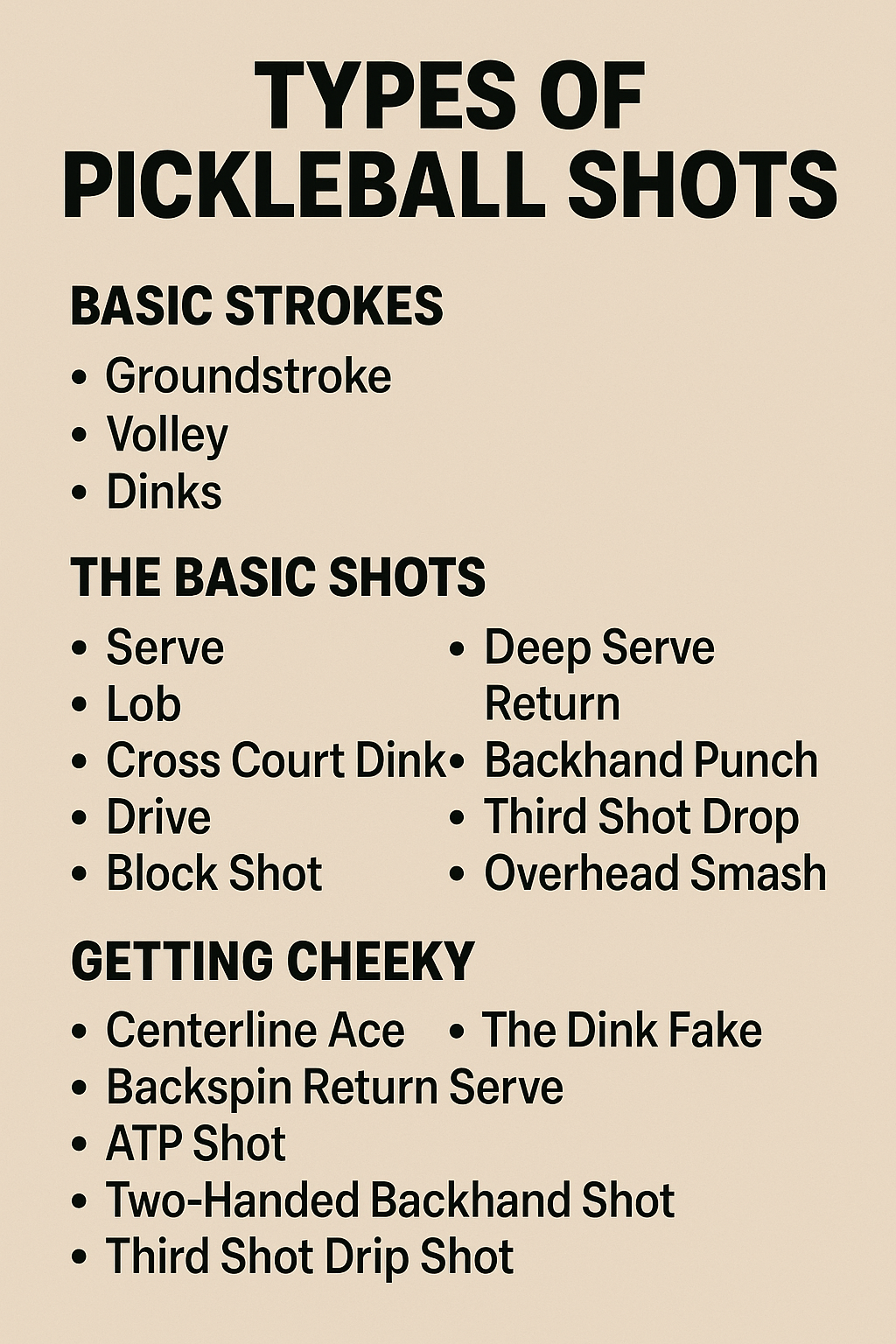
    Pickleball shots are traditional, yet evolving, so what’s better than having a shot named after you, am I right? To answer this question, I will first list and explain all the basic strokes, along with the names of all pickleball shots.

    Once you have learned about all the shots you can play, you can vote below on what is better, is it basic shots or innovative shots? Now Let’s play pickl…. I mean lets take a look at the types of Pickleball shots

    Basic strokes

    A lot of players feel stroke and shot refer to the same this. Knowing the difference between a stroke and a shot will help you with better shot selection and choices. A stroke is basically the action that you perform before making contact with the ball whereas a shot is the aftermatch of a stroke. Strokes in pickleball are of three types: 

    Groundstroke

    Groundstroke is the most common stroke in pickleball as it is a shot you make after the ball has bounced once. Dinks, third shots drops and speed up off the bounce are examples of groundstrokes.

    Volley

    Any shot that is made by directly taking it from the ait is a volley shot. Whether you hit the ball over your head or just near the ground, its a volley as long as the ball does not bounce. Volley strokes will help you return the ball with much more speed towards the opponent, and as we all know the overhead smash is an all time favourite stroke for all pickleball players. However, do not forget the golden rule of Pickleball, No volleying in the kitchen. 

    Dink

    A dink is a type of groundstroke that is exclusive to Pickleball. Dinking is the act where a player aims to land the ball in the opponents kitchen area with the softest of touches.In a match you can use dinking to outplay even the pros, which is one of the reasons why Pickleball is such a high IQ sport.

    If you are new to the game or even a seasoned pro, do check out this complete dink guide that I have curated with the help of some seasoned pros. The guide will surely help you think like the pros when it comes to playing pickleball. Now just to explain in brief, i’ll try to sum up what is dinking in a small paragraph here.

    In pickleball, dinking will help you with resetting the point, regaining momentum of the point and even tire out your opponent into making more errors. To dink a ball correctly all you need to do is push the ball as gently as possibly so that it just falls over the net and lands inside the opponents kitchen area. At first it may feel like a boring stroke but once you start understanding when and why to dink, you will end up doing more dinking drills then any other drills. 

    Golden giveaway on how to think of a dink (the pro’s would charge you $1500 for this), “Use the dink not as a winner but as a stroke that will never lose you a point.”

    How to hit a clean dink? 

    Again, I have compiled a detailed guide on how to hit a clean dink which you would not want to miss out on. The reason I have multiple guides about dinking is because it is the heart and soul of Pickleball, you will find most of the pros to have some sort of racket sport background, so adding a masterful dinking game in your arsenal will ensure an even playing field every time you enter a Pickeball court.

    In a gist, hitting a dink should almost be a soft pushing motion from down to up. You need to be gentle yet sturdy and accurate, similar to a surgeon’s precision. It may sound like a lot and don’t be disheartened if every now and then you offer your opponents a pop-up, remember, Practise is what makes you perfect. 

    The basic shots

    Stick to the basics! This rule also applies to Pickleball, what I mean by that is while Pickleball as a game is evolving with every passing year, i cannot emphasis enough on the importance of mastering the basic strokes of Pickleball. Whether you plan on playing a tournament only once a while or plan on competing every weekend or just want to enjoy a good game of pickleball you need to master the basic strokes.

    The basic strokes include a serve, a forehand drive, a forehand dink, a back hand drive and a back hand dink

    The serve

    Just like any other racket sport, a serve is the first shot that is played in Pickleball. Its the shot that starts the point. As a server all you have to do is perform a underhand motion and hit the point to opponents diagonal box. The ball should bounce ahead of the kitchen line and within the sideline and byline for it to be a legal serve. 

    Once you start getting comfortable with your serves, you will realize it is the shot that will help you set up the entire point, i have written about different service strategies, that you can use to help you take control of a point just with your serve.

    The lob

    The lob shot in pickleball is the rebel child of basic shots. If the execution of a lob is correct it will help you take control of the point but the downside is due to its loopy nature a good opponent can identify it as an easy put away. Hit a lob only when you know you are in a position to deceive your opponents, consider this shot as the least used basic shot on pickleball. 

    How to hit a lob?

    A lob shot is when you you hit the ball high up into the air with the aim of it going over the heads of your opponents and landing inside the court. When your opponents are dominating the kitchen line a lob shot can be your perfect weapon to force your opponents backwards so you can come forward and take control of the kitchen area. However, I strongly advise using the lob once once a while as its success depends on how well you are able to deceive your opponents, lobbing repeatedly will let your opponents read it well and end up hitting easy overhead smashes. 

    Cross-court dink

    Cross-court dink is a shot where you hit the ball on the opposite side of the opponent’s court. It’s call cross court dinking as you aim to land the ball in the opposite kitchen area.

    While the pro’s make it look easy, cross court dinking is actually one of the mist difficult shots to master in Pickleball. You can easily identify the skill level of a player by the way they hit their cross court dinks. This stroke is so important and effective that it also brough about the invention of a two handed cross court dink.

    The drive

    A drive in Pickleball is a shot that you hit with power, whenever you hit groundstroke or volley with power it is a drive shot.

    Drives are the most popular shots in pickleball as everybody fancies their chances when they get an opportunity to hit the ball as hard as possible. But the real trick to hitting a clean drive is use only 70% power and 100% placement. 

    Block shot

    The block shot in pickleball simply refers to a shot which is used to counter third shot drives or just regular drives and force your opponents to stay as far away from the kitchen line as possible. Most pickleball players possess a good drive shot so drilling a block shot will give you an added advantage out on the court.

    Hitting a block shot requires courage and that’s it. All you need to do is stand outstretched and face your paddle in a backhand position towards an incoming drive, have a premeditated position where you want to land the ball in the opponents court and thats it. Use the incoming ball’s power to hit a block shot, you do not want to use any force at all. Hold the paddle loose but keep your wrist cocked. At first you may seem weary of doing this so drill this scenario with a partner to build up that confidence of hitting block shots

    Deep return serve

    As the name reads, A deep return serve shot means you are hitting a serve return deep into the opponents court.

    A deep return of serve does not need to be a powerful shot, infact it is better if it is loopy and as close to the base line as possible. Read these two guides on understanding advances pickleball strategies and How to return a serve deep in Pickleball to learn more on this.

    The easiest way to begin is to have a friend/coach place cones in their court at different positions then hit a serve at you and you return the serve near those cones.

    Backhand punch

    In pickleball most shots are named after its literal meaning and a backhand punch shot follows this trend. When you are at the net and it is possible to take the ball out of the air simply hold your paddle in a backhand position and punch facing the paddle head downwards. This shot gives you the opportunity to hit a potential winner as it catches your opponent offguard. If not a winner, since you are targeting the opponents feet, they will be forced to hit down to up leading to an easy put away ball which you can finish with the next shot.

    Overhead smash

    Ah yes, the one shot which makes us feel on top of the world. I don’t think this shot needs any describing but for the sake of professionalism I need to write a few words about it. The overhead smash is a shot that is made by taking the ball on the volley and smashes into your opponents court, but do remembed you cannot hit a volley by stepping in the kitchen, even your follow through after hitting a volley cannot enter the kitchen orelse the point is rewarded to your opponent. 

    If your overhead smashes lack power or accuracy it maybe due to wrong mechanics, but ofcourse I have  solution for it, read my overhead smashing guide and in no time you will transform it as a winner shot.

    Third shot drop

    As the game evolves, players and coaches now recommend a fifth shot drop rather than a third shot drop, that being said, I still recommend utilizing the third shot drop almost everytime especially if you have just made that jump to advanced pickleball play. This shot is hit in a soft arc with the goal to land the ball in the opponents kitchen, if done correctly it will force the opponents to wait for the ball to bounce, and you will get an easier return and, in turn, take control of the point. Initially, you will hit a lop of loppy balls when you try a third shot drop but like any other skill, with practice and confidence, you will soon be hitting clean third shot drops. 

    Advanced level drop shot tips: When you are at the baseline, hit the ball 6ft high in the air with a soft touch; mathematically, it has to land in the opponent’s kitchen area. There are many more such tips which I couldn’t fit in this article, so I compiled a complete third shot drop shot guide which will help you think like a pro pickleball player

    Getting cheeky

    Before reading further, pay emphasis on the word ‘cheeky,’ these are the shots that would give you a Gael Monfils reputation on a Pickleball court, they are unorthodox, deceptive, and ensure you have the most fun on court while still managing to win the point. Use these shots sparingly, as they are high risk high-reward shots. Even the pro players stick to the basic first and only then go for the cheeky shots

    Centerline ace

    This shot is a serve in which you hit the ball with power while applying heavy topspin on the ball, if done correctly the ball will land low on the centerline and takes off after bouncing which makes it difficult for your opponent to return the serve. It’s most effective when you are constantly serving to the opponents backhand so to protect their backhand they leave a big gap open down the middle.

    There are times your opponent will not even move if your serve is accurate enough, out of all the cheeky shots, I highly recommend that you practise this shot.

    The dink fake

    Just like the name states, a dink fake is when you act like you are going to hit a simple dink but instead you hit a heavy drive which catches your opponent off guard, resulting in them making an unforced error. 

    If you are able to make this shot correctly it can be your x factor shot in Pickleball doubles. The reason it is difficult to make this shot is because a good dink fake requires minimum backswing, so not too many players are able to generate enough topspin and power with less backspin.  

    The key factors for you on when to hit this shot are

     1. Ensure that the ball is just above net height after it has bounced

    2. The ball does not have any spin on it (better if it is a dead dink)

    3. Your body position needs to resemble that of when you hit a dink

    4. Where you aim the speedup off the bounce is important; the safest option is on the body of your opponent, so even if your shot is going out, they have less time to duck and leave it.

    Backspin return serve

    A backspin return serve is when you return the turn with a top to down motion rather than the down to top swing. It is similar to a slice return expect that with this shot the ball will have more backspin to it.

    This shot is effective when you realize that your opponents serves are high and slow. If you hit this shot correctly, the ball will have a lot of sidespin to it which will make even the best of players hit a foolish looking shot, this will give you a great advantage on the next shot or it can even lead to a direct point. 

    The perfect place to land this shot is for you to aim it at the extreme corners of the opponents kitchen area. If you have a super spinny paddle then you should definitely try making this shot.

    Around-the-post shot

    When you go around the post and make a shot you will have hit an ATP which will make you the most popular pickleball player in your picklers group. Pro players hit this shot with ease and by now we should not be surprised that 4 out of 10 ATP’s are countered quite easily. This is because pickleball players today focus more on fitness and do many pickleball agility drills to be so nimble on court.

    If you want to feel like a gladiator wosrshipped in the colosseum then hit an ATP in front of all the people in the stands, be it 2 or 200 , I can bet that all of them will clap in awe. But remember, the only time you want to be hitting this shot is when an opponent it constantly cross court dinking with you, simply let the ball go as far as possible from the net and then make contact with the ball just before it is about to touch the ground, the low angle will force your opponents to backpedal resulting in them making an error. The key to hitting a perfect ATP is to wait for the right cross court dink and perfect footwork.

    You dont want to be attempting atp’s to every cross court dinks as most have heavy spin on them which will ntomally force your shot onto the side post.

    Two-handed backhand dink

    This shot is just like a two-handed drive, except you hit it as a dink, it is the most effective dink shot for placement and accuracy. If you hold your paddle with its head upright, you can also add a lot of top spin to your dink. 

    When you are stuck cross court dinking with an opponent who is sending their dinks with heavy top spin, a two handed backhand dink is arguably the best defence you could ask for. Fair warning, though, to perfectly execute this shot you need to have good footwork. 

    Third Shot Drip shot

    A third shot drip shot is a hybrid of a third shot drop shot and a third shot drive. If executed correctly, it will land in the kitchen area with a lot of speed, this catches your opponent off guard and forces then to hit the ball into to net or offer a pop up.

    The third shot drip shot is quickly becoming a fan favorite and the go to third shot for the next generation pickleball players.

  • Official Pickleball Net Dimensions

    Official Pickleball Net Dimensions

    ickleball net is often considered to be the same as a Tennis net. If you have made this mistake, don’t worry, we have all been there!

    This happens as the net structure and design is similar to a Tennis net, however, the height and weight are the differentiator between both nets.

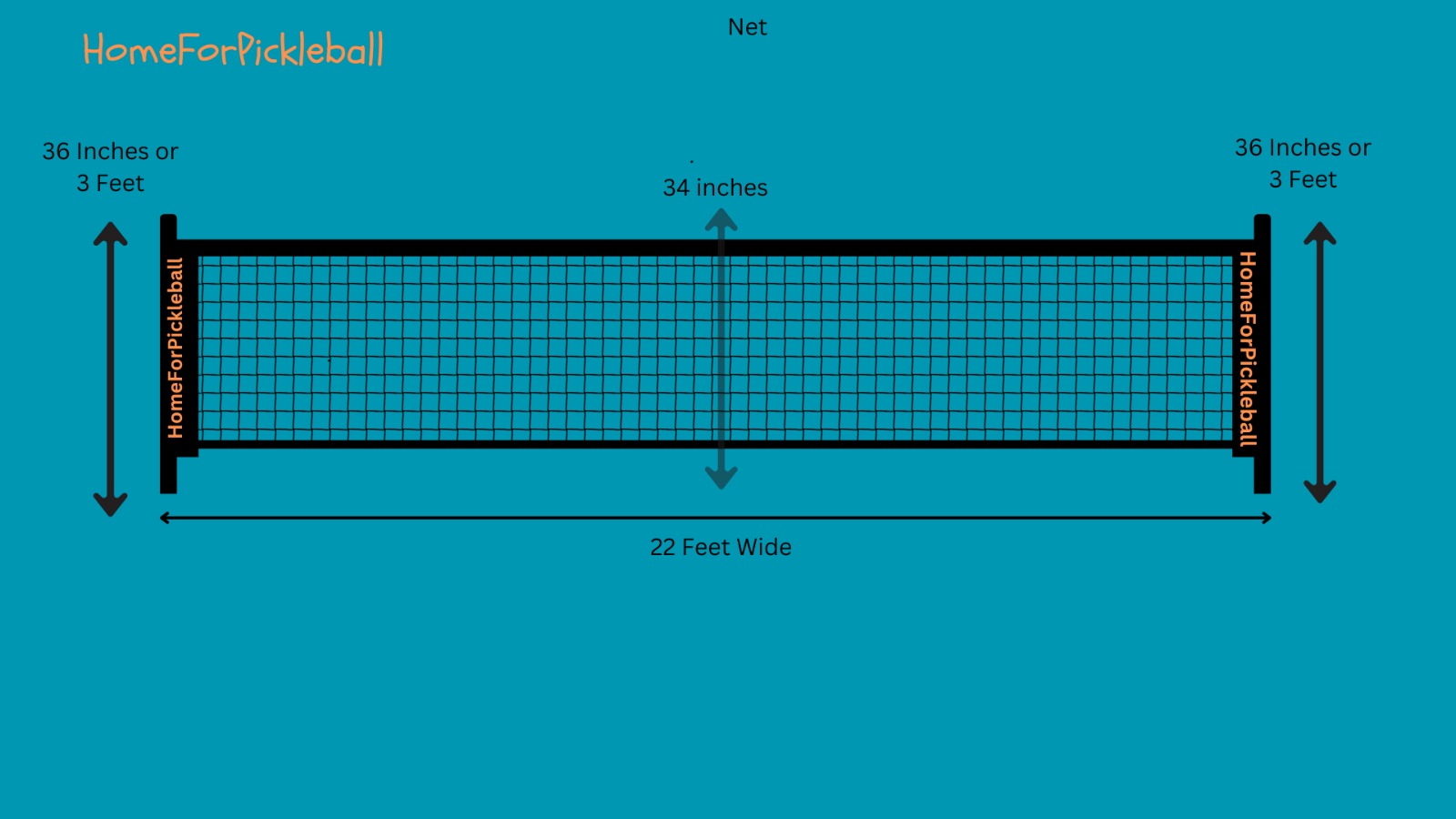
    USA Pickleball Rulebook, which is considered the official pickleball guide all over the world states that the right pickleball net height is 34″ in the middle and 36″ at the sidelines.

    What is the Pickleball net height?

    Now that we know that the pickleball net height is 34″ in the middle and 36″ at the sidelines, let’s learnt about the net width as well. As per the Official Pickleball rulebook, the width of a Pickleball net should be 22 feet wide with the net being set up one foot ahead in both directions beyond the sidelines of a 20-ft court.

    Pickleball net specifications and features

    Pickleball net materials

    The official Pickleball rulebook states that nets can be made of any mesh material as long as it can hold the ball from passing through. Most of the manufacturers use polyester, nylon, or polyethylene as the base mesh material

    How to make a Pickleball Net

    Nylon nets are the cheapest in comparison to other mesh materials with less durability being their biggest drawback.  For a permanent outdoor net, materials like polyethylene are ideal as it has the ability to withstand heavy winds, rains, and even stay intact despite regular exposure to UV rays from sunlight. 

    The top of the net should be edged with a 2-inch white tape binding over a cord or cable. This ensures that the top edge of the net is easily visible. The rules also suggest a center strap for permanent nets, which allows for easy adjustment of the net’s height.

    The best pickleball nets are always finding ways to bring more innovations to their designs, for eg incorporation of  straps or hook-and-loop closures or an added pouch for carrying your pickleball essentials, or a bottle holder at the base. 

    Pickleball net frames

    Portable pickleball net frames are made either of steel tubing or PVC. While Steel is on the heavier side and can require additional muscle to carry along, it is by far more effective in comparison to PVC-framed nets. The reason is that steel is much more sturdy, whereas PVC tends to move quite often due to wind or powerful shots. 

    Heres a pro tip on how to analyse if a portable pickleball net is of good quality or not. Simply look for a wide base frame that is made from interlocking powder-coated steel tubes that function just like camping tent frames and the latter will provide an added layer of  added stability.

    Pickleball net weight

    The weight of a basic pickleball net fluctuates between 25 lbs and 35 lbs, excluding the frame. You will also find carbon fiber framed pickleball nets which are costlier but lighter in nature. Although if you ask us, we would recommend sticking to carbon fiber paddles. The latest innovation for pickleball nets is detachable bags with wheels which serve as a means of transporting your pickleball gear.

    Pickleball net height vs Tennis net height

    As per the International Tennis Federation (ITF) the standard tennis height should be 36″ in the middle and 42″ at the sidelines. The pickleball net height is 34″ in the middle and 36″ at the sidelines. To sum it up there is a 2” height difference between a tennis and pickleball net.

    However, there is a more pronounced height difference between the sidelines and the middle on a tennis net due to its increased width. A tennis net is 33 or 42 feet wide, depending on whether it’s a singles or doubles court. On the other hand pickleball nets are normally set at 22 feet wide.

    Similarities between pickleball nets and tennis nets

    The basic design of Pickleball nets and tennis nets are quite similar as in both sport the net is placed in the middle of the court  to provide a barrier over which players have to hit.

    The materials used to make Pickleball nets and tennis nets are the same for basic nets, however, the stitching and weave techniques tend to be different between them due to weave sizes.

    Differences between pickleball nets and tennis nets

    The difference is clearly visible in the first glance it self, and if you dig deeper there are three major differences between pickleball nets and tennis nets. 

    1. The support posts of a tennis net are more sturdies than pickleball nets due to the latter being a larger net.
    2. Tennis nets are not portable whereas you will find it quite convenient and cheap to keep a portable pickleball net in your garage or even in your car. The reason being Tennis nets require built-in crank systems for increasing net tension which is not required for a pickleball net
    3. Youll also notice a different weave pattern in both nets, this is because tennis balls are smaller and faster in comparison to pickleballs. Thus tennis nets require a smaller weave and pickleball nets require a larger weave of pickleball nets.

    Can you play pickleball with a tennis net?

    The simple answer is yes pickleball can be played on a tennis court using a tennis net. Since it is just a couple of inches higher, a tennis net is the perfect alternative to a pickleball net for unofficial games or just practive. This proves that an extra couple of inches do not matter. 

    However, if your goal is tournament preparation then you might want to switch to an actual pickleball net as players who use a Tennis net enp with with the muscle memory of hitting shots a bit higher to clear the added net height. During tournaments your opponents will end up getting easier put away balls due to this.

    If you wish to stick with a Tennis net then you can check out any strap product called, “net converted”.  ConVERT aNet Pickleball Net Converter is one such example. How this product works is that it comes with a simple set of constricting straps that pull the tennis net down to match the net dimensions of pickleball.

    You can also find portable pickleball nets and if you wish to play on a makeshift pickleball court on a Tennis court, you can do so with the help of line chalk, removable tape, and measuring tape. Check out the correct Pickelball court dimensions,  if you need help on how to do the marking we have explained it in details here. 

    Where the pickleball net height came from

    The official pickleball net height orgins can be tracked from back in the days When the first pickleball game was played by Joel Pritchard and Bill Bell, they initially used a badminton net.

    The duo used a simple technique to decide the height of the net: Joel Pritchard would simply stand at the center of the net and see if it came up till his waist. 

    If the net was at the same height as his waist, it was accepted. Since Joel Pritchard’s waist was at a height of 34″, the height of the pickleball net was set at 34″ in the official rules.

    Bottom line

    To sum it up, the measurements of pickleball nets are 34 inches in height towards the middle and 36 inches at the sidelines. You are allowed to have a minimum of a foot of clearance on one or both sides of the 20-foot court as the width of the net is 22.

    Now given that a Pickleball court’s playing space and the court itself is smaller that the space needed for a Tennis court, the official pickleball net height is measured to be few inches shorter than a tennis net. 

    The net height , court space and ball dimensions combine to make Pickleball such an easy sport for everyone to get involved it (Yes I mentioned ‘sport’). But reaching that mastery level which separates the pros from the amateurs requires learning multiple combinations and consistency. The best part us that the game itself is still evolving so get out there and get playing and be part of the Pickleball Revolution!

    Can you use a tennis net for pickleball?

    Tennis nets can be used to play pickleball, albeit you will have to make slight adjustments as the nets in tennis are a couple of inches taller in comparison to standard pickleball nets. If you are looking to improve your shot percentage playing with a higher net could work to your advantage.

    What is the standard pickleball net height?

    As per the official Pickleball rulebook, a standard pickleball net should measure at 36″ high at the posts and 34″ high in the middle of the net.

  • How to play Pickleball

    How to play Pickleball

    Pickleball has arrived and who’s to say it will not be an Olympic sport soon? Having said that, get ready to learn how to play pickleball

    This guide on how to play pickleball covers all the rules of pickleball that are followed in professional tournaments, so as a total beginner, this is the stepping stone that will get you ready to hop onto the pickleball court, and for a pro pickleball player, this guide is a good read to know about the latest rule changes of the most entertaining sport out there.

    First things first, the essentials, what you need is a set of pickleball balls, a good pickleball paddle (this is absolutely important as it will play a major role in convincing you if pickleball is the sport for you or not), and lastly finding a pickleball court near you

    The best way to start playing pickleball, in my opinion, is to play a doubles match with people of similar level as you, if you do not have that, you can always join a beginners pickleball clinic to learn the basics, where you can also try of equipment on rental basis if you’re not ready to invest in gear yet.

    How to play pickleball

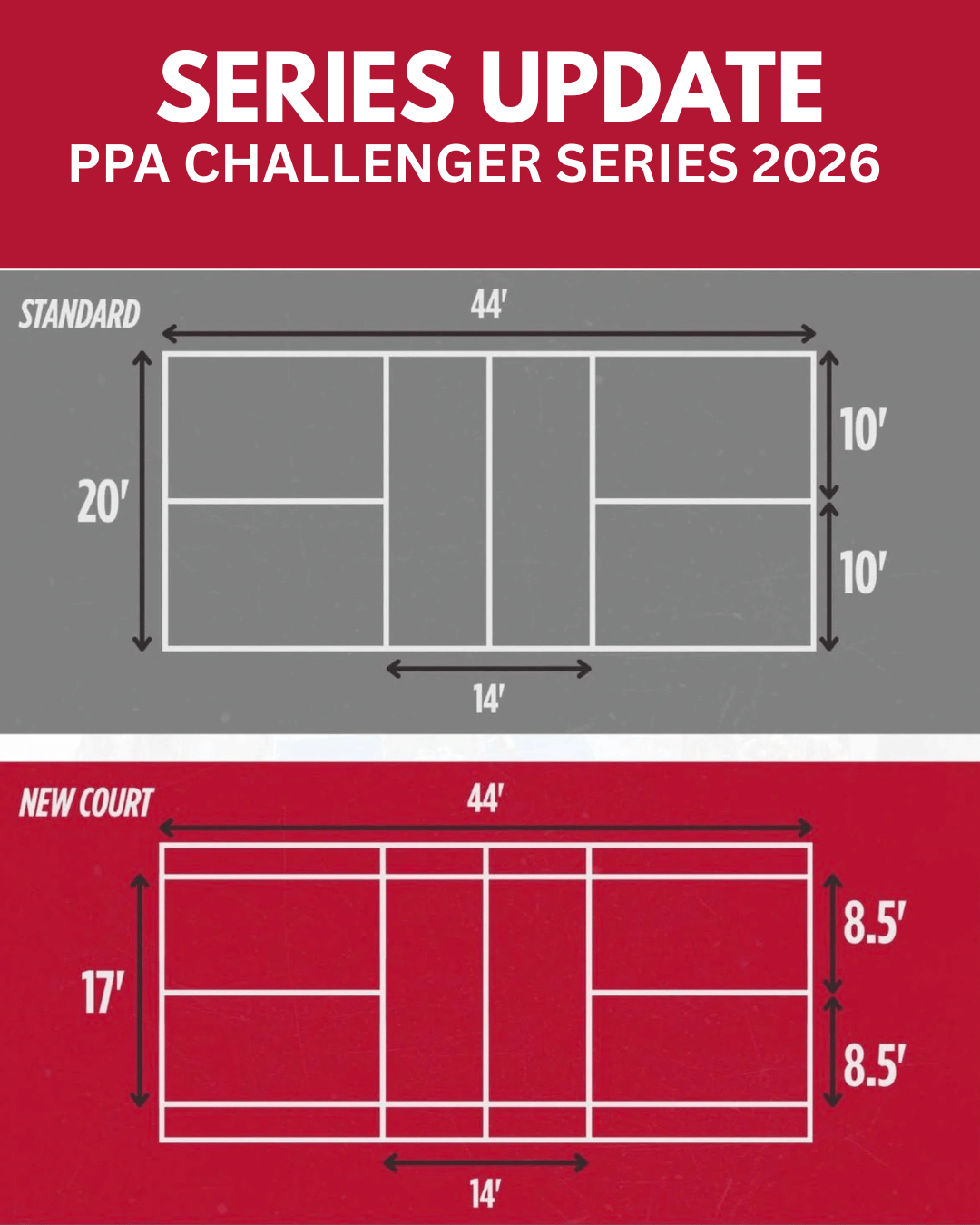
    Imagine a tennis court net on a badminton court and you have a Pickleball court ready. The official measurements of a Pickleball court is  (20′ x 44′) with a net height of 36″ at the sidelines and 34″ at the center. From the net, there is a non-volley zone at each end of the court (better known as the kitchen) where players cannot hit volleys (a shot hit out of the air), if a played does so, its considered a foul and the opponent team is rewarded a point. The non-volley zone measures at 7’ on each side.

    Now lets learn about the 7 major rules of pickleball that are followed in official tournaments, but before I begin, let me tell you that these rules are more doubles game focussed (2 players each side) so for all you singles enthusiast check out my detailed article on how to play singles pickleball, and gain some bragging rights in your local tournaments when you step on court as a singles player, with that being said lets take a look at the rules: 

    Rule #1: each rally begins with a serve

    The player standing on the right side of the court starts a pickleball game by serving. A serve is always done in toward the opponent standing in the diagonal court. A serve is how each point or rally is started. 

    There are two ways to do a legal serve , 1. Hit an underhand forehand or backhand after the ball bounces, or 2. Hit an underhand volley serve by hitting the ball right after you release it.  In both instances you have to make contact with the ball below the waist. 

    You also have to keep in mind certain aspects while releasing the ball to avoid a foul serve, read my guide on how to do a legal serve in pickleball to know more.

    Rule #2: the ball must bounce once on each side before either team can volley

    A volley in pickleball is when a player decides to hit a shot before the ball bounces. In a rally, all players need to let the call bounce once of each side of the court before deciding to start vollying. This rule is famous called the “two bounce rule” By professional pickleball organizations.

    So, always remember to stay behind the baseline when your partner is serving, a lot of beginners including myself have been caught  reacting with a volley to the opponents return of serve. 

    This rule is specifically designed to avoid a “serve and volley” Scenario, as it would give an unfair advantage to the service team who can easily rush the net as a pickleball court is small in comparison to a tennis court

    If you are looking to learn new vollying techniques, then check out my guide on how and when to volley in pickleball

    Rule #3: each point continues until a fault

    A play begins with a legal serve and continues until a rally is won by either a ‘fault’ being committed or if a player hits a winning shot. There are four faults that end a point in pickleball:

    An illegal serve: If a service is done with the paddle tap upwards and above the waist, or the serve lands in the kitchen (including the line) or beyond the baseline and sideline.

    The ball lands out of the playing area (outside the sideline or behind the baseline).

    The ball crashes in the net and falls on your side of the court.

    The ball bounces twice on one side before the player can return it.

    Rule #4: Volley shots are not allowed in the kitchen area

    Kitchen or non-volley zone in pickleball measures 7’ zone on each side of the net. A player cannot  hit a volley if any part of their body enters the kitchen (stepping on the kitchen line is also considered a foul). For a player to hit a successful volley, they must also ensure that they do not let their momentum carry them into the kitchen after smashing a volley.

    The only time you can step into the kitchen to play a shot is if the ball bounces in the kitchen. For eg: You can hit a shot in the kitchen if your opponent hits a short shot that touches the white tape of the net and lands in the kitchen area of your court.

    Rule #5: you only win points on your serve

    This scoring method is used in official Pickleball tournaments, as per this rule only the team that serves can win ponts and if the other team wins the rally they do not get a point but are awarded a break of serve. In doubles format, a non serving team has to achieve a break of service twice, as both opponents are required to serve.

    A team that is serving has to switch sides (left and right) between their partners and serve to the opponent standing in the diagonal court at the start of every rally.

    The referee calls “point” if the rally is won by the serving team or calls “side out” if the rally is won by the non serving team.

    Note: Since the beginning of 2025 , talks of rally points ( points regardless of which team serves) have been discussed citing reviews that it makes the game shorter and more exciting. If this rule is is made official, I will have it updated here.

    Rule #6: the correct score must be called before serving

    In pickleball you’ll often hear referees of players calling out three numbers before serving, which goes like “1-4-1”. Here’s what each number means:

    First Number

    serving team’s score

    Second Number

    Receiving team’s score

    Third Number

    Serving order of servers team, first server (1) and second server (2)

    ChatGPT said:

    Let’s say the score is 3–3. If you’re serving first, you’ll call out “3–3–1” — the last number shows you’re the first server on your team.

    If you lose the rally, the serve doesn’t switch sides yet. Your teammate now serves and says “3–3–2.”

    If your partner also loses the rally, that’s called a side out — meaning your team has lost both serves, and now your opponents get to serve. They’ll start their turn by calling “3–3–1.”

    There’s one special case: at the very start of a game, the first server calls “0–0–2.” This is because the serving team only gets one serve at the beginning, since they already have the first chance to score points.

    Rule #7: first team to 11 points wins—but you must win by 2

    By applying the above 6 rules, a game continues till one team reached 11 points. A total of 2 games of 11 points are to be won by one team in order for them to be declared the winner of the match. 

    If both teams reach 10 points each, the winner is declared by a difference of two points (popularly known as deuce). So the next time you see a 17-15 score line or a 23-21 scoreline know that, that was a quite exhilarating game.

    Also Read: What are the 5 basic rules of Pickleball

    What you need to play pickleball

    What equipment and gear is required to play pickleball

    First things first what you need is a partner or 3 others if you wish to start playing doubles. 

    Now comes the question of clothing, what do you wear? 

    While a basic non marking shoes paired which a sweat restantant tshirt and track pants/shorts is all you need to step on to the courts, I would recommend that you do invest into pickleball specific clothing, doing so would give you an additional confidence and sense of enjoyment on the courts. 

    Pickleball gear: while optional, I wou still recommend you get your own pickleball paddle and balls. However, most pickleball courts do offer paddles and balls on rental basis. 

    Last but no the least a pickleball court with accurate markings.

    Pro Tip: Choosing a paddle that suits your game is one of the most difficult things to do given the number of paddle options available in the market. You may see the pro’s applying tapes, using different grips, and even speed caps to know more about paddle modifications you can check out this ‘how to upgrade my paddle guide,’ now coming back to investing in a paddle, it is not cheap so to get a better idea on which paddle is best for you simply take this 15 second paddle buying quiz.

    How to set up a pickleball court

    If it is just an empty space, then you can check out this guide to learn the accurate measurement of a pickleball court, but in most instances, a court is already prepared with lines.

    With the growing buzz around pickleball, courts with permanent lines have become way more accessible, but you’ll still need a net as most courts do not install them. For such instances, I would recommend investing in a portable net which are easy to install.

    Types of shots in pickleball

    Knowing the names of shots in pickleball gives you a mental advantage over your opponents, as you would look well versed with the knowhow’s of the game.

    Drives: The shot that you hit with power after the ball bounces is called a drive, as the goal is to drive the ball with power. A drive is mostly hit on the forehand side but having a backhand drive would help you tremendously in tournaments.

    Drop Shots: A drop shot is your get-out-of-jail card when you are stationed at the baseline and want to make your way to the kitchen. A good drop shot execution is when the ball lands in the opponents kitchen and forces them to play a shot of the bounce. 

    Dinks: Dinks and drops are often looked upon as a same shot, however there is a main differentiator. The purpose of hitting a dink is to land the ball extremely close to the net in the opponents kitchen area. This shot is used to invite the opponent into the kitchen and hit a similar dink return for which you will be ready and can charge to hit a speed up. 

    Volleys: A volley shot is when you hit a ball out of the air before it bounces. You cannot hit these shots when you step inside the Kitchen.

    Lobs: A lob shot is when you hit the ball high in the air, normally it is played when the opponent is in the kitchen and to catch them off balance, but it is also used to defend heavy smashes coming your way.

    Overheads: An overhead shot is similar to badminton smashes, as the goal is to contact the ball at its highest point and smash it at your opponents feet or away from their strike zone.

    How to serve in pickleball

    A serve is the first shot of every Pickleball rally. As per the USA Pickleball Official Rules, you need to follow these pointers to execute a legal serve:

    • To execute a volley serve correctly you need to swing with an underhand stroke and make contact with the ball below the waist before the ball bounces.
    • You have to move your arm in an upward arc while making contact with the ball.
    • You cannot hold the paddle in a straight position while serving, meaning the paddle head will always have to face side ways or downward while serving. As long as the paddle head is not upwards you can use a backhand or forehand stroke in your serve.

    Update: Since 2021 both “volley serves” and “drop serves” are deemed legal as per USA Pickleball guidelines. Meaning you can execute a serve after dropping the ball and letting it bounce, (Multiple bounces are so far considered legal)

    Where to serve in pickleball

    In doubles pickleball, you always serve to the court diagonal from you. The ball must go completely past the kitchen line and land inside the area between the sideline and baseline. It’s okay if your serve lands on the baseline or sideline, but it can’t touch the kitchen line.

    Where to stand when serving

    When serving in pickleball, you must stay behind the baseline — your feet can’t touch the baseline or sideline while you serve.

    As the serving team, stay behind the baseline until after the third shot has been hit. If you rush toward the kitchen too soon, you might break the two-bounce rule.

    Tip: The returning team can use a “one-up, one-back” position. Since the serve has to bounce on their side first, this setup helps them move in quickly and start volleying after their return.

    Serving strategies

    Serving is the way to start a Pickleball rally which puts the server in a good position to command and possibly win the point on a serve itself (Called an Ace). Master these three key strategies to upgrade your pickleball serve from beginner to pro level.

    • Push it deep: By serving deep you can push your opponents behind the baseline which gives you time to come towards the kitchen line which will allow you to hit easier volleys and dictate the point.
    • Find your opponents weakness: Once you analyse which is your opponent’s weaker side (Forehand or backhand) you can target that side with your serve which will bring about more errors or a lofty return from your opponent. 
    • Spin it to win it (advanced): This is the most effective way to gain some easy points. Once you are comfortable with your serving routine, start practicing the art of applying spin to your serves. A spinny serve lets you catch your opponent off balance which will result in more unforced errors. 

    Learn more about pickleball serving rules

    What is an illegal serve in pickleball?

    If any of these below mentioned serving rules are not meet then the serve is considered illegal:

    • A serve is always supposed to bounce in the diagonal box, it can touch the baseline or sideline but must cross the kitchen line.
    • The server must stand behind the baseline while serving
    • Only underhand serves are allowed in Pickleball
    • The first serve is always done by the played standing in the even point side of the court and once their serve is broken the other player has to take over for the second serve.

    Types of serving mistakes

    While serving you need to be aware of these mistakes as they will lead to a faul and as a result award your opponents a very easy break of serve.

    Foot Faults

    The server’s foot touches the baseline or sideline while making contact with the ball on a serve.

    A Pre Spun Serve

    The server rotates the ball with his hand and then hits the spinning ball for the serve.

    Hitting The Net

    The ball hits into the net and falls back to your side of the court or lands in the opponents kitchen area which includes the kitchen line. If it hits the net but still lands in the correct service area, then it is considered a ‘let’ (earlier was considered a legal serve).

    Missing The Serve

    The server hits the serve outside the baseline, or not to the correct side.

    Also Read: What are the different types of serves in Pickleball

    How to start a game & keep score

    The Game of Pickleball starts with a serve — but who serves first? According to the USA Pickleball rulebook, any fair method can decide it. You can flip a coin, or follow local rules (some courts always have the north side serve first). Just agree on a method before starting.

    Once the serving side is chosen, the player on the right side of the court serves first. They’ll call out the score as “0–0–2.” Both teams start with zero points, and the “2” means the starting team only gets one serve to begin the game.

    After that first “side out,” each team gets two serves — one per player — before the serve switches sides again.

    Remember: a side out happens when the serving team loses both serves. Then it’s the other team’s turn to serve.

    There’s a lot to take in here, so let’s recap how to start a pickleball game:

    • Decide the starting team based on local rules or a coin toss.
    • The player on the right side of the court serves first.
    • The first server announces “0-0-2” as the starting score.
    • Players serve (out of the air or off the bounce) to the diagonal side
    • If the service is “good”, play continues.
    • After the first point is over (if won by the serving team), the next serve is hit from the left side of the server’s court. Points then alternate from left to right until the serve “sides out”.

    Learn more about how pickleball scoring works

    What is the two-bounce rule in pickleball?

    The “two-bounce rule” means that the ball must bounce once on each side after a serve before any player can volley the ball out of the air.

    Let’s use doubles as an example. When a player serves the ball, and it lands in their opponent’s court, that counts as the first bounce. After the opponent returns the ball, the serving team must wait for the ball to bounce again before hitting it.

    This means players can only “volley” the ball once the two-bounce rule has been fulfilled. If a player is standing close to the net before fulfilling this rule, they cannot legally hit it out of the air.

    So, it wouldn’t make any sense for the serving team to start at the kitchen. You should only start at the kitchen if you’re on the receiving team but not currently receiving the serve. This is because the ball will always have bounced twice before ever being hit to you.

    Once the two-bounce rule is fulfilled, all players are free to move to the kitchen area and begin volleying. This is often the most strategic place to be in pickleball.

    How to play pickleball doubles

    Pickleball doubles involves two players on each team and is by far the most popular way to play pickleball. Here’s a quick guide on where to stand:

    Since doubles is the most common variation, all the rules I’ve discussed so far apply here unless otherwise mentioned. This goes for things like serving, scoring, volleying, and the two-bounce rule.

    Learn even more about pickleball doubles rules

    How to play pickleball singles

    Doubles is the most popular format to play pickleball, but you can also play singles — one player on each side instead of two. The game works almost the same, with just a few key differences.

    Main Differences in Singles

    • The serving side after a side out depends on the player’s score.
    • The score call has only two numbers: your score first, then your opponent’s.

    Key Scoring Rules for Singles

    1. Each game starts with the serve from the right side.
    2. If the server wins the rally, they move to the left side to serve next.
    3. If the receiver wins the rally, no one switches sides.
    4. The server keeps serving (alternating sides) until they lose a rally.
    5. There’s only one serve per turn once the server loses a rally, it’s a side out, and the opponent serves next.

    Which Side to Serve From

    • Serve from the right side when your score is even (0, 2, 4, etc.).
    • Serve from the left side when your score is odd (1, 3, 5, etc.).

    Other than these small changes, all the usual pickleball rules — serving, faults, lines, and the kitchen — stay exactly the same as in doubles.

    Can you play pickleball by yourself?

    While it goes against the whole essence of Pickleball, you can indeed play Pickleball alone, the advantages of doing so include fast hands, improved hand-eue co-ordination, more confidence in approaching the kitchen, and turning your weaknesses into your strengths. Don’t know where or how to start solo? Then check out our guide on the best solo pickleball drills that you could even do in your bedroom giving a whole new meaning to Tyson McGuffin’s “Bedroom Cardio” quote.

    Here are the top three ways to get maximum value from solo pickleball sessions: 

    • Practice Wall:
    • You don’t need fancy equipment — any solid, upright surface such as a garage door or a sturdy wall works perfectly. Repeatedly hitting the ball against it is an excellent way to sharpen your precision, control, and reaction time.
    • Many players like to place a temporary net or tape line to ensure their shots stay at the right height. You can also draw or tape on specific targets, or hang a dedicated dink pad to simulate real play.
    • Rebound Net:
    • A rebound net is another great option for practicing alone. It returns the ball to you, helping simulate a rally with an opponent. These nets can be easily set up in your driveway, backyard, or even indoors. By adjusting the angle, you can change how the ball rebounds, giving you a variety of shot types to practice. Plus, they’re much quieter than hitting against a wall — ideal if you want to keep the peace with your neighbors.
    • Some players like to place a temporary net or draw a line across the wall to check that their shots stay at the right height. Others add taped targets to aim for, or hang a specialized dink pad to create a more realistic practice setup.
    • A pickleball machine: This is a cheat code that almost all the pro’s use, be it any match situation on any angle of the court you can practice a shot for every situation multiple times until it becomes first nature to you. So while investing in a pickleball machine is the most efficient way of getting better quickly, it can also be an expensive investment and not to mention take up real estate space at your home or garage so only go for it if you are fully committed to mastering the game

    One of the best pickleball machine’s to exist is The Erne that is able to hold more than 150 balls and can be programmed and operated via through its app which you can download on your phone. The app has in-built drill routines along with the option to add customized routines

    Tips for pickleball beginners

    As a beginner who’s just started playing pickleball, you could rapidly improve your game by following these tips: 

    • Take control of the kitchen: Once you hit a deep serve return, you are at an advantage as you have enough time to make your way near the kitchen line. A lot of beginners including the Tennis pros tend to stick to the baseline, which gives the opponent the advantage of taking control of the nets.
    • Pickleball is all about fast hands, once you’ve stationed yourself at the kitchen line, hold your paddle near your chest height with your arms stretched out, this is called a ready position which will help you take more balls out of the air and force your opponents into hitting an easy return.
    • Tight is not always right! Well atleast in pickleball, a lot of beginners tend to squeeze onto the handle while hitting a touch shot which is completely wrong as you will end up hitting one too many pop ups. What you want to be doing is loosen your grip, this will give you that smooth touch shot which will force your opponents to hit a dink reset.
    • Its all in the shoulder: With the aim to hit an over ambitious dink Beginners tend to flick their wrist on all touch shots—especially dinks, but doing so just generates extra pace on the bal which results in a pop up or the ball going out of play. To hit a precise dink you need to keep your wrist completely still and only let your shoulder rotate your arm.  Don’t be shy to follow through after making contact with the ball which will help you place your dink where you want it to go.
    • Drop it low: If you wish to hit a deep return or a drive with pace what you need to be doing is slightly bending your knees. This slight squat position combined with a spilt step routine will provide a stable base and keep you ready to hit all your shots with an added zit to them. Split stepping is honestly a cheat code which is a foundation of every pros game, so ive curated a detailed guide on what is a split step to help you inculcate this routine to your game
    • Lobs are for bob: Bob loves to lob his way while transitioning to the kitchen area, only to get smashed 9/ out of 10 times, bob will remain a beginner if he continues to do so, dont be bob.  While pro’s are not completely against lobbing, it is a low-percentage shot, by simply deciding to replace your lob shots by dinks you will start winning more points and over a period of time dinks will come naturally to you.
    • Patience is key: Regardless of the level of your opponent you do not want to use extra power on all your shots, instead construct the point find the right opportunity and hit a power shot when your opponent offers a pop up.
    • Be a master of the drop: While the Third shot drop shot is not as popular as it used to be, it is still the greatest weapon to have in your array of shots in pickleball. A drop shot is easy to hit but difficult to execute to perfection , hence to master it you need to practice it daily either with a coach, drilling partner or a pickleball machine.
    • Deeper is always better: You can push your opponents behind the baseline by simply returning deep or serving deep, this will let you take control of the kitchen area and set you up to hit a winning volley.
    • Practice makes you perfect: Like any other sport, you need to practise to get better. Beginners often end up skipping drilling sessions and directly playing matches. In drilling sessions you can specifically work on your weak areas which will give you the confidence to apply those shots the next time you play a match.
    • Paddle does make a difference: One could not emphasize enough on the wonders a good paddle would do to your gameplay. You do not need to buy the super expensive paddles, but find the one that suits your game the best, to simplify this we have curated a paddle quiz, take it to get a better idea of which is the best paddle for you 

    Bottom line

    All in all, if you have made it till here, you are already in love with Pickleball and are looking to play it as its meant to be played with the correct rules. So to summarise all that we have learned from this guide, here are the main rules that you need to keep in mind. You can screenshot this paragraph if you wish to access it quickly while on the courts: 

    1. An underhand serve is the first shot of every Pickleball rally  (forehand or backhand).
    2. The two-bounce rule must be followed before either team starts engaging in volley shots.
    3. A point is continued to be played until an error is made by either team
    4. The kitchen area including the kitchen line is a no volley zone, Period!

    Now without further adieu, Let’s play Pickleball!