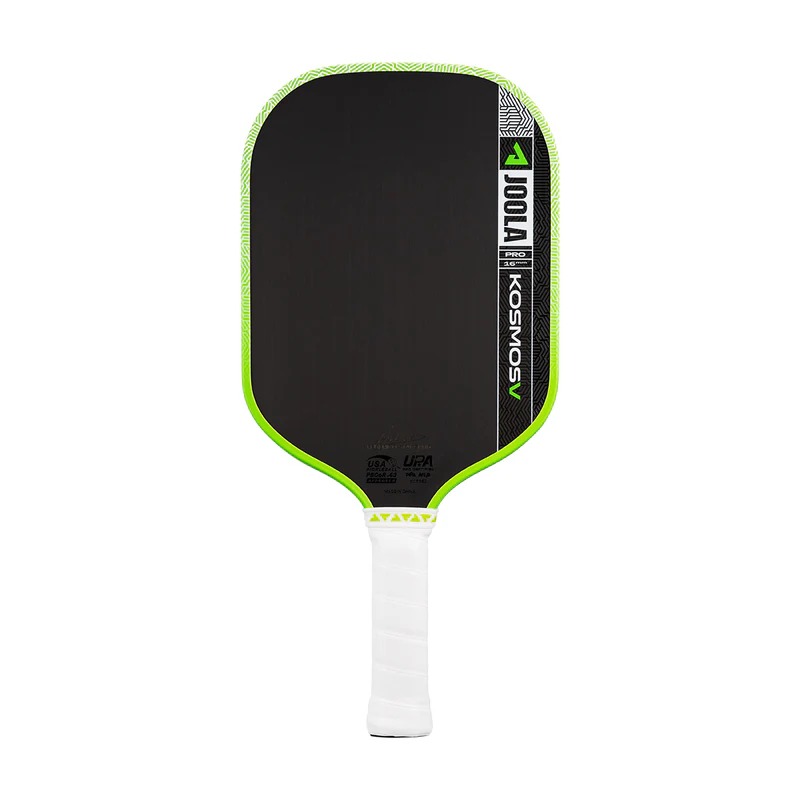
When JOOLA unveiled the Kosmos Pro V 16mm on March 3, 2026, it debuted as Federico Staksrud’s first signature paddle shape in the JOOLA lineup and arguably the most talked-about release in the brand’s Pro V series. The name Kosmos is fitting: JOOLA described it as the “missing link” in their lineup, blending the elongated reach of the Perseus with the wider forgiveness of the Scorpeus to create something genuinely new, a hybrid shape designed for all-court dominance.
I’m a 16mm player through and through. I’ve spent considerable time with the JOOLA Pro IV Perseus 16mm, and when the Kosmos landed in my hands, the transition was immediately interesting, not always comfortable, but interesting. This review covers every meaningful performance dimension of the Kosmos 16mm, along with an honest verdict on whether its $300 price tag can be justified given the number of options available in the market. Please note: This review is based on a 12-day usage of the paddle, one which I bought as any other regular customer. If you guys find my paddle reviews, do help me get my affiliate links so I can support my dream of becoming a paddle reviewer like John Kew.
JOOLA Kosmos Pro V 16mm — Full Specs
| Specification | Detail |
|---|---|
| Paddle Shape | Hybrid (Perseus × Scorpeus) |
| Paddle Length | 16.3 inches |
| Paddle Width | 7.7 inches |
| Core Thickness | 16mm (0.629″) |
| Average Weight | 8.1 oz (Range: 7.9–8.3 oz) |
| Paddle Face | Textured Carbon Fiber |
| Core Material | Honeycomb Propulsion (Polypropylene) + Hyper-Foam Edge Wall |
| Construction | Thermoformed, KineticFrame Technology |
| Handle Length | 5.25 inches (Elongated) |
| Grip Circumference | 4¼” (Medium) |
| Grip Style | Perforated, Cushioned (Feel-Tec) |
| Edge Guard | Yes |
| Approvals | USAP, UPA-A Approved |
| Warranty | 12 months (registration required) |
| Price | $299.99 |
| Signature Player | Federico Staksrud |
| Country of Manufacture | China |
Construction & Materials
The Kosmos Pro V doesn’t chase trends, and JOOLA will tell you that’s intentional. While most of the pickleball industry has stampeded toward full-foam Gen 4 cores in 2025 and 2026, JOOLA doubled down on their Gen 3 Honeycomb Propulsion polymer core, the same foundational material that powered the legendary Pro IV series. The difference this time is what’s wrapped around it.
KineticFrame Technology
The headline engineering feature of the Pro V series is the patent-pending KineticFrame. Inspired by kick-point engineering in hockey sticks and golf clubs, the KineticFrame modifies the frame structure to flex and recover during impact in a more controlled, parallel way rather than the traditional “diving board” neck flex seen in conventional thermoformed paddles. The result is a reduction in launch angle deviation (from ~4.5° in prior models to ~1.5° with the Pro V), meaning a more predictable ball exit on every shot.
Textured Carbon Fiber Face
The paddle face uses JOOLA’s proprietary textured carbon fiber, not raw T700 like you find on CRBN or many foam-core paddles, but a finish designed to balance spin generation with predictable response. The texture is noticeable but not aggressive, fitting the overall “precise power” philosophy JOOLA built the Pro V around. On contact, the face feels crisp and connected.
Hyper-Foam Edge Wall
New to the Pro V series, the Hyper-Foam Edge Wall supplements the polymer core at the perimeter. This addition contributes to a wider effective sweet spot and adds vibration dampening that makes the Kosmos noticeably more comfortable on repeated off-center contact compared to the Pro IV.
Thermoformed Construction
The Kosmos is built using thermoformed construction, a process that bonds the face to the core under heat and pressure to create a unified, dense structure. This contributes to the paddle’s pop and power potential, but is also why thermoformed paddles like this one carry a delamination risk over time, particularly with a polypropylene honeycomb core. More on this in the verdict.
Performance Breakdown: Rated & Reviewed
Swing Weight8.5 / 10
Relatively light for a 16mm paddle, making it one of the standout physical attributes of the Kosmos. Despite the hybrid shape’s added width, swing weight stays low enough that your hand speed doesn’t suffer during fast NVZ exchanges. If you’re coming from a traditional elongated 16mm, you’ll notice the Kosmos feels more manageable under pressure. It’s also forgiving on big, full swings; you can commit from the baseline without feeling the paddle take over your mechanics.
Twist Weight8.0 / 10
The twist weight on the Kosmos is on the heavier side, and that is a feature, not a bug. In hands battles at advanced levels, a heavier twist weight means the paddle stays square on contact rather than rotating on your grip. That fraction of added stability is the difference between a reset that sits in the kitchen and one that pops up for your opponent to attack. As someone who plays a lot of fast doubles, this is one of the quiet performance advantages of the Kosmos that doesn’t show up in a spec sheet. I would also like to point out that I did not feel too much vibration on off-center shots, which i generally feel with other 16mm paddles.
Sweet Spot8.5 / 10
Surprisingly wide for a paddle at this performance level, but it’s a controlled sweet spot, not an explosive one. The Hyper-Foam Edge Wall pushes the effective hitting area toward the perimeter, meaning mishits don’t punish you as harshly as on the narrower Perseus. That said, don’t mistake width for liveness. The Kosmos sweet spot is designed to keep the ball in play with precision, not to juice every contact with extra pace. For dinks, drops, and transition resets, this is exactly what you want.
Handle (Elongated, 5.25″)9.0 / 10
The 5.25-inch handle is a genuine strength of the Kosmos 16mm. It provides enough real estate for two-handed backhands without feeling oversized, and the Feel-Tec perforated cushioned grip sits well in the hand during long sessions. Two-handed players will feel right at home. Single-handed players will find the length natural and the 4¼” grip circumference ideal for a medium-grip preference. No fatigue issues observed during extended play.
Dwell Time9.0 / 10
This is where the Kosmos 16mm meaningfully separates itself from the Pro IV 16mm, and from most 16mm paddles in this price bracket. The dwell time is noticeably longer: the ball stays on the face a fraction longer at every contact point, whether dinking softly at the kitchen or driving from the baseline. The practical outcome is exceptional shot shaping. Topspin comes easily, slice bites cleanly, and returns, both dinks and drives, arrive with more shape and predictability than you’d achieve with a faster-rebounding paddle. In my experience, this longer dwell time adds spin on every single return, giving the ball good shape going into your opponent’s side.
Power6.5 / 10
Honest rating: roughly 75% compared to dedicated power paddles. The Kosmos is not a power paddle, and JOOLA makes no pretence of that. The KineticFrame’s “precise power” philosophy means the paddle amplifies your mechanics rather than adding free pace. If your technique is strong and you generate your own power through kinetic chain and swing path, the Kosmos rewards you with clean, well-directed drives. If you rely on your paddle to generate pace on serves and drives, then do not expect the Kosmos to do that for you. Players coming from the Pro IV will specifically notice a reduction in passive pop off the face.
Pop / Put-Away Ability9.5 / 10
This is the Kosmos 16mm’s standout feature, barely edging out its dwell time. High balls become weapons in your hand. I was able to put away overhead opportunities with a confidence I haven’t felt in many 16mm paddles, which tend to soften the response too much on aggressive overheads. The pop on finishing shots is distinctly sharper than what the dwell time metric would suggest; the KineticFrame’s stored energy releases cleanly on full-swing contact. Initially, I struggled in hands battles because I’m accustomed to 16mm paddles, and the Kosmos required adjustment. But once I found my rhythm, the pop in fast exchanges became a genuine offensive weapon. When you’re set up and going for a finish, the Kosmos delivers.
Pros & Cons at a Glance
Pros
- Outstanding dwell time: best-in-class for shot shaping
- Standout pop on high balls and put-away shots
- Heavy twist weight stabilizes hands-battle exchanges
- Light swing weight for a 16mm: fast in hand
- Wide, controlled sweet spot: forgiving on mishits
- Elongated handle perfect for two-handed backhands
- USAP & UPA-A tournament approved
- 12-month warranty (registration required)
Cons
- $300 price is hard to justify for most players
- Power output is below average: you must generate your own
- Polypropylene honeycomb core risks delamination under 12 months
- Requires 4.0+ skill level to fully exploit
- Hands battles take adjustment time switching from other 16mm paddles
- No Gen 4 foam core — durability concern vs. competitors
- Cheaper alternatives offer comparable performance
⚠ Durability Alert: JOOLA has retained the Honeycomb Propulsion polypropylene core for the Pro V series. While KineticFrame adds carbon reinforcement at the upper frame, historically prone to core crush in Gen 3 thermoformed designs, the fundamental delamination risk remains. Based on the track record of similar paddles, players who log heavy hours should realistically budget for potential delamination within 12 months. At $300, that’s a legitimate concern.
Pricing & Value: Is $300 Justified?
This is the most difficult question the JOOLA Kosmos 16mm faces, and I’ll be direct. I am a genuine fan of Federico Staksrud’s game. His strategic, composed approach is exactly what the Kosmos was engineered to express. But being a fan of the player does not mean the paddle is the right recommendation for most buyers.
At $299.99, the JOOLA Kosmos 16mm sits at the absolute premium end of the market. For context, the Friday Aura Pro Elongated, a Gen 4 full-foam paddle with competing performance metrics, is available for around $159. The CRBN TruFoam Barrage comes in at $279.99 with a newer core architecture. The SLK ERA Power sits at $200 with a comparable feel profile for aggressive players.
The Kosmos’s value proposition rests on KineticFrame precision, Federico’s design input, and JOOLA’s brand heritage. Those are real things. But they don’t offset the reality that the core material is the same honeycomb polypropylene that has delaminated in competitive players’ Pro IV paddles, and the paddle’s performance ceiling requires a certain skill level to access.
I would not recommend this paddle to the masses, the pricing does not justify the durability concern, and you need to reach a certain level to truly adapt to and extract value from the Kosmos 16mm.
That said, if you’re a 4.5+ player who values shot shaping, dwell time, and controlled pop above all else, and you replace paddles regularly anyway, the Kosmos 16mm is genuinely excellent at what it does. The pop is special. The dwell time is special. The twist weight in hands battles is special. It just needs to be the right player at the right price point.
How Does It Compare? Head-to-Head Table
Here’s how the JOOLA Kosmos Pro V 16mm stacks up against four of its closest rivals across key buying factors:
| Paddle | Price | Core Type | Thickness | Power | Control | Pop | Durability Risk | Best For |
|---|---|---|---|---|---|---|---|---|
| JOOLA Kosmos Pro V 16mm ★ | $299 | Gen 3 Poly | 16mm | Moderate | Excellent | Standout | Medium-High | 4.5+ Control-First |
| CRBN TruFoam Barrage | $279 | Gen 4 Foam | 14–16mm | High | Good | High | Low | Aggressive Power Players |
| SLK ERA Power | $200 | Gen 3 + EVA | 16mm | High | Good | Good | Low | 3.5–4.5 Power-First |
| Luzz Inferno Pro 4 | ~$165 | Gen 4 MPP Foam | 16mm | Moderate | Good | Good | Very Low | Budget-Conscious 3.5–4.5 |
| Friday Aura Pro | $159 | Gen 4 EPP+EVA | 16mm | High | Good | Explosive | Very Low | All Levels, Value Seekers |
Key Takeaway: The Friday Aura Pro and SLK ERA Power deliver comparable or superior power output at $100–$140 less than the Kosmos, with significantly lower durability risk thanks to Gen 4 foam cores. The Kosmos’s advantages: dwell time, shot-shaping precision, and twist-weight stability are real, but they primarily manifest at the 4.0+ level.
Who Should Buy the JOOLA Kosmos 16mm?
Buy It If You…
- Play at 4.0 DUPR or higher with an established soft game
- Have the technical ability to generate your own power on drives and serves
- Prioritize shot shaping, controlled dwell time, and dinking precision over raw firepower
- Are a fan of Federico Staksrud’s strategic, transitional style of play
- Replace paddles regularly, and durability is less of a concern
Skip It If You…
- Play below 4.0 and are still developing fundamentals
- Want a paddle that helps generate pace, the Kosmos requires you to supply that yourself
- Are concerned about durability and don’t want to spend $300 every 10–14 months
- Primarily want power and pop on serves and drives, the CRBN TruFoam Barrage or Friday Aura Pro serves you better at lower cost
- Are budget-conscious, the SLK ERA Power and Luzz Inferno Pro 4 offer excellent value at significantly less
Final Verdict
7.5 out of 10: Very Good, with Caveats
The JOOLA Kosmos Pro V 16mm is a technically excellent paddle with a genuinely special pop profile and the best dwell time I’ve experienced in the 16mm Gen 3 category. But durability concerns tied to the polypropylene core, a power output that demands high-level technique, and a $300 price tag in a market flush with outstanding Gen 4 alternatives mean it earns a conditional recommendation, outstanding for the right player, hard to justify for everyone else.
FAQ’s
Is the JOOLA Kosmos 16mm good for beginners?
No. The Kosmos 16mm is a precision performance paddle designed for players at the 4.0 DUPR level and above. Its power profile requires you to generate pace through your own technique; beginners and intermediate players will find it underwhelming on drives and serves. We recommend something like the SLK ERA Power or Friday Aura Pro for players below 4.0.
How does the JOOLA Kosmos 16mm compare to the JOOLA Pro IV Perseus 16mm?
The Pro IV Perseus 16mm has a more explosive, “free” pop profile, meaning the paddle contributes more passive pace on shots. The Kosmos Pro V is quieter, softer, and more controlled, with significantly more dwell time and better shot shaping. The KineticFrame reduces launch angle deviation, making it more consistent but requiring more player-generated power. If you want the livelier, poppier paddle, stick with the Pro IV. If you want shot-shaping precision and controlled power, the Kosmos is the step up.
What skill level is the JOOLA Kosmos 16mm designed for?
The Kosmos 16mm is designed for high-level all-court play at the 4.0–5.0+ DUPR range. The Pro V series is built around “precise power,” meaning the paddle amplifies your mechanics rather than providing free pace. Players who can generate their own power and rely on placement, dwell, and shot shaping will extract the most value from this paddle.
Is the JOOLA Kosmos Pro V worth $300?
At $300 with a honeycomb polypropylene core that carries a meaningful delamination risk within 12 months of regular competitive play, the Kosmos’s value proposition is difficult to justify for most players. Excellent Gen 4 foam-core alternatives, including the Friday Aura Pro at $159 and the SLK ERA Power at $200, offer comparable or superior durability and performance for $100–$140 less. For elite 4.5+ players who specifically need the Kosmos’s dwell time and shot-shaping precision, the premium may be justified.
What is JOOLA KineticFrame technology?
KineticFrame is JOOLA’s patent-pending frame engineering system introduced with the Pro V series. Inspired by kick-point engineering in hockey sticks and golf clubs, the KineticFrame redesigns the paddle’s frame and throat to flex and recover parallel to the paddle face during impact. The result is a more predictable ball exit trajectory on every shot, with reduced launch angle deviation from ~4.5° to ~1.5° compared to the Pro IV series.
What is the difference between the JOOLA Kosmos 14mm and 16mm?
The 14mm Kosmos is Tyson McGuffin’s version, designed for players who prioritize fast hands, more pop in exchanges, and aggressive attacking play. The 16mm is Federico Staksrud’s version, designed for more dwell time, greater control, softer feel in transitions, and a broader sweet spot. Choose the 16mm for control-first or soft-game-heavy play; choose the 14mm for maximum speed and offensive pop.
Will the JOOLA Kosmos 16mm delaminate?
It’s a legitimate risk. The Kosmos uses JOOLA’s Honeycomb Propulsion polypropylene core, the same core family used in the Pro IV, which has a documented history of delamination in competitive players who log high hours. JOOLA has added carbon fiber reinforcement to the upper frame in the Pro V, which may help. But players who play 4+ times a week should realistically account for potential delamination within 12 months. The 12-month warranty (registration required) provides some protection; confirm the terms carefully before purchase.
What paddle shape is the JOOLA Kosmos?
The Kosmos is JOOLA’s first hybrid shape, blending the elongated reach of the Perseus with the wider body of the Scorpeus. At 16.3″ × 7.7″, it sits between the two: longer than a standard paddle, wider than a pure elongated, more forgiving than a narrow performance shape. JOOLA positions it as the “Goldilocks” shape for all-court play.
Which pros use the JOOLA Kosmos 16mm?
The JOOLA Kosmos Pro V 16mm is Federico Staksrud’s signature paddle. Staksrud is a top-ranked professional on the PPA Tour and one of the most strategically sophisticated players in men’s professional pickleball. The Kosmos 16mm was designed to match his composed, transition-heavy playing style.