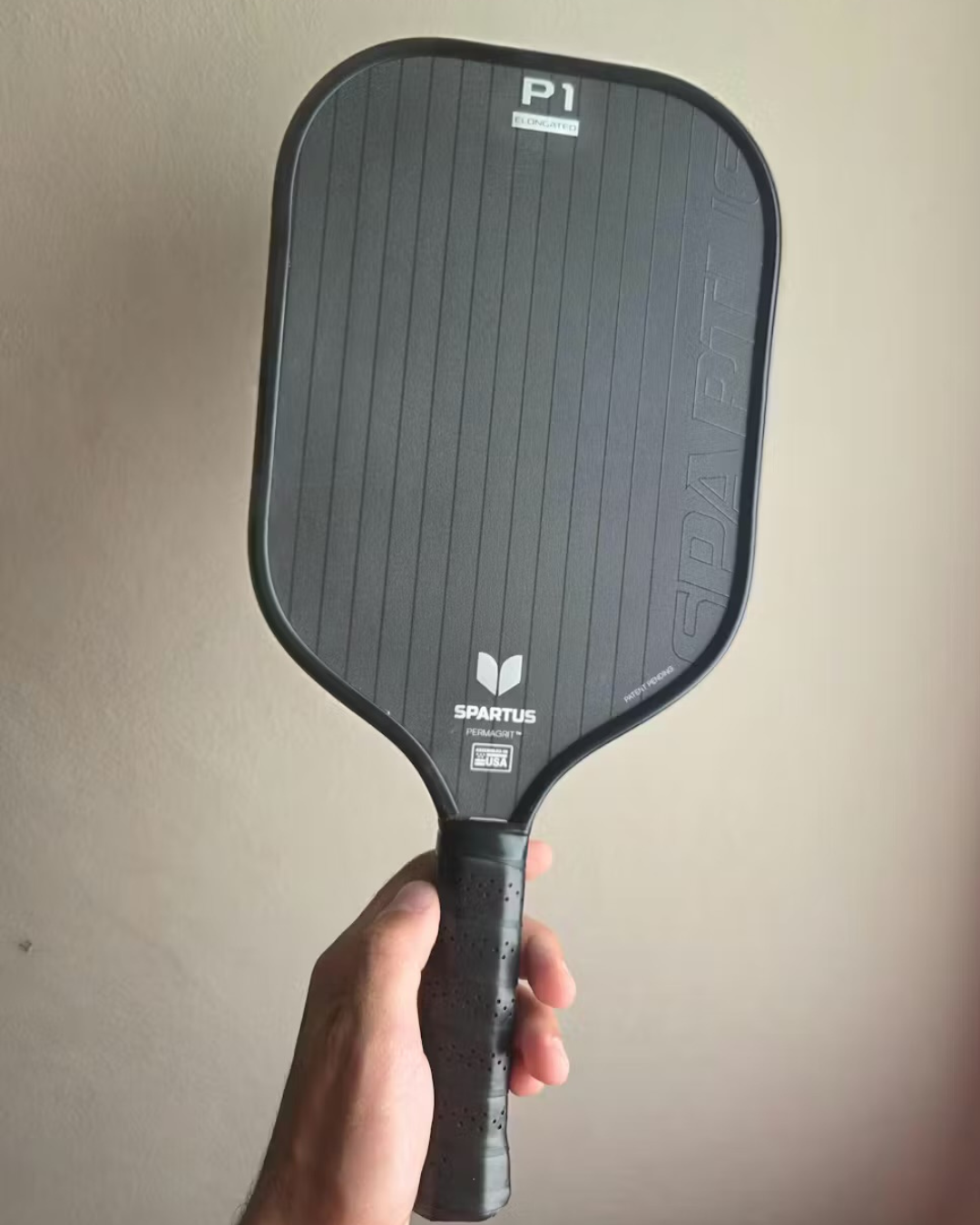
The Spartus P1 arrived quietly in January 2026, but the pickleball community quickly noticed. It launched as one of the first paddles in the market to solve what had become the sport’s most persistent equipment complaint: raw carbon fiber paddles losing their grit, and therefore their spin, after just a few months of heavy use. The P1’s answer is PermaGrit™, a patent-pending ceramic-hybrid surface that embeds particles directly into the face rather than relying on a surface texture that gradually wears away. Combined with a Gen 4 floating EPP foam core and assembled in the USA, the P1 pitches itself as a “long-term weapon” at a refreshingly honest $219.99 price point.
I’ve spent considerable time on court with the Spartus P1 Hybrid, the flagship shape in the P1 lineup. This review covers every meaningful performance dimension in honest detail, from the head-heavy swing weight to the surprisingly strong dwell time, along with a clear-eyed verdict on who this paddle is and isn’t for. If you are a doubles player who puts spin on every shot and wants a durable paddle that holds up for the long haul, keep reading.
Spartus P1 Full Specs Table
| Specification | Detail |
|---|---|
| Available Shapes | Hybrid (reviewed), Standard / Widebody, Elongated |
| Paddle Length (Hybrid) | ~16.3 inches |
| Paddle Width (Hybrid) | ~7.7 inches |
| Core Thickness | 16mm |
| Average Static Weight | 8.1–8.22 oz |
| Swing Weight | 116–119 (head-heavy profile) |
| Twist Weight | 6.7–6.9 (above average stability) |
| Balance Point | ~24.4 cm (head-heavy confirmed) |
| Paddle Face | PermaGrit™ Ceramic-Hybrid Surface (CFC composite) |
| Core Material | Gen 4 Floating EPP Foam + EVA Perimeter Ring |
| Construction | Floating foam core; Assembled in USA |
| Handle Length | ~5.0–5.25 inches (short; fits two-handed shots) |
| Grip Circumference | 4¼” (Medium) |
| Includes | Free neoprene paddle cover ($20 value) |
| Approvals | USAP Approved (tournament legal) |
| Warranty | Standard Spartus warranty (verify current terms at gospartus.com) |
| Price | $219.99 |
| Assembly | USA |
Construction & Materials
The Spartus P1 is built around two innovations that work together in a way that’s genuinely unusual in the 2026 paddle market. Most manufacturers have chosen one direction, go full Gen 4 foam for durability and feel, or stay with thermoformed Gen 3 carbon for explosive performance. Spartus did something different: they paired a Gen 4 floating EPP foam core with a completely proprietary ceramic-hybrid surface that redefined how grit can behave.
PermaGrit™: The Ceramic-Hybrid Surface
PermaGrit is the headline feature of the P1 and the technology Spartus has staked its reputation on. Traditional raw carbon fiber paddles use a “peel-ply” surface texture, think of it like a very fine sandpaper weave that is applied on top of the carbon face. The problem is that this texture physically abrades with use: the microscopic surface peaks get worn flat, and by month three of serious play, your drives start sailing long because the face can no longer grip the ball. Players who play four or more times per week often find themselves replacing paddles every quarter.
PermaGrit takes a fundamentally different approach. The ceramic particles are embedded into the face material itself rather than applied on top. Independent playtesters have reported virtually zero spin degradation even after 50+ hours of play, and Pickleball Studio’s grit-wear testing found 0% degradation over 80 games, a number that no traditional raw carbon paddle comes close to matching. On contact, the PermaGrit surface feels distinct: it has a slightly tacky, grippy quality that resembles running your finger across rubber rather than sandpaper. The ball literally sticks to the face for an extra microsecond, which is exactly what translates to higher spin output on brushing strokes and topspin serves.
The surface also has a crystalline visual quality, it actually sparkles in sunlight. This is not a cosmetic trick; it is a byproduct of the ceramic-particle composition and gives the P1 a distinctive look that immediately stands out on court.
Gen 4 Floating EPP Foam Core + EVA Perimeter Ring
Beneath the PermaGrit surface sits Spartus’s Gen 4 Floating-Foam Core. This is an expanded polypropylene (EPP) foam construction, the same core technology that powers the top-tier paddles from CRBN, Six Zero, and Friday Pickleball. Floating foam cores differ from traditional honeycomb polypropylene in a critical way: the core is a dense, continuous foam structure rather than a series of hollow cells. This means the core cannot “crush” under pressure (a known failure point in thermoformed Gen 3 paddles), and it maintains consistent performance characteristics across the entire face rather than behaving differently at the center versus the edges.
Surrounding the EPP core is an EVA perimeter ring, a softer, energy-absorbing foam layer at the edges. This ring serves two functions: it expands the effective sweet spot by stabilizing off-center contact, and it adds a layer of vibration dampening that makes the P1 more comfortable on repeated impact than a pure EPP or standard thermoformed paddle. The combination of dense EPP center and softer EVA perimeter creates what Spartus calls a “controlled force” response, powerful and predictable on full swings, composed and soft on resets.
CFC Composite Paddle Face
Independent testing has revealed that the P1 face material is a CFC (carbon fiber composite) layup, a blend of carbon fiber and fiberglass rather than pure T700 raw carbon. This is not a negative. The fiberglass component is what gives the P1 its denser, less hollow feedback on contact compared to paddles with pure raw carbon faces. It also explains the PermaGrit surface’s ability to retain its texture: the substrate beneath the ceramic particles is denser and more stable than pure peel-ply carbon, giving the embedded particles better structural support over time.
Performance Breakdown: Rated & Reviewed
Swing Weight 7.0 / 10
The P1’s swing weight landing between 116 and 119 is firmly head-heavy and this is expected, even natural, for a dense 16mm floating foam paddle. The mass in the head gives you real plow-through on drives and overheads, which is why the paddle feels authoritative on full swings from the baseline. It is also very forgiving on big swings: you do not need to time the paddle precisely because the head weight carries the ball through contact. The downside is that the head-heavy balance makes the paddle physically taxing over long sessions, and quick hand-speed adjustments in NVZ battles take slightly more effort than with a lighter, more balanced paddle. For players who can sustain the weight, the stability dividend is real and meaningful.
Twist Weight7.5 / 10
The twist weight sits in the 6.7–6.9 range, which is strong for a hybrid-shape paddle strong enough that you will feel wrist lag on fast exchanges if your wrist and forearm strength is not well-conditioned. Off-center hits stay surprisingly square and directionally honest, which is a genuine competitive advantage in hands battles at the NVZ. But the physical cost of that stability is real: the heavier twist weight means the paddle resists sudden directional changes. I would not recommend the Spartus P1 to players who have a history of arm injury, shoulder problems, or weak wrists. The combination of head-heavy swing weight and elevated twist weight is taxing even for healthy, well-conditioned players during long sessions. If you flag any of those concerns, look at the Six Zero Coral or Friday Aura instead, both of which are more ergonomically forgiving.
Sweet Spot 9.0 / 10
Genuinely surprising for a paddle in this weight and swing-weight class. The EVA perimeter ring working in combination with the EPP core creates a sweet spot that is wider than most players expect when they first pick the P1 up. Mishits lose pace but stay directionally controlled the face stays square on off-center contact far more often than a standard 16mm thermoformed paddle would. The PermaGrit surface compounds this advantage: on volley exchanges, the tackier surface grabs the ball even on slightly off-center contact, which produces spinny, shapeful volleys that stay in the kitchen. This is one of the P1’s genuine standout qualities. Put the ball in the right zip code and the paddle rewards you consistently.
Handle (Short, ~5.0–5.25″) 7.5 / 10
The handle on the P1 Hybrid is on the shorter side compared to the current wave of elongated handles dominating the market. That said, there is enough room for two-handed backhand shots without feeling cramped, and one-handed players will find the length comfortable and natural. The grip circumference is a medium 4¼”, which suits the majority of players well. The stock grip has a pleasant feel out of the box. Where the shorter handle becomes a notable trade-off is on serves and returns where players want maximum leverage and reach those shots may feel slightly more compact. If extended reach is important to your game, consider the P1 Elongated shape when it becomes more widely available.
Dwell Time 9.0 / 10
This is where the combination of Gen 4 construction and PermaGrit becomes genuinely greater than the sum of its parts. The floating EPP foam core creates a longer dwell time than traditional thermoformed paddles the ball stays on the face a fraction longer, giving your stroke mechanics more time to impart spin and shape. But the PermaGrit surface takes this further: the ceramic-hybrid tackiness means the ball grips the face during that extended contact window, allowing you to add more rotational force than a smoother or worn surface would permit. The practical result is that returns whether a dink, a drive, or a reset carry noticeably more shape and force than you would produce with a standard 16mm paddle at the same swing speed. The ball exits with spin that actually curves and dips. For spin-oriented players, this dwell-time and PermaGrit combination is the best reason to choose the P1 over its competitors.
Power 6.5 / 10
Power is the P1’s honest weak point and I say that without it being a dealbreaker. Placed on a spectrum, the P1 sits in the mid-tier among power paddles. It is not a power-first weapon like the Six Zero Black Opal or the CRBN TruFoam Barrage. The EPP foam core absorbs more impact energy than a stiffer thermoformed structure, and the PermaGrit surface’s tackiness actually slows the ball’s exit velocity marginally compared to a slicker, harder carbon face. What this means in practice: for players who generate their own power through swing mechanics and kinetic chain, the P1 delivers clean, well-directed drives with satisfying depth. For players who rely on the paddle to do the power work, the P1 will feel underwhelming on hard drives and serving. This profile makes it ideally suited for doubles players who prioritise spin, placement, and consistency over raw pace which is exactly the correct strategy for most doubles formats.
Pop / Put-Away 6.0 / 10
Pop is where the P1 feels most limited and in a curious way. In my experience, the PermaGrit surface is so grippy that it actually seems to absorb some of the sharp, crisp rebound energy that players associate with “pop.” The ball grips the face, dwells, gets spin applied, and then exits with shape and pace, but not with the explosive trampoline snap you feel with a raw carbon Gen 3 paddle or even the Six Zero Black Opal. At the NVZ during speed-up exchanges, you will notice this most: the P1 is composed and stable, but it does not give you that extra burst of energy on aggressive volleys that finishers want. If your game relies heavily on fast hands and put-away pop, the P1 is not your paddle. If your game is built on spin-heavy, placed volleys that make opponents work for every shot, the lack of pop becomes a non-issue because you are not relying on the paddle to finish points with explosive force.
Pros & Cons at a Glance
Pros
- PermaGrit™ surface, industry-leading grit longevity (0% degradation over 80 games)
- Outstanding dwell time enhanced by ceramic-hybrid tackiness
- Surprisingly wide sweet spot for a paddle this dense
- Spinny, shape-heavy volleys even on off-center contact
- Heavy twist weight = steady face in hands battles
- Excellent durability, EPP foam core resists crush
- Strong value at $219.99 vs. competitors
- Includes free neoprene cover ($20 value)
- USAP approved for tournament play
- Fun, serious, and recommended for all levels
Cons
- Head-heavy swing weight, taxing over long sessions
- High twist weight causes wrist lag; not for arm-injury-prone players
- Mid-tier power, you must generate pace yourself
- Pop is the weakest attribute, not a finisher’s paddle
- Short handle may limit reach on elongated shots
- Best suited for doubles rather than singles-dominant players
⚠ Arm Injury Warning The Spartus P1’s combination of head-heavy swing weight (116–119) and elevated twist weight (6.7–6.9) places a real physical demand on the wrist, forearm, and shoulder. Players with a history of tennis elbow, golfer’s elbow, rotator cuff issues, or general arm fatigue should approach this paddle with caution. Consider the Six Zero Coral (lighter, more balanced) or the Friday Aura (softer feel, lower physical demand) as alternatives.
Pricing & Value: Is $219 Worth It?
At $219.99, with a free neoprene cover included, the Spartus P1 represents strong value in the context of the 2026 market. This price puts it meaningfully below the Six Zero Black Opal ($250), the JOOLA Kosmos Pro V ($299), and even the CRBN TruFoam Barrage ($279). More importantly, the P1’s durability story changes the value calculation compared to every paddle at similar or higher price points. When a raw carbon fiber paddle at $250 needs replacing after four months because the grit has worn flat, the “cheaper” P1 at $219 may outlast two of those paddles on spin performance alone.
I would strongly recommend the Spartus P1 to players across all skill levels, with the caveat that arm-injury-prone players read the warning above carefully. The combination of long-lasting grit, EPP core durability, a generous sweet spot, and the unique dwell-plus-PermaGrit spin experience makes this one of the most honest, player-friendly paddle launches of 2026. It is a fun paddle to play with, and it is serious enough for tournament use. At $219 that combination is rare.
“The Spartus P1 is one of the few paddles I’ve played where I stopped thinking about the equipment after about twenty minutes. It just lets you play pickleball, and it rewards spin-first players every single rally.”
💡 Who Is This Paddle Built For? The Spartus P1 is at its best in the hands of doubles players at any level who love applying spin on every single shot, dinks, drives, serves, returns. If you describe your game as placement-first, spin-heavy, and rally-oriented rather than power-first and point-ending, the P1 will feel like it was made specifically for your style. It is also ideal for any player who is tired of replacing paddles every three to four months due to grit degradation.
Who Should Buy the Spartus P1?
Buy It If You…
- Love applying spin on every shot and want a surface that keeps that spin alive for months, not weeks
- Play primarily doubles and prioritise placement, rally construction, and spin-heavy dinking
- Are tired of replacing paddles every 3–4 months because the grit wears out
- Want strong dwell time that lets you shape shots with intention
- Are a beginner, intermediate, or advanced player wanting a tournament-legal, durable all-rounder at a fair price
- Have healthy wrists and shoulders and are conditioned for a slightly heavier paddle feel
Skip It If You…
- Have a history of arm injury, tennis elbow, or weak shoulder, the head-heavy swing weight and high twist weight are a real physical risk
- Primarily play singles and need a lighter, more maneuverable paddle for wide coverage
- Rely on explosive pop and fast-hands put-aways as your primary finishing mechanism
- Want a paddle that generates power for you, the P1 asks you to bring your own pace
- Prefer a balanced or head-light paddle for extended sessions
How Does It Compare? Head-to-Head Table
Here is how the Spartus P1 Hybrid stacks up against three of the most popular paddles in its competitive price range and skill bracket:
| Paddle | Price | Core | Thickness | Power | Spin / Grit | Pop | Durability | Best For |
|---|---|---|---|---|---|---|---|---|
| Spartus P1 ★ | $219 | Gen 4 EPP | 16mm | Mid-Tier | Elite (PermaGrit) | Below Avg | Excellent | Spin-first doubles players |
| Six Zero Black Opal | $250 | G4 Solid Foam | 14mm | Elite | Top tier (Diamond Tough) | Explosive | Very Good | Advanced power attackers |
| Head Radical Pro15 | $199 | Triflex (PP+EPP+EVA) | 15mm | Moderate | Good (SpinOn) | Moderate | Good | Versatile all-court players |
| Six Zero Coral | $200 | G4 Tectonic EPP | 16mm | Moderate-High | Top tier (Diamond Tough) | Good | Very Good | All-level all-court players |
💡 Quick Verdict on the Alternatives If pure power is your priority, the Six Zero Black Opal at $250 is the most exciting option, but it has a tighter sweet spot and demands advanced technique. The Head Radical Pro15 at $199 is a versatile all-court paddle that plays well for intermediate players but won’t match the P1’s grit longevity. The Six Zero Coral at $200 is perhaps the P1’s most direct rival, both are 16mm Gen 4 paddles with durable diamond-or-ceramic grit surfaces, but the Coral is lighter, more balanced, and easier on the arm, while the P1 delivers more dwell time and spin shape.
Final Verdict
8.5 out of 10 Highly Recommended (with one key caveat)
The Spartus P1 is a genuinely excellent paddle that solves a real problem, grit degradation, better than almost any competitor at any price. The PermaGrit surface and Gen 4 EPP core combine to deliver one of the best dwell-time and spin-shaping experiences at $219. It is fun, durable, tournament-legal, and seriously capable. The only reason it is not a 9.5 is its head-heavy profile and high twist weight, which genuinely limit its audience. For spin-obsessed doubles players with healthy arms: this is one of the best buys in pickleball right now.
FAQ’s
What is PermaGrit on the Spartus P1?
PermaGrit™ is Spartus’s patent-pending ceramic-hybrid surface technology. Unlike traditional raw carbon fiber paddles that use a peel-ply surface texture that wears away with play, PermaGrit embeds ceramic particles directly into the face material itself. The result is a surface that retains virtually all of its spin-generating texture for far longer than standard carbon, with independent playtesters reporting 0% spin degradation over 80 games, and minimal loss even after 50+ hours of heavy play. On contact it feels slightly tacky or grippy, which increases ball dwell time and spin output.
Is the Spartus P1 good for beginners?
Yes, with one caveat. The P1’s wide sweet spot, forgiving Gen 4 foam core, and durable spin surface actually make it a very accessible paddle at any skill level. Beginners who start with the P1 will benefit from a paddle that does not become less effective after a few months, unlike most budget-tier raw carbon paddles. The one caveat is the head-heavy weight profile: players with weak wrists or any history of arm injury should opt for a lighter, more balanced paddle like the Six Zero Coral or Friday Aura instead.
Is the Spartus P1 good for singles pickleball?
The P1 can be used for singles, but it is better suited to doubles play. Singles demands more court coverage, faster hand exchanges across the full court, and higher power output on drives. The P1’s mid-tier power, slightly lower pop, and head-heavy profile are better matched to the tactical, spin-first game typical of doubles. Players who primarily play singles may prefer the Six Zero Black Opal (more power, faster swing) or the SLK ERA Power Elongated (better reach and drive output).
Will the Spartus P1 hurt my arm?
It depends on your physical condition and history. The P1’s swing weight (116–119) and twist weight (6.7–6.9) are both on the heavier end of the 16mm hybrid category. Healthy players with conditioned wrists and shoulders will typically manage fine, though they may notice fatigue during extended sessions. Players with a history of tennis elbow, golfer’s elbow, rotator cuff issues, or general arm fragility should avoid this paddle and choose a lighter, more balanced option. The EVA perimeter ring does provide some vibration dampening, which helps, but it does not fully offset the impact of the paddle’s mass on the arm and shoulder over time.
How does the Spartus P1 compare to the Six Zero Coral?
These are the two most directly comparable premium spin-focused 16mm Gen 4 paddles at similar prices. The Coral ($200) is lighter, more balanced, and easier on the arm, making it a better all-round recommendation for the broadest range of players. The P1 ($219) offers more dwell time, a tackier spin-generating surface (PermaGrit vs. Diamond Tough), and potentially better grit longevity based on current testing. The P1 is the better choice for spin-obsessed players who can handle the weight; the Coral is the better choice for players who want a forgiving, comfortable all-court paddle that is also excellent for beginners and intermediates.
How does the Spartus P1 compare to the Six Zero Black Opal?
The Six Zero Black Opal ($250) and Spartus P1 ($219) are different paddle archetypes. The Black Opal is a 14mm power-first paddle with explosive pop, fast ball speed, and elite spin, but a tighter sweet spot and a more demanding feel that suits advanced players. The P1 is a 16mm control-and-spin paddle with more dwell time, a wider sweet spot, and better arm-friendly forgiveness, but noticeably less pop and power ceiling. For players who finish points aggressively: Black Opal. For players who construct points through spin and placement: Spartus P1.
How does the Spartus P1 compare to the Head Radical Pro15?
The Head Radical Pro15 ($199) is a more traditional all-court paddle with a Triflex core (PP honeycomb + EPP + EVA) and a micro-forged raw carbon surface. It is lighter and more balanced than the P1, with better maneuverability. However, the P1’s PermaGrit surface will retain significantly better spin performance over time compared to the Radical’s standard raw carbon face. The Radical Pro15 is a great choice for versatile intermediate players who want a well-rounded feel; the P1 is the better choice for players who prioritise long-term spin performance and dwell time over raw power.
Is the Spartus P1 USAP approved for tournament play?
Yes. The Spartus P1 carries USAP (USA Pickleball) approval, making it legal for use in sanctioned amateur tournaments and leagues. Players targeting pro-adjacent qualifiers or specific event formats should verify the current approved paddle list at usapickleball.org, as approval lists are updated periodically. For the vast majority of recreational and competitive players, the P1’s legality is not a concern.
What shapes does the Spartus P1 come in?
The Spartus P1 is currently available in three shapes: Hybrid (the flagship and most widely available shape, reviewed here), Standard/Widebody, and Elongated. The Elongated version has a swing weight that can reach 120–124, which makes it even more demanding on the arm than the Hybrid. If you are newer to the P1 platform, start with the Hybrid shape. All shapes feature the same PermaGrit™ surface and Gen 4 floating EPP foam core.
How do I clean and maintain the PermaGrit surface?
The PermaGrit surface benefits from gentle care over aggressive maintenance. A standard rubber grit eraser can be used sparingly to clean the surface between sessions. Avoid aggressive scrubbing or using hard-bristle brushes, as these can potentially dislodge the ceramic particles over time. Light wiping with a damp cloth after play is typically sufficient. Store the paddle in the included neoprene cover to protect the face between sessions. Unlike traditional raw carbon paddles, the P1 surface does not require regular maintenance to restore spin, the ceramic particles do not degrade with normal play.