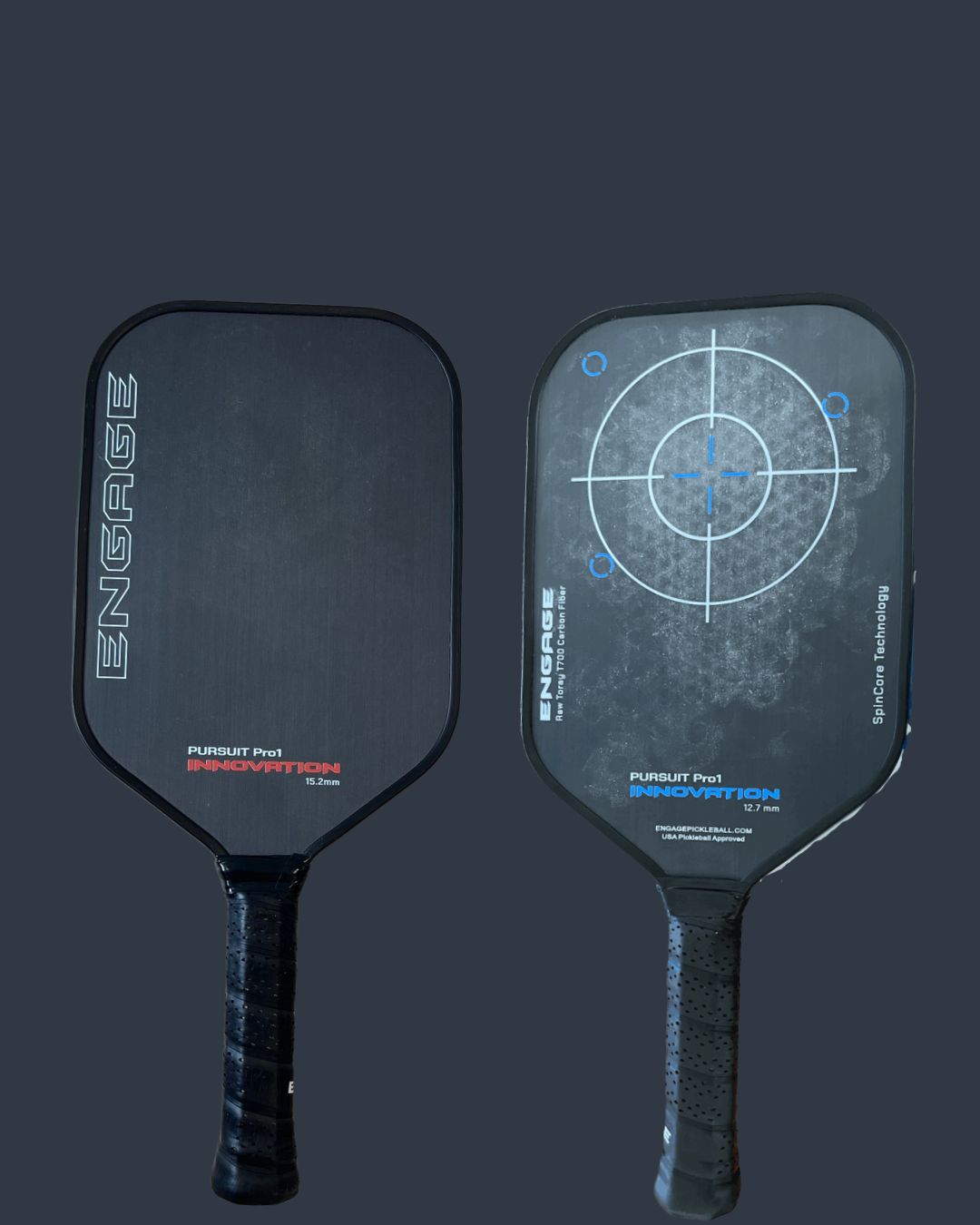
I spent a little over two weeks switching between the 12.7 mm and 15.2 mm Engage Pursuit Pro1 Innovation paddles, and my experience with the two couldn’t have been more different. I’ll start with the obvious: the 12.7 mm is noticeably more head heavy, and because of that, I naturally gravitated toward it for singles. The 15.2 mm, on the other hand, felt surprisingly lighter in hand, well, not actually lighter in weight, but much better balanced, making it the easy pick for doubles pickleball
First Impressions
The first thing that caught me off guard was the handle. It’s thinner than almost anything else I’ve used, and I ended up putting an overgrip on it immediately. Without it, my hand felt like it was pinching the paddle instead of holding it. The shape is nice, the length is good, but out of the box, the grip is lean.
Once I got past that, the differences between the two models started showing quickly.
Another modification that I made was to add lead tape to the throat of both versions of the paddle, as I am a control-oriented player you will find that I make this modification to all the paddles I use while collecting data for my review articles. For the 15.2mm paddle I ended up using tungsten tape and added strips from the throat to the center of the paddle as this allowed me to unlock a larger sweet spot on the paddle while maintaining control as well.
12.7 mm — The Baseline Bully
This version really shines from the back of the court. The extra head weight gives you that satisfying snap on drives, and you can shape the ball into some wicked corners if you get the timing right. During singles, I was hitting those deep heavy drives that force your opponent off balance, exactly what you want.
However, the trade-off shows up immediately when you move into the soft game.
My dinks started floating higher than I wanted, my drops weren’t dipping enough, and during fast-hand battles, the head weight made me feel just half a beat slower. Not slow-slow, but just enough to lose exchanges I’d normally win.
For singles, though? I loved it. It felt like a weapon. You need to be comfortable sacrificing a bit of touch.
15.2 mm — The Doubles Workhorse
Switching to the 15.2 mm was honestly a little confusing at first because it felt lighter than the 12.7 mm, which is the opposite of what you’d expect. But it comes down to how evenly the weight is spread out. It doesn’t tug your arm forward the same way, and because of that, it’s a lot easier to control on short balls.
I noticed the difference in touch right off the bat (pun intended). My dinks stayed low, my drops actually landed where I wanted, and my backhand punches didn’t sail long the way they sometimes do with stiffer paddles. And when the game sped up, this version really came alive. My hands felt quicker, cleaner, and more in control.
Power-wise, it’s not as naturally explosive as the 12.7 mm. Drives and serves still carried good depth, but you don’t get that automatic “ball jumps off the face with shape” feeling. But honestly, for doubles, I’d rather have control than violent power, and that’s what the 15.2 mm gives you.
Technology Breakdown
Engage packs a lot of tech terms into their marketing, but here’s what actually matters on court:
Power Flex Polymer Core
This is the heart of the paddle. It gives the paddle a slightly longer dwell time, meaning the ball lingers for a split second. Not mushy, not overly soft — just enough to help with control. It takes a couple of sessions to fully get used to, but once you do, it becomes predictable in a good way.
Raw Toray T700 Carbon Fiber Face
Great spin, great ball bite. You’ll notice it more on drives and heavy drops than on trick shots.
Optimized Twist-Weight & Torque Acceleration
This helps with stability on off-center hits and contributes to the pop on the 12.7 mm version. It cuts down the vibration and gives the paddle a very “connected” feel.
Durability
Engage paddles have always held up well for me. With this one, I’ve seen people get a year or more comfortably. Grit starts wearing around month eight, but it’s still very playable. For the price (especially when discounted), it’s a solid long-term paddle.
Comparison With Similar Paddles
| Paddle | Strengths | Weaknesses | Best For |
|---|---|---|---|
| Engage Pursuit Pro1 Innovation (12.7/15.2) | Great spin, choice of power vs control, excellent dwell time | Thin handle, 12.7 mm soft game needs practice | Singles (12.7 mm), Doubles (15.2 mm) |
| Paddletek Bantam | Solid feel, dependable control | Not as much spin or shaping ability | Players who want a classic feel with modern pop |
| Six Zero Double Black Diamond | Insane stability, clean control | Not the most powerful paddle | Control-heavy, doubles-focused players |
| JOOLA Perseus 3S | Big power + modern carbon face | Can feel stiff to some players | Players who like a firmer, more aggressive paddle |
Please note: I have made this comparison table based on how similar the Engage Pro1 Innovation paddles feel to the paddles I have used
Final Thoughts
What I liked most about the Pro1 Innovation line is that the two thickness options feel like two genuinely different paddles, not just “more or less foam.”
- If you’re a singles player, the 12.7 mm does almost all the heavy lifting for you.
- If you’re a doubles player, the 15.2 mm gives you control and confidence exactly where you need it.
At its discounted price point, it’s an easy paddle to recommend — especially if you’ve been wanting something that blends modern spin with a clean, controlled feel.
FAQs
Is the Engage Pursuit Pro1 Innovation USAP approved?
Yes, the Pro1 Innovation line is USAP-approved for competitive play. Both the 12.7 mm and 15.2 mm models meet approval standards.
What’s the difference between the 12.7 mm and 15.2 mm versions?
The 12.7 mm is more head-heavy, offering more pop and shape on drives, making it better for singles. The 15.2 mm has a more even weight distribution, giving you better touch, softer control, and quicker hands for doubles.
Which version is better for spin?
Both use a Raw Toray T700 carbon face, so spin is strong on both. The 12.7 mm may feel slightly spinnier on aggressive swings due to its head-heavy balance.
Is the handle comfortable?
The handle is on the thinner side, and many players add an overgrip immediately for comfort and better hold.
How does the paddle perform in the soft game?
The 15.2 mm performs noticeably better for dinks, drops, resets, and fast hands. The 12.7 mm can make soft play trickier due to its swing weight.
Does the Engage Pursuit Pro1 Innovation have good power?
The 12.7 mm definitely does it produces crisp drives and deep serves. The 15.2 mm has controlled power, not overwhelming, but enough for consistent depth.
How long does the paddle last?
Expect well over a year of durability. Surface grit starts wearing after 7–8 months, depending on play volume, but the paddle remains very playable.
Is the Pursuit Pro1 Innovation good for beginners?
It can be, but beginners may find the 12.7 mm a little too lively. The 15.2 mm is friendlier thanks to its control-focused feel and stability.
How does the paddle compare to other top paddles?
It offers more customization (power vs control versions) than most, strong spin, and one of the more predictable cores. If you like a paddle with a balanced feel and modern carbon performance, it competes well.
Is it worth the price?
At its retail price itself, I would recommend this paddle, and at discounted pricing, it’s a great value, especially for beginners and intermediate players
Leave a Reply