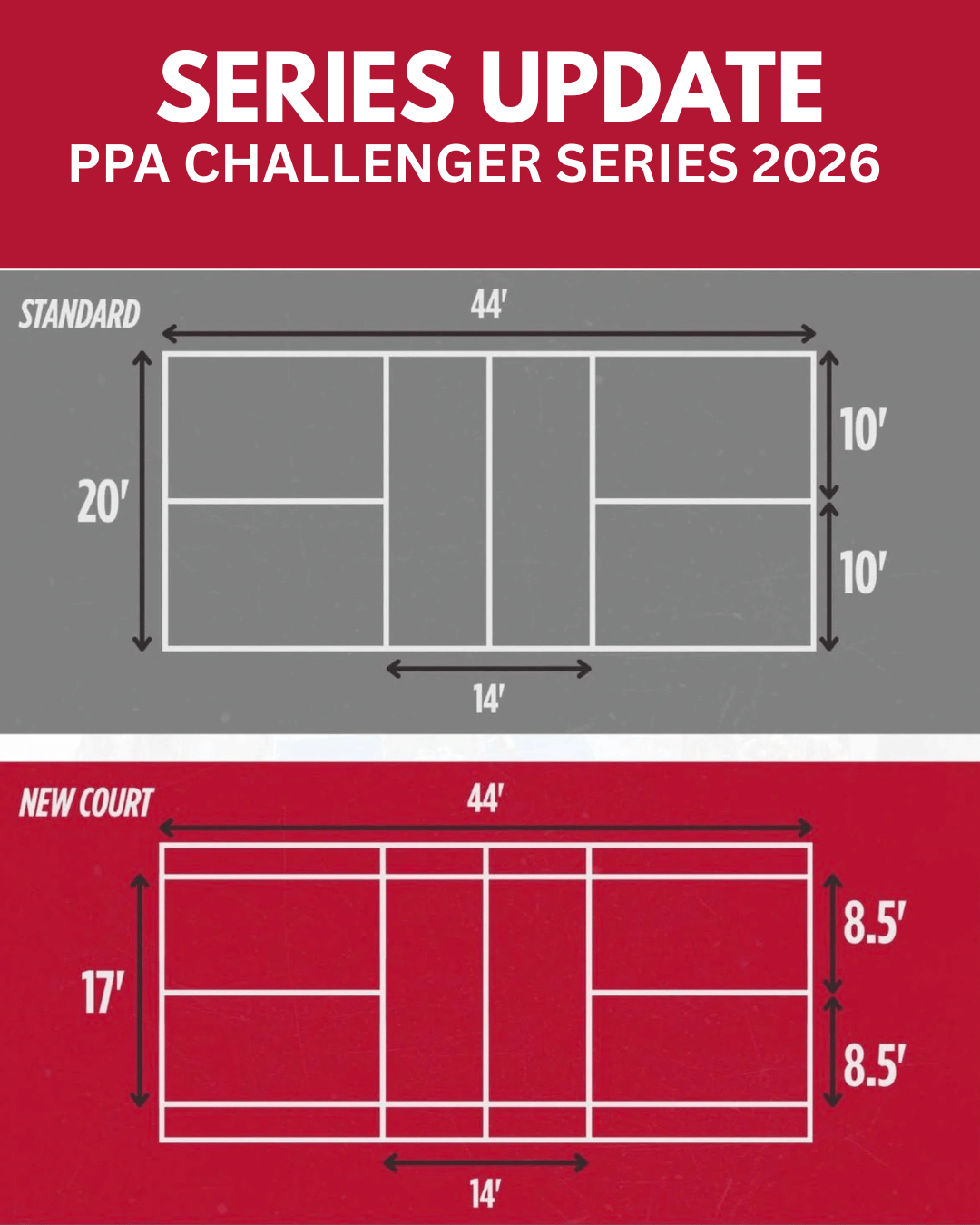
The PPA Tour is experimenting with a notable change to professional singles pickleball. As per this announcement, at upcoming Challenger-level events, Pro Singles matches will be played on a narrower court, reducing the width from the standard 20 feet to 17 feet.
The adjustment, announced midweek, is part of a broader effort to make singles play more dynamic while highlighting the athletic range of top professionals. By moving the sidelines inward by a total of three feet, the PPA hopes to generate longer rallies and more engaging point construction for both players and spectators.
The change will be tested across four Challenger tournaments: Houston, Harbour Island, Newport Beach, and Opelika.
What’s Driving the Change?
Singles pickleball has evolved quickly over the past two years. As paddle technology has advanced, players have gained easier access to pace, spin, and depth from the baseline. The result has been a clear stylistic shift: fewer net approaches, more passing-shot attempts, and shorter points decided from deep in the court.
While this baseline-oriented style has proven effective, it has also reduced the tactical variety that once defined singles play. Players are now far more selective about coming forward, knowing that even a well-timed approach can be punished by a high-quality passing shot.
By narrowing the court, those passing angles shrink. In theory, this makes the transition game more rewarding and reduces the risk associated with moving to the net.
How a Narrower Court Could Change Singles Strategy
From a strategic standpoint, a 17-foot-wide singles court alters several key dynamics:
- Passing shots require more precision, especially down the line
- Net approaches become safer, encouraging offensive positioning
- Point construction matters more than outright power
- Defensive scrambling and hands skills are emphasized at the kitchen
This approach aligns more closely with how singles pickleball was played two to three years ago, when forward movement, soft resets, and quick exchanges were central to winning points.
What Players and Fans Might Notice
For spectators, the most noticeable change could be longer rallies and more visual variety. Instead of repeated baseline exchanges, points may feature transitions, dinks, counter-volley battles, and athletic recoveries.
For players, adaptation will be key. Singles specialists who rely heavily on power passing may need to adjust shot selection, while athletes comfortable at the net could find the narrower court playing to their strengths.
Why the PPA Is Testing This at Challenger Events
The decision to roll out the change at Challenger-level tournaments allows the PPA to gather meaningful feedback without immediately disrupting main-tour competition. These events serve as a controlled environment to assess:
- Match length and rally duration
- Player movement patterns
- Injury risk and physical demand
- Overall entertainment value
If the data and player response are positive, the concept could eventually influence higher-tier events or spark further experimentation in singles formats.
A Sign of Bigger Conversations in Pickleball
This court-width test reflects a larger conversation happening across professional pickleball: how to balance technology, athleticism, and watchability as the sport continues to grow.
Rather than restricting paddle innovation, the PPA appears to be exploring structural adjustments that preserve competitive depth while enhancing the on-court product.
Whether the narrower singles court becomes a long-term solution remains to be seen, but for now, it represents one of the most intriguing rule experiments in recent pro pickleball history.
Also Read: Official Pickleball net dimensions
FAQ’s
Why is the PPA Tour narrowing the singles court?
The PPA Tour is testing a narrower singles court to encourage longer rallies, increase net play, and reduce the dominance of baseline passing shots caused by modern paddle technology.
How wide is the new singles pickleball court?
The test court will be 17 feet wide, with the sidelines moved in by a total of three feet from the standard 20-foot court used in pickleball.
Will doubles pickleball use a narrower court?
No. The court-width change applies only to Pro Singles matches at select PPA Challenger events. Doubles play will continue using standard court dimensions.
Which tournaments will use the narrower singles court?
The experiment will take place at four PPA Challenger events: Houston, Harbour Island, Newport Beach, and Opelika.
How could a narrower court affect singles strategy?
A narrower court limits passing angles, making net approaches safer and encouraging more transition play, volley exchanges, and tactical point construction.
Is this rule change permanent?
No. This is a trial experiment. The PPA Tour will evaluate player feedback and match data before deciding whether to expand or modify the rule in future events.
Leave a Reply