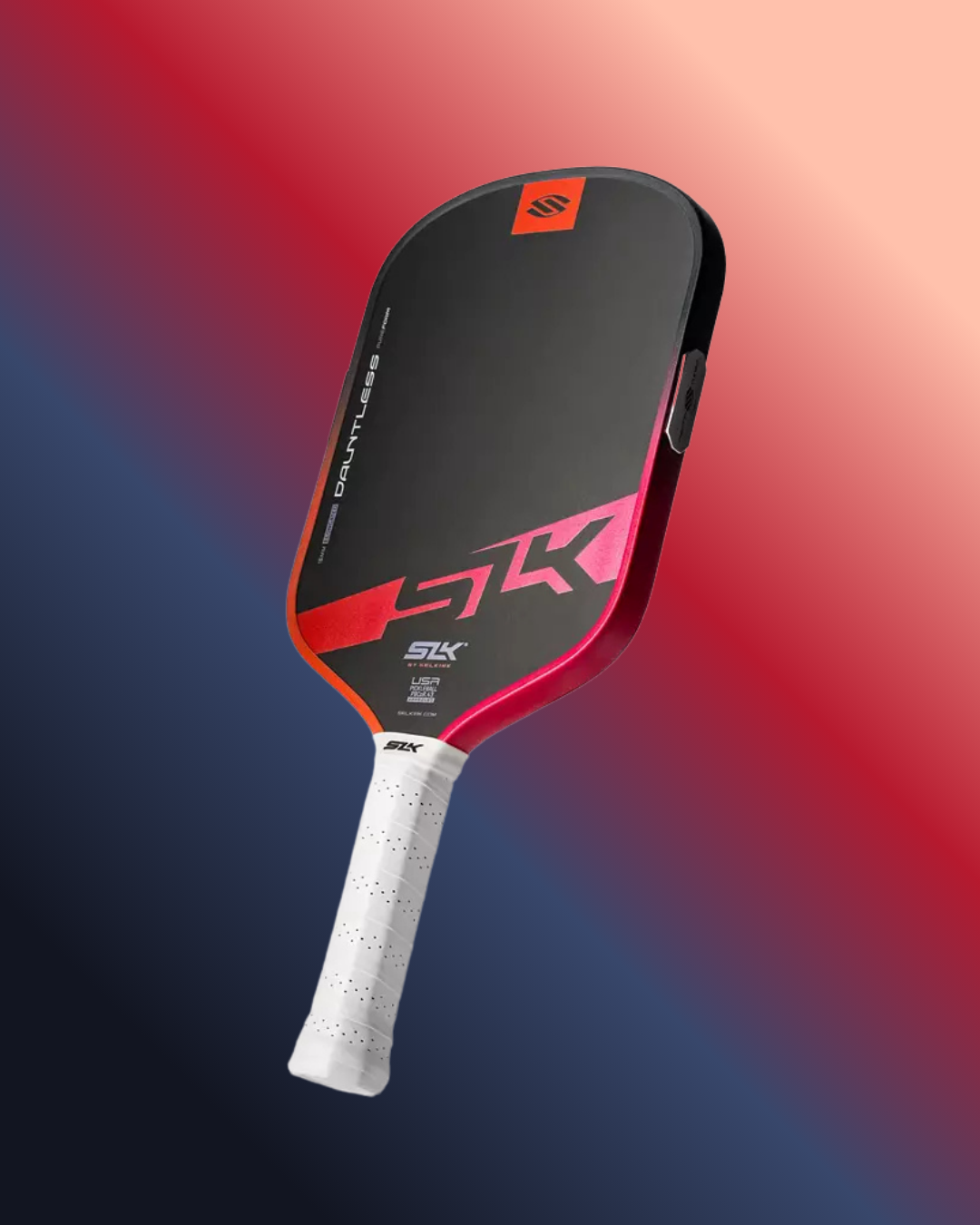
The all-foam paddle wave is no longer coming; it’s already here. With brands pushing Gen IV foam builds as the future of pickleball tech, Selkirk’s SLK line has officially entered the chat with the SLK Dauntless. On paper, it promises dwell time, forgiveness, and all-court versatility. On court, after 10 days of use, the story is a bit more nuanced, in a good way.
I spent the first two days strictly drilling with the Dauntless because right out of the box, the paddle felt noticeably stiff and a bit muted. That’s fairly common with denser foam constructions, but it’s worth mentioning because the paddle you feel on day one is not the paddle you’ll be playing with a week later. Once the face started to open up, the Dauntless settled into its true personality: controlled, composed, and very confidence-friendly.
The simplest way to describe it? Think of it as a more controlled version of the Selkirk Boomstick, but absolutely not a power replacement. Would I call it a cheaper version of the Boomstick? Yes, I would.
| Feature | Details |
|---|---|
| Paddle Type | Gen IV All-Foam |
| Core | Full foam construction |
| Feel | Plush after break-in |
| Power | Low–Medium |
| Control | High |
| Dwell Time | High (similar to SLK Era) |
| Sweet Spot | Forgiving |
| Target Player | Beginner to Advanced |
| Play Style | All-court |
How It Played (10-Day Court Experience)
After the initial stiffness wore off, the Dauntless started to make a lot more sense. The dwell time is the first thing that stood out. It’s very similar to the SLK Era, which, for context, is currently my paddle of choice, and that familiarity made the transition fairly smooth once the paddle broke in.
In the soft game, the Dauntless is steady and predictable. Drops were easy to place, resets felt forgiving, and dinks stayed relatively low without that jumpy pop you sometimes get from livelier thermoformed paddles. If your game involves a lot of kitchen work, this paddle gives you the confidence to play patient points.
Power, however, is not the headline feature here. Drives have enough depth to be effective, but if you’re expecting Boomstick-level pop, you’ll be disappointed. The Dauntless clearly leans toward control first, power second. Personally, I didn’t mind that trade-off because it made the paddle much easier to manage during fast exchanges and transition play.
What did surprise me slightly was how comfortable it felt in hand battles. For an all-foam build, it holds up well in quick firefights. I even managed to hit a clean Erne during testing, not the easiest shot to execute consistently at the 4.5 level. The contact felt crisp and confident, and the point ended immediately in my favor. Moments like that are where you start to trust a paddle.
The Adjustment Factor (Especially From Gen 3)
If you’re moving from a Gen 3 paddle, expect a short learning curve. Early on, you may see a few higher-than-usual drops or slightly floaty dinks. That’s mostly timing and feel adjustment with the foam construction.
From what I experienced, beginner and intermediate players may need a few sessions to fully dial it in. Advanced players, on the other hand, will likely adapt much faster and start extracting the control benefits almost immediately.
Build Quality and Durability
Selkirk’s manufacturing consistency shows here. The paddle feels well put together, the face texture is holding up fine after the first stretch of play, and there are no early red flags with the foam.
It’s still early for long-term durability claims, but initial signs are positive. Add Selkirk’s customer service reputation into the mix, and the Dauntless comes across as a relatively safe buy in the all-foam category.
Price Reality Check
If I’m being honest, the sweet spot for this paddle would have been around $150. That said, spending roughly $30 more for Selkirk’s warranty support and brand trust isn’t unreasonable, especially for players who value after-sales service and peace of mind.
All-Foam Paddle Comparison
Here’s where the Dauntless currently sits among other popular all-foam options.
| Paddle | Power | Control | Feel | Forgiveness | Best Fit |
|---|---|---|---|---|---|
| SLK Dauntless | Low–Med | High | Plush after break-in | High | Balanced all-court |
| CRBN All Foam | Medium | High | Crisp-plush | Medium-High | Competitive control |
| Six Zero Opal | Medium | Medium-High | Lively | Medium | Aggressive all-court |
| J2CR | Medium-High | Medium | Firmer | Medium | Drive-leaning players |
In simple terms, the Dauntless is probably the most control-leaning paddle of this group. If your game is built around patience, placement, and kitchen consistency, it makes a strong case for itself.
Who This Paddle Is Really For
The Dauntless makes the most sense for players who don’t want to choose between soft-game confidence and the ability to speed things up when needed. If you’re the type who enjoys long dink exchanges but isn’t afraid to jump into hands battles or mix in drives, this paddle fits that balanced identity very well.
Where it may fall short is for pure power hitters or singles players who rely heavily on put-away pace. There are simply hotter paddles in that category.
Final Thoughts
Selkirk didn’t try to overpower the all-foam market with the Dauntless. Instead, they built something far more measured, a paddle that rewards control, patience, and smart all-court play.
After the brief break-in period, the Dauntless becomes easy to trust. The dwell time is excellent, the forgiveness is real, and the overall feel settles into that familiar Selkirk comfort zone. For players who felt the Boomstick was a bit too hot or who want a foam paddle that doesn’t feel wild, the Dauntless is a very sensible option.
It may not be the flashiest all-foam paddle on the market, but it quietly does a lot of things right, and for many players, that’s exactly the point.
Rating: 4.3 / 5
FAQ’s
Does the SLK Dauntless require a break-in period?
Yes. Expect some initial stiffness. After roughly 6–10 hours of play, the face becomes noticeably more responsive.
Is the Dauntless suitable for beginners?
Yes, though beginners coming from Gen 3 paddles may need a short adjustment period with drops and dinks.
How does it compare to the Boomstick in power?
The Dauntless is clearly more control-oriented and does not deliver the same level of pop as the Boomstick.
Is this paddle good for fast-hand battles?
Surprisingly, yes. Despite the foam construction, it holds its own well in quick exchanges.
Who benefits most from the Dauntless?
All-court players from roughly 3.5 to 5.0 who value control, dwell time, and consistency over raw power.
Leave a Reply