If you’re new to pickleball, one of the fastest ways to improve long before you start working on spins, roll volleys, or fancy shots is learning how to hold your pickleball paddle correctly. It sounds basic, almost too simple to matter, but your grip is the foundation for everything you do on a pickleball court.
A proper grip boosts your control, speeds up your reactions, improves your power, and helps you transition between offense and defense just like the pros. And take it from me, if you have no racket sport background then grip mistakes are the hardest habits to fix once you have already started playing pickleball. I have seen so many players getting no where with their game not because they lack skill but simply because they started with the wrong grip so they had to do a lot of unlearning before they started playing shots correctly
In this article I will show you all the possible ways to hold a pickleball paddle the right way, how to switch grips in between shots and by the end of it you will learn which is the best one for you. Since I am a right handed player, I will share details from a right handed perspective, but if you’re left-handed simply reverse the directions and follow the same steps.
What a Proper Pickleball Grip Really Means
Anyone can wrap their hand around a paddle handle, but holding it correctly is something else entirely. A proper grip gives you a cleaner feel on dinks, more stability in fast hands rallies, sharper blocks, and smoother resets. It’s not about squeezing tighter it’s about positioning.
You’ll find all kinds of grip tutorials online, but the one that forms the base of almost every advanced player’s game is the continental grip. Mastering it will simplify everything you’ll learn afterward.
The Continental Grip (AKA the “Handshake Grip”)
If you naturally hold your paddle like you’re shaking hands with it, you’re already doing a version of this grip. But setting it up intentionally makes a world of difference.
To do it correctly:
- Reach your hand toward the paddle like you’re greeting someone.
- Wrap your fingers around the handle in a relaxed, natural position.
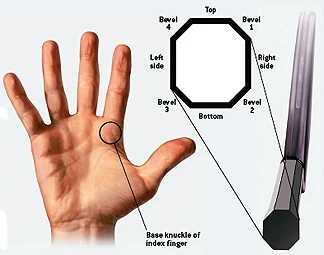
- Look at the “V” formed by your thumb and index finger it should point straight up the paddle toward your face.
That’s the continental grip. Simple, clean, and incredibly versatile. You can hit dinks, volleys, blocks, resets, drives, and even overheads without switching to a different grip.
Variations: Neutral, Strong, and Weak Continental Grips
The continental grip isn’t fixed in one exact position. Instead, it has subtle variations that act like fine-tuning adjustments. These tiny angles completely change how your paddle behaves, and advanced players use them constantly.
Neutral Continental Grip
This is your all-purpose, everyday grip. It keeps the paddle face stable and predictable.
Use it for:
- Dinks
- Resets
- Blocks
- Clean forehand and backhand drives
- Controlled volleys
The “V” points straight up the paddle. You’ll use this around 80% of the time.
Strong Continental Grip
Rotate your hand slightly clockwise (lefties go counter-clockwise) so the “V” angles toward the paddle edge. Now your wrist, forearm, and paddle align with more leverage, giving you extra stability and power.
Best used for:
- Overheads
- High put-aways
- Offensive counterattacks
- Driving forehands
- Punch volleys at the chest
If someone ever told you, “You hit so effortlessly!” its because you have a strong continental grip.
Weak Continental Grip
Rotate your hand in the opposite direction so the “V” points toward the other paddle edge. Most players never use this intentionally because it reduces power.
But it does have uses:
- Slices
- Cuts
- Defensive scrapes
- High, soft roll-backs
For most players, neutral and strong grips cover almost everything.
Where to Hold the Paddle on the Court
Knowing how to hold the paddle is one thing; knowing where to position it is just as important, here I am not referring to your wrist placement on the paddle handle, infact I am showing you the right posture to have, this will help you hit cleaner shots and not get caught in that awkward ‘chicken wing’ position.
Neutral Ready Position
This is your “home base,” and high-level players return to this posture constantly.
Here’s what it looks like:
- Paddle held in front of your chest
- Elbow relaxed
- Paddle tilted slightly forward
- Wrist neutral not bent up or down
- Optional: support the paddle lightly with your off-hand for stability
This position gives you the quickest reaction window possible.
At the Kitchen Line
Your posture and mindset shift here because exchanges are fast and unforgiving.
At the NVZ line:
- Hold your paddle slightly higher (chest height or above)
- Keep your knees bent
- Weight leaning forward
- Grip slightly stronger so the paddle doesn’t twist
Never stand upright or let the paddle drop.
Defending Power Shots or Blocking Drives
Blocking drives is all about simplicity.
- Keep the paddle in front
- Hold the face slightly open
- Absorb the ball rather than pushing at it
- Use a neutral grip for stability
Too strong a grip sends the ball sailing. Too weak and the paddle wobbles.
Do You Need to Switch Grips Mid-Rally?
Yes but don’t worry, you won’t even notice it after some practice. Just like tennis or badminton, your hand naturally adjusts mid-rally as certain shots require different leverage. Beginners often feel awkward switching grips, but it quickly becomes muscle memory. Eventually, you won’t think about grip changes at all they’ll happen automatically.
Got a Grip on It?
Learning how to hold your pickleball paddle properly is one of the easiest high-impact improvements you can make. If any of these grips feel strange at first, that’s normal. Stick with it. Your swing will get smoother, your blocks cleaner, and your fast hands more confident. Once the continental grip and its small variations become second nature, the rest of your game becomes far easier.
FAQs
What is the best grip for beginners?
The continental (handshake) grip is the best starting point because it works for most shots and helps both forehand and backhand transitions.
Should the paddle be held tightly or loosely?
Firm but relaxed just like holding a hammer. Too tight = no control. Too loose = paddle twists.
Do I need different grips for different shots?
Eventually, yes. Neutral for most shots, strong for power.
What grip is best for dinking?
Neutral continental. It keeps your paddle face stable and low.
How high should the paddle be at the net?
Around chest height, slightly forward.
Is switching grips mid-rally okay?
Absolutely. With practice, it becomes second nature.
Also Read: What are the basic pickleball rules?
Leave a Reply